ace-agent/ace
Evolving system prompts without context collapse
ACE lets language models self-improve by treating system context as an evolving playbook of accumulated strategies and mistakes, updated incrementally rather than rewritten from scratch.
Not currently ranked — collecting fresh signals.
star history
What it does
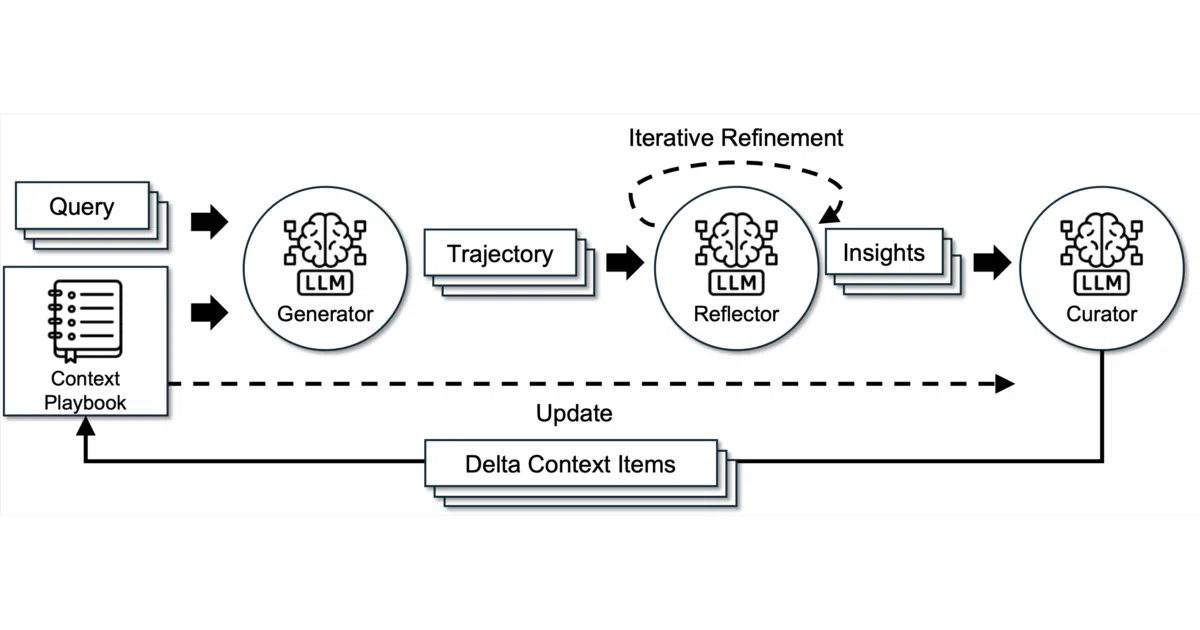
ACE is a training framework that treats an LLM’s system context as a structured playbook. As the model works through tasks, a three-agent pipeline—Generator, Reflector, and Curator—surfaces what worked, what failed, and why, then appends or prunes discrete “bullets” in the playbook rather than rewriting the whole thing. The result is a self-supervised adaptation loop that runs offline against a training set or online against live traffic.
The interesting bit
The Reflector scores each playbook bullet with helpful and harmful counters, and the Curator applies deterministic delta updates—merging, deduplicating, and pruning—so institutional knowledge doesn’t suffer the iterative erosion the authors call “context collapse.” It’s essentially version control for prompts, except the commits are made by agents.
Key highlights
- Claims +10.6% improvement on AppWorld agent tasks and +8.6% on finance benchmarks (FiNER, XBRL Formula), matching or beating GPT-4.1 on harder splits with a smaller open-source model.
- Reports 86.9% lower adaptation latency on average, with up to 91.5% latency reduction and 83.6% token savings in online finance tasks versus Dynamic Cheatsheet.
- Playbooks are human-readable text files with tagged sections—
STRATEGIES & INSIGHTS,COMMON MISTAKES TO AVOID, etc.—each bullet annotated with usage counters. - Extending to a new domain requires implementing only three methods in a
DataProcessorclass; evaluation orchestration is handled by reusable utilities. - Supports offline training with validation, online streaming adaptation, and eval-only modes.
Caveats
- Tool-calling support is listed as “Coming Soon,” so the current release focuses on text-based reasoning tasks.
- The repository is brand new—the README notes the paper and repo “Hello World” in November 2025—so real-world battle testing is likely limited.
- Requires external API providers (e.g., Sambanova, Together, OpenAI); there is no mention of local or fully offline model execution.
Verdict
Worth a look if you’re building domain-specific agents and tired of hand-tuning prompts every time the model drifts. Skip it if you need mature tool-use integrations or a fully local, API-free stack today.
Frequently asked
- What is ace-agent/ace?
- ACE lets language models self-improve by treating system context as an evolving playbook of accumulated strategies and mistakes, updated incrementally rather than rewritten from scratch.
- Is ace open source?
- Yes — ace-agent/ace is open source, released under the Apache-2.0 license.
- What language is ace written in?
- ace-agent/ace is primarily written in Python.
- How popular is ace?
- ace-agent/ace has 1.3k stars on GitHub.
- Where can I find ace?
- ace-agent/ace is on GitHub at https://github.com/ace-agent/ace.