abhigyanpatwari/GitNexus
Drop a repo, get a knowledge graph—no server required
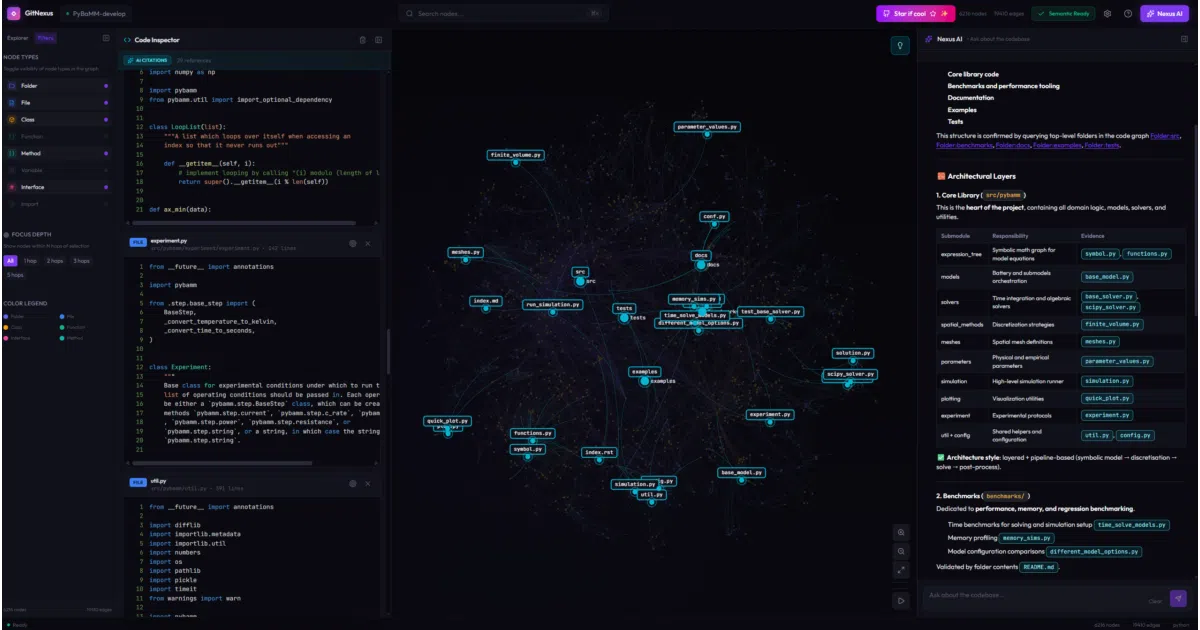
GitNexus turns your codebase into a queryable dependency graph so AI coding agents stop shipping blind edits.
Velocity · 7d
+8.6
★ / day
Trend
↘cooling
star history
What it does
GitNexus ingests a repository—via Git URL, ZIP file, or local path—and parses it into an interactive knowledge graph of dependencies, call chains, and execution flows. It runs entirely in the browser with WebAssembly, or locally through a CLI that feeds the graph to AI agents via MCP. The aim is to stop agents from missing hidden architectural relationships.
The interesting bit
Rather than flattening code into searchable text, it preserves every structural relationship in a queryable graph. The CLI layer hooks into Claude Code, Cursor, and Antigravity to inject that graph context directly into agent tool calls, and can prompt the agent to reindex after commits when the graph goes stale.
Key highlights
- Fully offline: the browser build uses LadybugDB WASM and Tree-sitter WASM with no network traffic; the CLI keeps everything local with native bindings.
- MCP-native integration with Claude Code, Cursor, Codex, Windsurf, OpenCode, and Google’s Antigravity, including editor-specific hooks for context injection.
- Dual interface: a zero-install web UI for quick exploration (practically limited to ~5,000 files by browser memory) and a CLI for unlimited daily development, bridgeable so the web UI can browse CLI-indexed repos.
- Auto-generates agent context files (
AGENTS.md,CLAUDE.md) after indexing and supports fast full-text search index repair without rebuilding the entire graph. - PolyForm Noncommercial license; enterprise offerings add PR blast-radius analysis, auto-reindexing, multi-repo graphs, and OCaml support.
Caveats
- Browser memory caps the web UI to roughly 5,000 files unless you rely on backend mode.
- Parsing Dart, Proto, or Swift requires a C++ toolchain during installation unless optional grammars are disabled.
- Commercial use requires an enterprise license; the open-source release is noncommercial by default.
Verdict
A solid bet if you want AI agents that actually read the map before rewriting your code. Look elsewhere if you need a commercially unencumbered open-source tool.
Frequently asked
- What is abhigyanpatwari/GitNexus?
- GitNexus turns your codebase into a queryable dependency graph so AI coding agents stop shipping blind edits.
- Is GitNexus open source?
- Yes — abhigyanpatwari/GitNexus is an open-source project tracked on heatdrop.
- What language is GitNexus written in?
- abhigyanpatwari/GitNexus is primarily written in TypeScript.
- How popular is GitNexus?
- abhigyanpatwari/GitNexus has 48k stars on GitHub and is currently cooling off.
- Where can I find GitNexus?
- abhigyanpatwari/GitNexus is on GitHub at https://github.com/abhigyanpatwari/GitNexus.