a16z-infra/ai-town
LLM Agents Get a 2D Town and a JavaScript Runtime
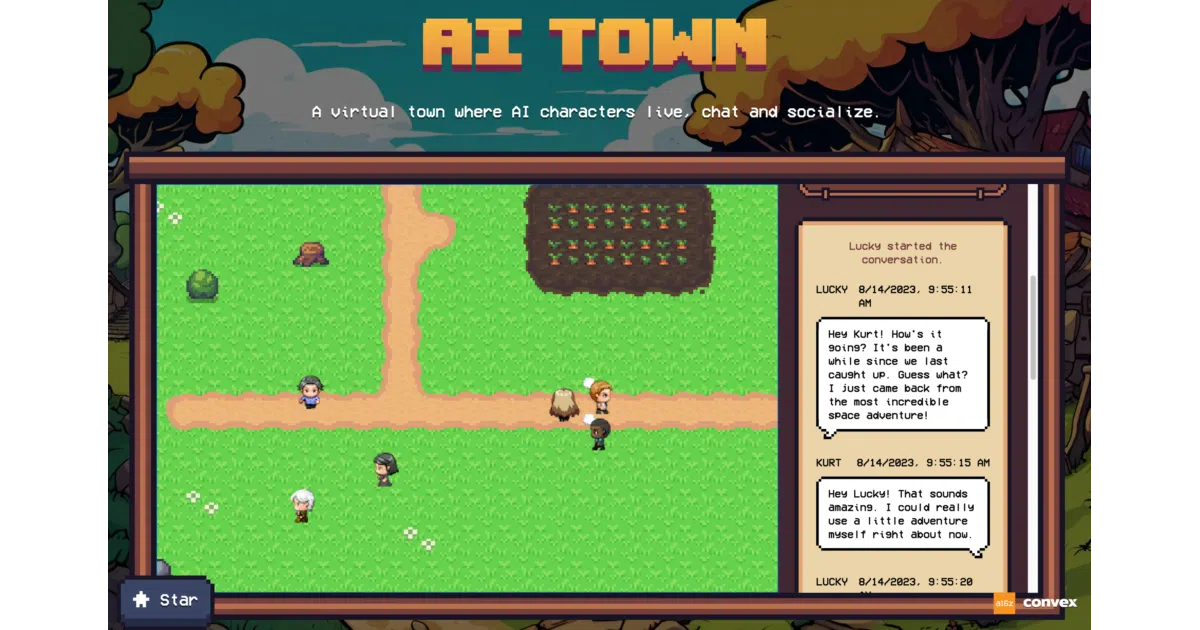
AI Town is a deployable starter kit for building virtual worlds where LLM-backed characters live, chat, and socialize—written in TypeScript because most agent simulators are still Python-only.
Not currently ranked — collecting fresh signals.
star history
What it does AI Town is a virtual town simulator inspired by the Generative Agents research paper. It drops LLM-driven characters into a 2D pixel-art world where they can move around, start conversations, and form memories backed by a vector database. The whole thing is built as a starter kit on top of Convex, giving it shared global state, transactions, and a simulation engine out of the box.
The interesting bit Most implementations of this idea are Python notebooks; AI Town deliberately built itself in TypeScript to fit into a modern web stack. It also tries hard to be deployment-agnostic, running locally via Ollama and Docker Compose or scaling up to cloud LLMs and Fly.io without rewriting the core.
Key highlights
- JS/TS-native stack: Uses Convex for the game engine, database, and vector search, with PixiJS handling the frontend rendering.
- Pluggable LLMs: Defaults to entirely local inference with Ollama (
llama3), but can swap in OpenAI, Together.ai, or any OpenAI-compatible API by changing a few config values. - Persistent memory: Agents rely on embeddings stored in Convex’s vector search, though switching embedding models forces a full database wipe.
- Customizable world: Characters, spritesheets, and tilemaps can be edited via TypeScript files and the Tiled map editor; optional background music generation hooks into Replicate.
- Idle pause: The simulation freezes after five minutes of browser inactivity unless you disable the cron job or keep the page open.
Caveats
- Switching LLM providers or embedding dimensions requires wiping the entire database and starting over, since vector memories are tied to the specific model.
- Any tweak to character data also demands a full table wipe and re-upload to Convex, so iteration can be destructive.
- Self-hosting with Docker Compose involves regenerating admin keys if you tear down the containers, and Replicate webhooks need manual proxying to reach a local instance.
Verdict Worth a look if you want to experiment with multi-agent LLM simulations without leaving the JavaScript ecosystem. Skip it if you need a polished, zero-config game or a Python-first research environment.
Frequently asked
- What is a16z-infra/ai-town?
- AI Town is a deployable starter kit for building virtual worlds where LLM-backed characters live, chat, and socialize—written in TypeScript because most agent simulators are still Python-only.
- Is ai-town open source?
- Yes — a16z-infra/ai-town is open source, released under the MIT license.
- What language is ai-town written in?
- a16z-infra/ai-town is primarily written in TypeScript.
- How popular is ai-town?
- a16z-infra/ai-town has 10.6k stars on GitHub.
- Where can I find ai-town?
- a16z-infra/ai-town is on GitHub at https://github.com/a16z-infra/ai-town.