Yuan-lab-LLM/ClawManager
A control plane for when your AI agents need a landlord
ClawManager exists because running AI agent instances on Kubernetes requires more than a container runtime—it needs governance, orchestration, and a way to share skills across teams.
Not currently ranked — collecting fresh signals.
star history
What it does
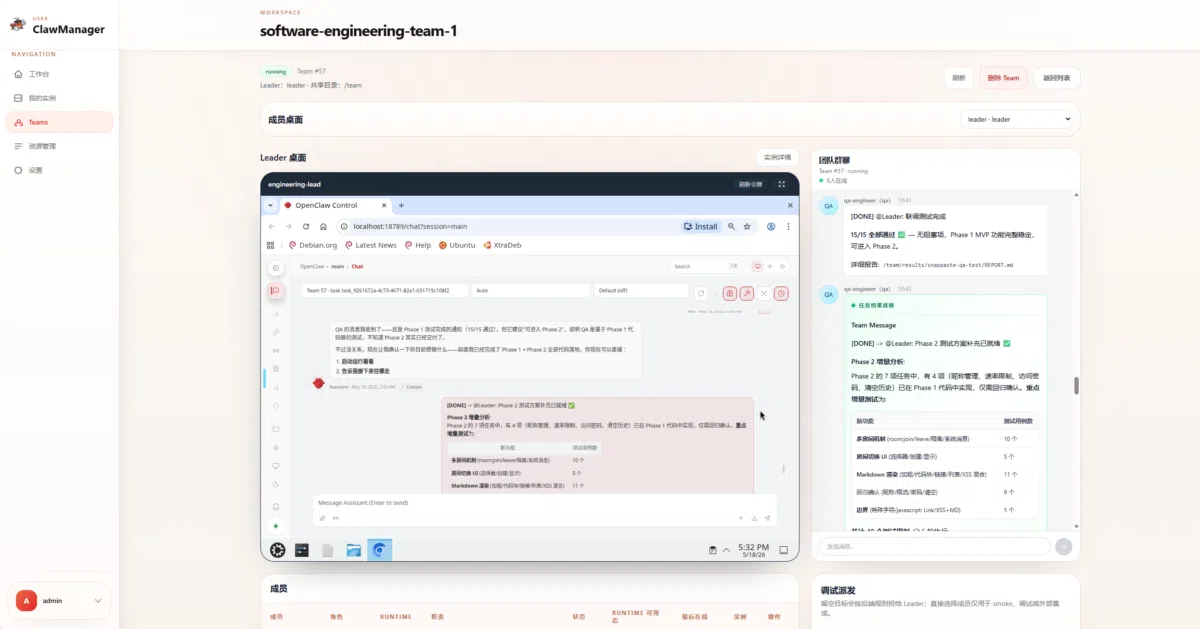
ClawManager is a Kubernetes-native platform that runs AI agent instances inside managed runtimes—currently OpenClaw and Hermes—and layers three control planes on top. Teams get an AI Gateway for audited, policy-routed model access; an Agent Control Plane for heartbeat-driven runtime orchestration; and a Resource Management layer for bundling channels and skills with security scanning. It also coordinates multi-agent Team workspaces via a Redis message bus and shared storage, keeping the database as the source of truth while Redis handles the chatter.
The interesting bit
Instead of treating AI agents as simple containers, ClawManager gives them a full tenancy model: registration, desired-state sync, command dispatch, and even a Team Bus for collaboration. The Hermes runtime integration adds a persistent .hermes workspace inside a Webtop environment, suggesting the project sees agent workspaces as long-lived desktops rather than ephemeral inference jobs.
Key highlights
- Three distinct control planes: AI Gateway (governance/audit/cost), Agent Control Plane (orchestration/commands), and Resource Management (skills/bundles/scanner)
- Supports OpenClaw and Hermes runtimes, with the latter offering Webtop-based persistent workspaces
- Team workspaces provision multiple member Pods with Redis-backed messaging, shared PVC mounts at
/team, and DB-backed task/event records - Skill Scanner workflows for risk review, plus bundle-based composition for repeatable workspace setup
- Go backend with MySQL state, React frontend, and Kubernetes-native deployment targets including K3s
Caveats
- The Team workspace is explicitly labeled MVP, with current focus limited to OpenClaw member orchestration
- Only two managed runtimes are listed so far; broader ecosystem support is still emerging
- The README notes the repository is organized around product subsystems rather than a monolith, which may mean navigating multiple guides to understand the codebase
Verdict
Platform teams running multi-user AI agent infrastructure should look here; if you just need to ship a single LLM container, this is overkill.
Frequently asked
- What is Yuan-lab-LLM/ClawManager?
- ClawManager exists because running AI agent instances on Kubernetes requires more than a container runtime—it needs governance, orchestration, and a way to share skills across teams.
- Is ClawManager open source?
- Yes — Yuan-lab-LLM/ClawManager is open source, released under the MIT license.
- What language is ClawManager written in?
- Yuan-lab-LLM/ClawManager is primarily written in Go.
- How popular is ClawManager?
- Yuan-lab-LLM/ClawManager has 1.9k stars on GitHub.
- Where can I find ClawManager?
- Yuan-lab-LLM/ClawManager is on GitHub at https://github.com/Yuan-lab-LLM/ClawManager.