YixuanLi/densenet-tensorflow
DenseNet in TensorFlow: a faithful port with training wheels
A straightforward TensorFlow reimplementation of the densely connected convnet paper, built on someone else's ResNet code and benchmarked on standard CIFAR.
Not currently ranked — collecting fresh signals.
star history
What it does
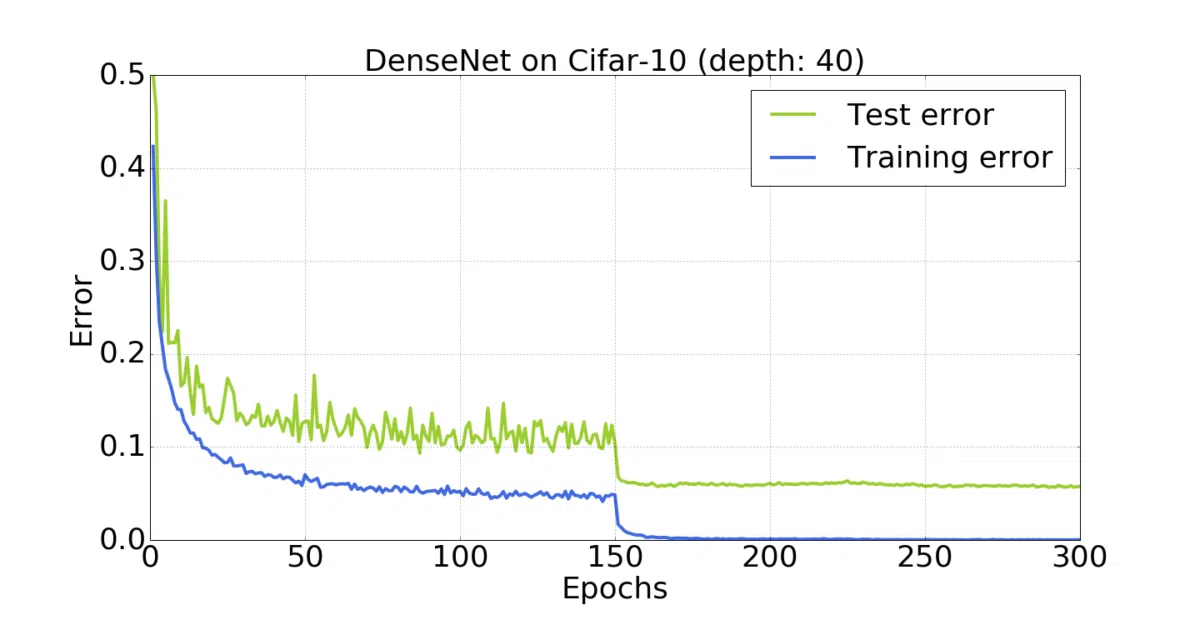
Implements the DenseNet architecture from Huang et al.’s 2017 CVPR paper in TensorFlow, using the Tensorpack framework. Trains and evaluates on CIFAR-10+ and CIFAR-100+ with the same hyperparameters as the original Lua/Torch version.
The interesting bit
The README is admirably honest about its lineage: it’s “developed based on Yuxin Wu’s implementation of ResNet” — in other words, this is architectural adaptation, not ground-up reinvention. The author also documents where their preprocessing and batch-normalization treatment diverge from the original, which saves you from discovering the mismatch the hard way.
Key highlights
- Reaches ~5.77% error on CIFAR-10+ and ~26.36% on CIFAR-100+ after 300 epochs
- Runs at 5 iters/s on a single TITAN X (batch size 64, CUDA 7.5, cuDNN v5.1)
- Single-command training:
python cifar10-densenet.py - Explicitly notes two implementation differences from the Torch reference (preprocessing scope, BN parameter regularization)
Caveats
- Requires TensorFlow ≥ 1.0 and Tensorpack — this is not a standalone, dependency-light project
- Python 2 or 3 supported, but the code dates from the TF 1.x era; modern TF users may need migration work
- Only CIFAR-10/100 results shown; no ImageNet or larger-scale validation in the README
Verdict
Worth a look if you need a proven DenseNet baseline in legacy TensorFlow or want to compare Tensorpack against PyTorch implementations. Skip it if you’re already committed to PyTorch/TF 2.x and want production-ready code without archaeology.
Frequently asked
- What is YixuanLi/densenet-tensorflow?
- A straightforward TensorFlow reimplementation of the densely connected convnet paper, built on someone else's ResNet code and benchmarked on standard CIFAR.
- Is densenet-tensorflow open source?
- Yes — YixuanLi/densenet-tensorflow is open source, released under the GPL-3.0 license.
- What language is densenet-tensorflow written in?
- YixuanLi/densenet-tensorflow is primarily written in Python.
- How popular is densenet-tensorflow?
- YixuanLi/densenet-tensorflow has 563 stars on GitHub.
- Where can I find densenet-tensorflow?
- YixuanLi/densenet-tensorflow is on GitHub at https://github.com/YixuanLi/densenet-tensorflow.