Xilinx/finn
Your quantized neural network, now running on bare metal silicon
FINN compiles low-bit neural networks into custom FPGA dataflow accelerators instead of treating the chip like a GPU.
Not currently ranked — collecting fresh signals.
star history
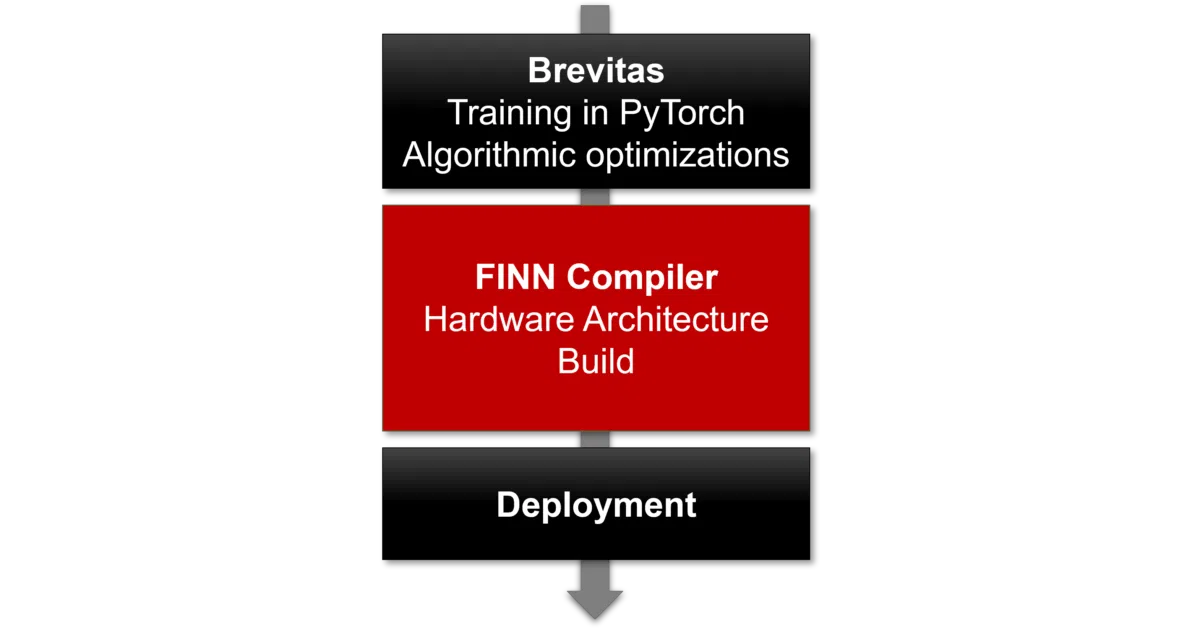
What it does FINN is an open-source compiler that takes quantized neural networks—think 1-bit or low-precision weights—and generates bespoke FPGA hardware for inference. Each layer becomes a dedicated pipeline stage, so the network unrolls into silicon rather than looping through memory. The project comes from AMD Research and targets exploration across the full software-to-silicon stack.
The interesting bit Most FPGA ML tools map operations onto generic overlays. FINN goes further: it synthesizes a fresh dataflow architecture per model, trading flexibility for throughput and latency. The README is admirably blunt that this is “experimental” and Docker-only, which suggests the team knows exactly where the sharp edges are.
Key highlights
- Targets quantized networks specifically (binarized, low-bit), not standard 32-bit floats
- Generates custom dataflow pipelines rather than overlay-based acceleration
- Ships with Jupyter notebook tutorials and a separate examples repository
- Docker-only execution supported; the dependency stack is too complex for bare-metal installs
- Active GitHub Discussions community; Gitter channel is deprecated and unmaintained
Caveats
- Docker-only support means no straightforward native installation
- Explicitly labeled “experimental” by its own authors
- v0.1 branch is completely deprecated with no shared history to main
Verdict Worth a look if you’re doing research at the intersection of neural network quantization and custom hardware, or if you need inference latency that CPUs and GPUs can’t touch. Skip it if you want a polished, general-purpose FPGA ML deployment tool.
Frequently asked
- What is Xilinx/finn?
- FINN compiles low-bit neural networks into custom FPGA dataflow accelerators instead of treating the chip like a GPU.
- Is finn open source?
- Yes — Xilinx/finn is open source, released under the BSD-3-Clause license.
- What language is finn written in?
- Xilinx/finn is primarily written in Python.
- How popular is finn?
- Xilinx/finn has 1.1k stars on GitHub.
- Where can I find finn?
- Xilinx/finn is on GitHub at https://github.com/Xilinx/finn.