WujiangXu/A-mem
Memory that files its own notes, Zettelkasten-style
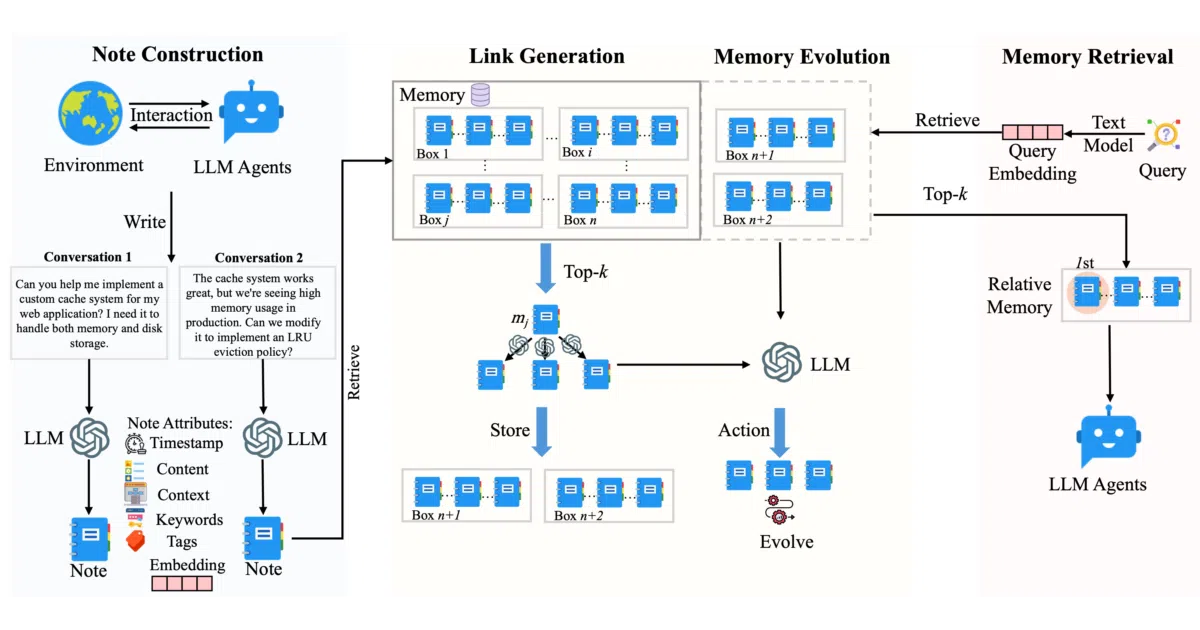
A-Mem lets LLM agents organize their own memories into a linked, evolving knowledge network instead of a flat retrieval pile.
Collecting fresh signals — velocity needs a few days of history.
collecting data…
star history
What it does A-Mem is the code behind the NeurIPS 2025 paper “A-Mem: Agentic Memory for LLM Agents.” When a new memory enters the system, the agent generates structured notes with attributes, descriptions, and tags, then analyzes existing memories to decide what to link it to. Old memories get updated as the network evolves — retrieval isn’t just lookup, it’s navigation through a self-organized graph.
The interesting bit The design borrows from Zettelkasten, the note-taking method where atomic notes cross-link into an emergent knowledge network. Instead of a vector store with a fixed index, the agent itself decides how memories connect and when they need refinement — memory management becomes an agentic task, not a pipeline step.
Key highlights
- Dynamic memory organization: notes are generated, linked, and evolved by the agent rather than statically stored
- Structured note generation with contextual descriptions and tags
- Evaluation harness for the LoCoMo dataset across five QA categories (multi-hop, temporal, open-domain, single-hop, adversarial)
- A robust evaluation script (
test_advanced_robust.py) that works with OpenAI, vLLM, and Ollama backends - Memories are cached after the first run, so hyperparameter sweeps only re-run the QA step
Caveats
- This repo is explicitly for reproducing the paper’s results; the authors point anyone building actual agents to their separate
A-mem-sysimplementation - Reported performance depends on tuning the retrieval hyperparameter
kper model — the defaults aren’t the paper’s numbers
Verdict Worth a look if you’re researching agent memory or want a concrete alternative to RAG-style flat retrieval. If you just want a drop-in memory module for your agent, go to the sibling repo instead — this one is a lab bench, not a product.
Frequently asked
- What is WujiangXu/A-mem?
- A-Mem lets LLM agents organize their own memories into a linked, evolving knowledge network instead of a flat retrieval pile.
- Is A-mem open source?
- Yes — WujiangXu/A-mem is open source, released under the MIT license.
- What language is A-mem written in?
- WujiangXu/A-mem is primarily written in Python.
- How popular is A-mem?
- WujiangXu/A-mem has 1k stars on GitHub.
- Where can I find A-mem?
- WujiangXu/A-mem is on GitHub at https://github.com/WujiangXu/A-mem.