Windy3f3f3f3f/how-claude-code-works
How Claude Code works, according to Claude Code
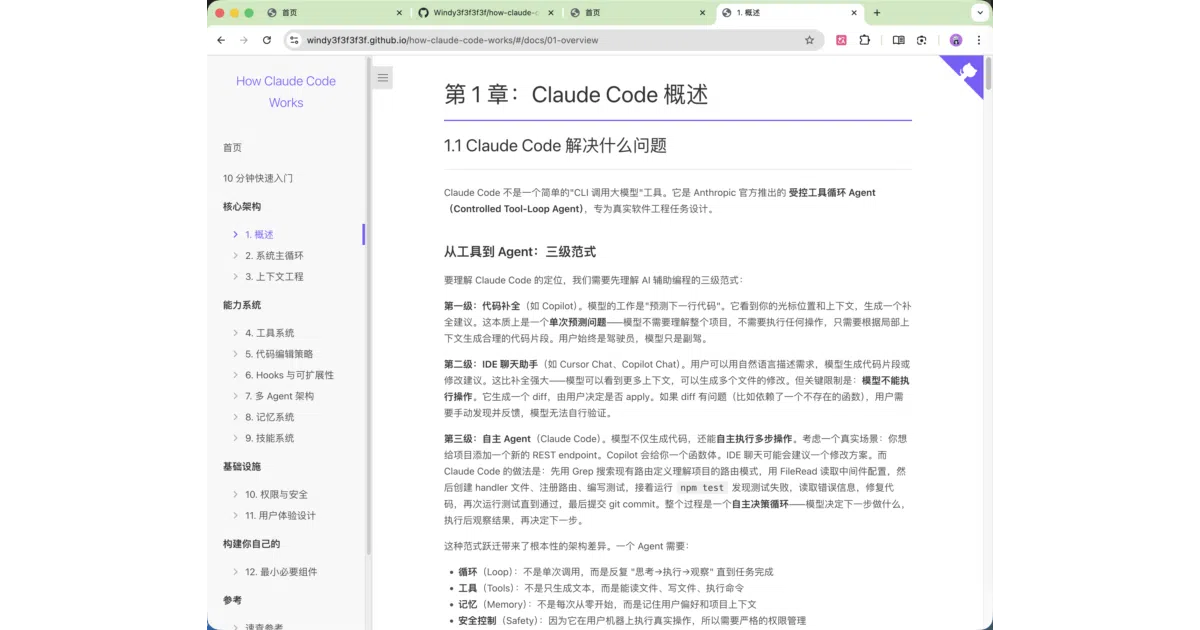
A 15-chapter field guide to the 500,000-line codebase behind Anthropic's coding agent, written with help from the tool itself.
Not currently ranked — collecting fresh signals.
star history
What it does
This is a reader’s guide to the internals of Claude Code, Anthropic’s widely used AI programming agent. The authors used Claude Code itself to navigate the 500,000+ lines of TypeScript, then distilled the findings into 15 chapters covering the agent loop, context engineering, tool system, security model, and UI architecture. Think of it as engineering notes for a codebase too large to browse over lunch.
The interesting bit
The project has a pleasingly recursive quality: the subject helped dissect itself. Among the findings are a four-stage progressive context-compression pipeline, a five-layer security stack that parses Bash ASTs rather than relying on regex, and a latency-hiding trick where tool calls are pre-executed while the model is still streaming its reasoning.
Key highlights
- 4-level context compression — trims old tool output, deduplicates, folds inactive conversation segments, and finally summons a sub-agent to summarize, automatically restoring the last five edited files afterward so the model doesn’t lose its place.
- 5-layer security — permission modes, rule matching, Bash AST analysis with 23 specific checks, user confirmation with a 200ms debounce to prevent accidental key-mashing, and user-customizable hooks.
- Latency hiding — the system parses and begins executing tool calls while the model is still generating, using the 5–30 second inference window to mask roughly one second of tool latency.
- Silent recovery — the agent loop defines seven distinct “continue” strategies to handle failures like context-window overflow or token limits without surfacing errors to the user.
- Multi-agent isolation — sub-agents, coordinators, and swarm agents operate on independent Git worktrees to prevent conflicting file edits.
Verdict
Worth bookmarking if you are building a production AI agent and need a battle-tested reference for context management, safety, and concurrency. Skip it if you are hunting for a drop-in library—this is documentation, not code.
Frequently asked
- What is Windy3f3f3f3f/how-claude-code-works?
- A 15-chapter field guide to the 500,000-line codebase behind Anthropic's coding agent, written with help from the tool itself.
- Is how-claude-code-works open source?
- Yes — Windy3f3f3f3f/how-claude-code-works is open source, released under the MIT license.
- How popular is how-claude-code-works?
- Windy3f3f3f3f/how-claude-code-works has 3.8k stars on GitHub.
- Where can I find how-claude-code-works?
- Windy3f3f3f3f/how-claude-code-works is on GitHub at https://github.com/Windy3f3f3f3f/how-claude-code-works.