UbiquitousLearning/mllm
Running Qwen3 on your phone via an in-app Go server
mllm exists to run quantized multimodal LLMs locally on phones and edge hardware without cloud round-trips.
Not currently ranked — collecting fresh signals.
star history
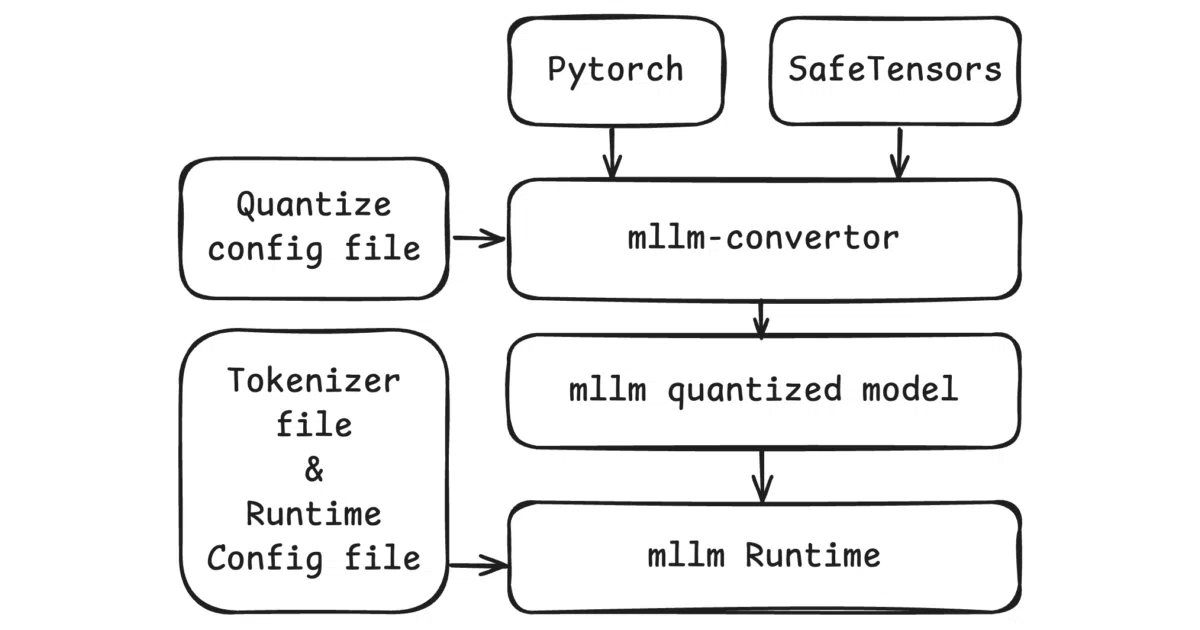
What it does mllm is a C++ inference framework that takes standard PyTorch and SafeTensors checkpoints, quantizes them into its own format, and runs the result on mobile and edge hardware. It supports a broad catalog of models—Qwen3, DeepSeek-OCR, SmolLM3, LLaVA, Gemma, and others—across Arm CPUs, OpenCL GPUs, Qualcomm Hexagon NPUs, and Ascend NPUs. For Android, it offers a reference demo that wraps the engine inside an on-device Go server to keep inference off the main thread.
The interesting bit
Rather than the usual JNI shim, the Android demo spins up an in-app Golang server (mllm_server.aar) so the UI talks to inference over a local client-server protocol. It is a deliberately heavyweight decoupling for a resource-constrained device. The framework also acts as a middleman between high-level optimizations like speculative decoding and pruning and low-level hardware runtimes such as CANN, CUDA, and MLIR.
Key highlights
- Ingests PyTorch and SafeTensors directly via
mllm-convertor, quantizing to w4a8, INT4, or INT8. - v2 offers Pythonic eager execution, compilation support for NPU integration, and parallel model execution.
- Hardware targets include Arm CPU, OpenCL GPU, QNN NPU, and Ascend NPU; experimental CUDA support for Jetson is available through
pymllm. - Provides an SDK, CLI inference tool, and an Android reference architecture using the Go server.
- Model coverage in v2 focuses on recent small-to-mid size multimodal models like Qwen2-VL and Qwen2.5-VL.
Caveats
- v1 is being retired; the README warns that V1 support is ending soon and new features are landing on the v2 branch.
- NPU support is still spotty—only specific model variants have Hexagon or Ascend binaries, and Jetson CUDA is labeled experimental.
- The documentation shows extensive model tables but offers no concrete latency, memory, or power measurements, so real-world efficiency remains an open question.
Verdict A solid candidate if you need a single pipeline from PyTorch weights to offline phone inference and are willing to tolerate some experimental hardware support. Look elsewhere if you need battle-tested server GPU throughput or published benchmarks to guide hardware selection.
Frequently asked
- What is UbiquitousLearning/mllm?
- mllm exists to run quantized multimodal LLMs locally on phones and edge hardware without cloud round-trips.
- Is mllm open source?
- Yes — UbiquitousLearning/mllm is open source, released under the MIT license.
- What language is mllm written in?
- UbiquitousLearning/mllm is primarily written in C++.
- How popular is mllm?
- UbiquitousLearning/mllm has 1.6k stars on GitHub.
- Where can I find mllm?
- UbiquitousLearning/mllm is on GitHub at https://github.com/UbiquitousLearning/mllm.