Tura-AI/tura
Tura cuts LLM agent round-trips by treating context like state
Tura is an open-source Rust runtime that reduces token burn by replacing repetitive tool-calling loops with macro workflows and backward reasoning.
Not currently ranked — collecting fresh signals.
star history
What it does
Tura is a Rust-based agent runtime harness with both terminal and graphical interfaces. It wraps coding tasks in a state-machine context manager and exposes a single command_run macro tool that lets an LLM chain multiple shell commands, patches, builds, and tests into one structured turn instead of several separate round-trips. The project ships as an npm package and targets long-horizon software engineering benchmarks like DeepSWE.
The interesting bit
Instead of the usual forward planning, Tura nudges the model to reason backward from the desired end state—estimating the step just before the goal, then working in reverse. This is meant to counter the LLM’s bias toward statistically common (and often mediocre) solutions. It also compacts context surgically: rather than keeping stale skill files and vague summaries, it checkpoints exact code locations, patches, and task status, then resumes work in about half the rounds that Codex CLI needs after compaction.
Key highlights
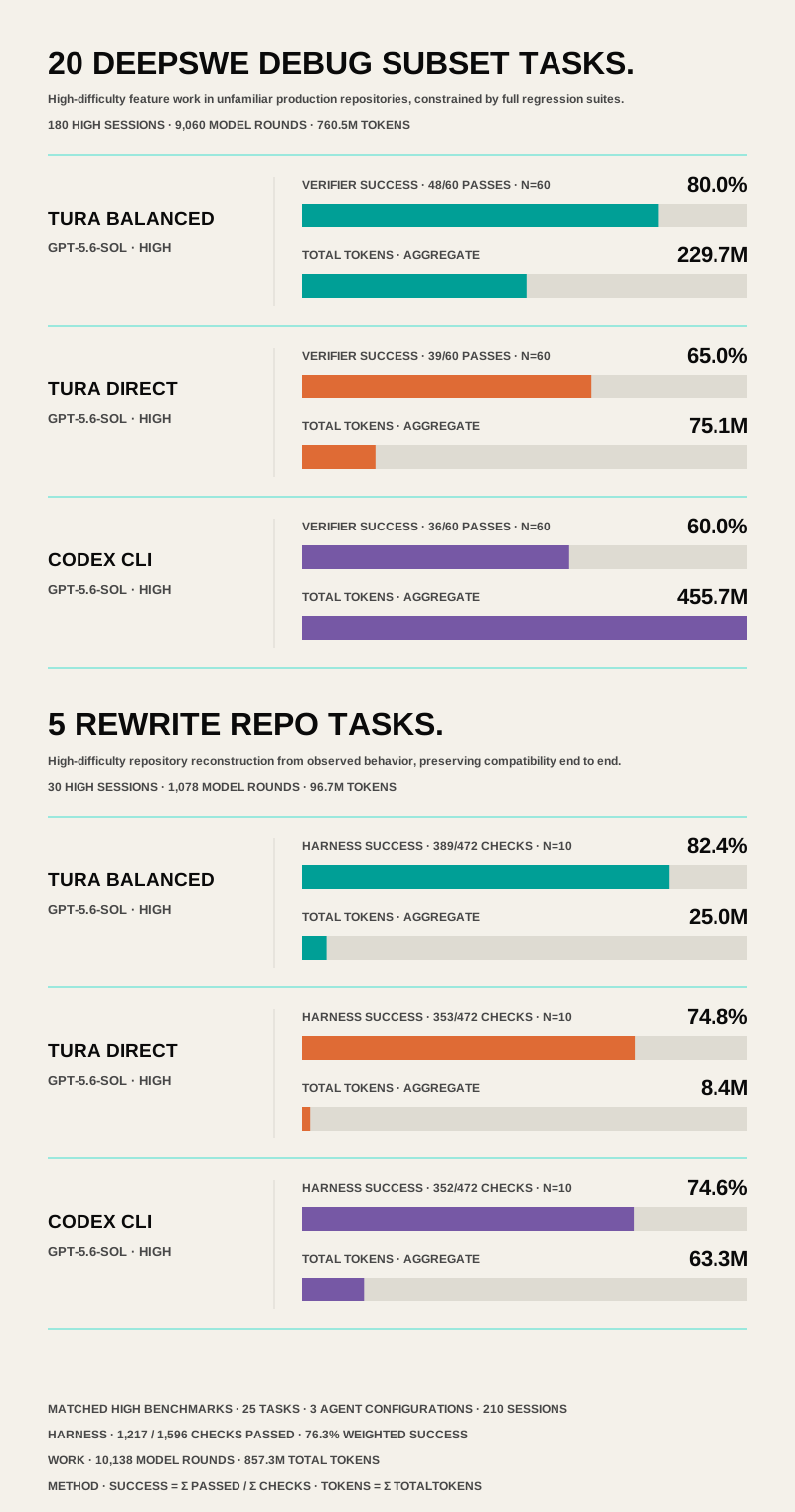
- Published benchmarks across 348 long-horizon sessions claim up to 83.1% fewer turns on rewrite tasks and a 16.7 percentage-point DeepSWE pass-rate improvement over Codex CLI.
- The
command_runmacro bundles multi-step execution trees—inspect, patch, build, test—into single LLM turns, slashing conversational overhead. - Backward reasoning guides the model to reconstruct failure states and root causes before generating code, aiming to avoid “statistically average” solutions.
- Context is scoped to explicit
task_statusstates; compaction preserves execution artifacts rather than loose summaries, with archived sessions resuming an average of 2.6 rounds later. - Supports multiple LLM providers (Anthropic, Google, OpenAI-compatible, local), though credentials are not bundled.
Caveats
- The authors note there is no ablation test isolating
command_runas the sole cause of reduced turn counts; the gains could stem from the combined system. - Benchmark coverage is narrow so far: broader provider, OS, and latency measurements remain on the roadmap, and the published results do not guarantee equivalent performance across every provider configuration.
- Codex CLI’s post-compaction round count is estimated from token-drop patterns, not directly measured, since Codex does not expose equivalent compaction events.
Verdict
Worth a look if you are building or operating coding agents and care about token economics and long-horizon session stability. Pass if you need a fully validated, provider-agnostic solution today—the evidence gaps are openly documented.
Frequently asked
- What is Tura-AI/tura?
- Tura is an open-source Rust runtime that reduces token burn by replacing repetitive tool-calling loops with macro workflows and backward reasoning.
- Is tura open source?
- Yes — Tura-AI/tura is open source, released under the AGPL-3.0 license.
- What language is tura written in?
- Tura-AI/tura is primarily written in Rust.
- How popular is tura?
- Tura-AI/tura has 637 stars on GitHub.
- Where can I find tura?
- Tura-AI/tura is on GitHub at https://github.com/Tura-AI/tura.