TimeCopilot/timecopilot
Time-series forecasting with an LLM referee
TimeCopilot hands the tedious work of selecting, cross-validating, and explaining time-series forecasts to an LLM agent that queries 30+ foundation models through one API.
Not currently ranked — collecting fresh signals.
star history
What it does
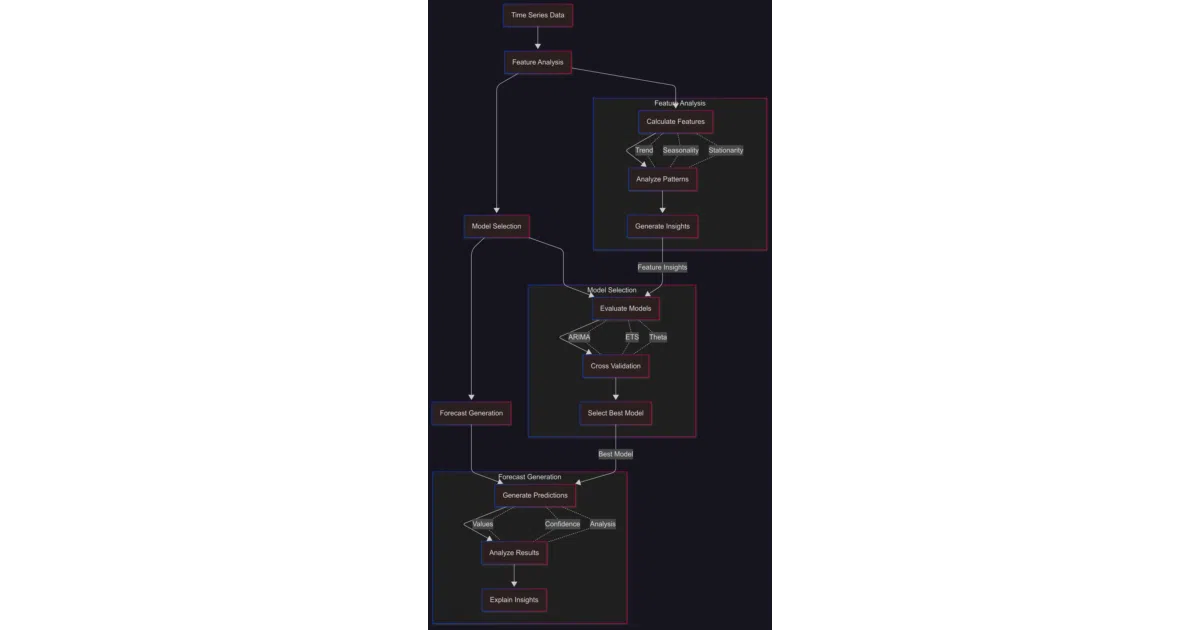
TimeCopilot is an open-source Python agent that wraps more than 30 time-series foundation models—including Amazon Chronos, Salesforce Moirai, Google TimesFM, and Nixtla TimeGPT—and puts a large language model in charge of the forecasting workflow. Feed it a dataset and, optionally, a plain-English question; it computes statistical features, runs cross-validation across candidates, selects the best performer, generates future values, and returns a structured report explaining its reasoning. The output is less a raw tensor and more a narrative complete with model comparisons, feature analyses, and a boolean flag indicating whether the winner actually beat a seasonal-naive baseline.
The interesting bit
The value is in the orchestration, not a novel neural architecture: the LLM acts as a meta-reasoning layer that reads tsfeatures output, steers model selection, and writes the justification, turning a forecasting pipeline into a conversational agent. Here, the usually invisible scaffolding—cross-validation, baseline checks, and prose explanations—is the entire point.
Key highlights
- Claims the top spot on the GIFT-Eval benchmark, ranking above entries from AWS, Salesforce, Google, and IBM.
- Accepted at the NeurIPS 2025 BERTs Workshop for work on agentic forecasting.
- Supports non-OpenAI LLM endpoints via Pydantic, so you are not locked into a single provider.
- Returns verbose, structured output including feature analysis, model rationale, and a comparison against a seasonal-naive baseline.
- Requires Python 3.10 or newer.
Caveats
- The README explicitly warns that macOS on Intel (x86_64) is unsupported, largely due to PyTorch dependency issues.
- Windows users are steered toward Python 3.10 specifically, suggesting some dependency fragility on that platform.
- While the README advertises “30+” models, it only names a handful; the full roster and how deeply each is integrated remain unclear.
Verdict
Data scientists tired of hand-writing cross-validation loops and who want an LLM to both run and narrate their forecasts will find this a useful abstraction. Researchers hunting for a novel time-series architecture should skip it—TimeCopilot is an orchestration layer, not a new model.
Frequently asked
- What is TimeCopilot/timecopilot?
- TimeCopilot hands the tedious work of selecting, cross-validating, and explaining time-series forecasts to an LLM agent that queries 30+ foundation models through one API.
- Is timecopilot open source?
- Yes — TimeCopilot/timecopilot is open source, released under the MIT license.
- What language is timecopilot written in?
- TimeCopilot/timecopilot is primarily written in Python.
- How popular is timecopilot?
- TimeCopilot/timecopilot has 627 stars on GitHub.
- Where can I find timecopilot?
- TimeCopilot/timecopilot is on GitHub at https://github.com/TimeCopilot/timecopilot.