ThinkWatchProject/ThinkWatch-Lite
The AI gateway that assumes your relay is lying
A local gateway for Claude Code, Codex and a dozen other AI clients: swap upstreams without touching client configs, keep secrets away from relays, and stop tool calls a relay smuggles into an answer.
Too new to rank. Velocity needs a few days of history.
not enough history yet
star history
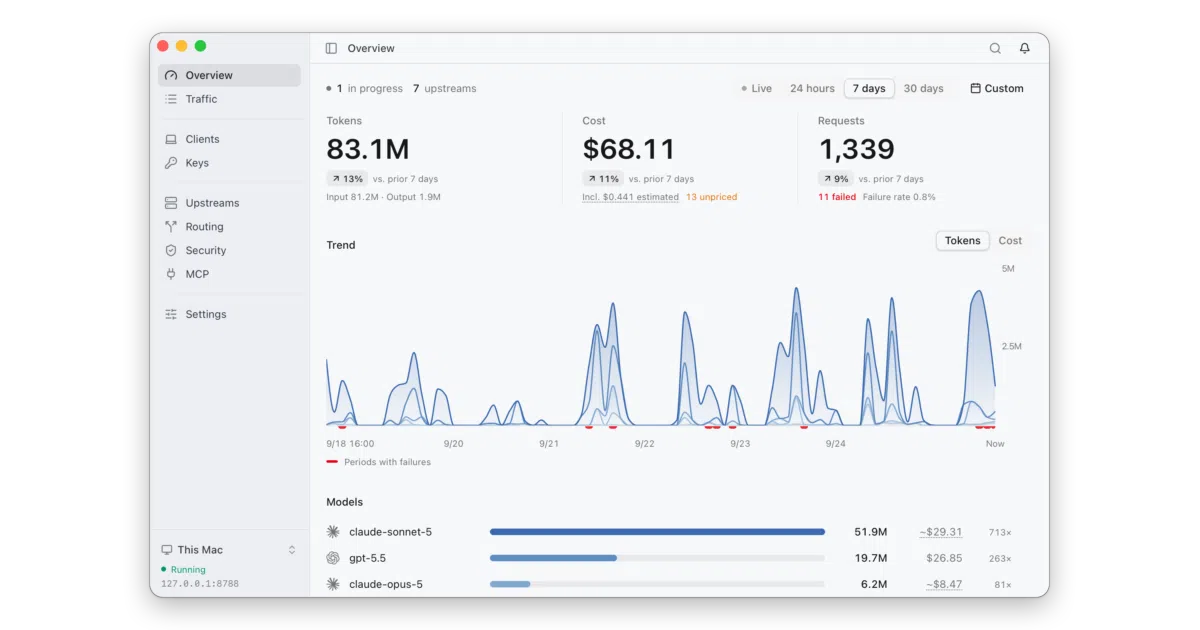
What it does A Tauri 2 desktop app with the ThinkWatch Core gateway shipped inside, sitting between your AI coding clients and their upstreams. You point Claude Code, Codex, opencode, Zed, Aider and friends at it once — config change previewed, original backed up, restore available — and from then on switching providers or models happens in the gateway alone. It converts between the Anthropic, OpenAI and Gemini API formats, routes by model, tools, images and extended thinking, fails over when an upstream dies before the answer begins, and keeps each session on one upstream so prompt caches keep hitting. Every request is recorded with its cost and route, and the full history is searchable, request and answer text included.
The interesting bit Most gateways stop at cost dashboards; this one treats the relay as an active adversary that sees every request and can rewrite every answer. Secrets — API keys, private keys, JWTs, connection-string passwords — are swapped for placeholders before a request leaves the machine, and answers carrying tool calls that download-and-run code, exfiltrate environment variables or credential files, or install startup items are stopped before the client executes them. The upstream check-up goes further, cross-examining upstreams serving the same model and flagging mismatched model names, off-baseline token counts and low prompt-cache reads, with sample sizes attached.
Key highlights
- One-time client wiring for Claude Code, Claude Desktop, Codex, opencode, Zed, Aider, Qwen Code and more, with the change previewed and restorable
- Full request tracing — matched rule, upstreams tried, format conversions, cost math — plus replay of any finished request against a different upstream, side by side
- Scans MCP servers, skills, hooks and project instructions across thirteen clients for hidden characters, prompt injection, dangerous commands and overly broad permissions
- Honest cost accounting: estimated amounts are marked, and unpriced requests are counted separately instead of silently logged as zero
- The gateway can run on a remote Linux server, with the app connecting over an encrypted control channel
Caveats
- The app is not signed by Apple or Microsoft, so the first launch needs a manual trust step
- Protections ship in Observe mode — it watches and logs by default, and blocking only starts once you flip each rule to Enforce
- Building from source downloads a pinned
twcorerelease binary rather than compiling the gateway core in-tree
Verdict Worth a look if you route Claude Code or Codex through third-party relays, or juggle several upstreams and want the switching, tracing and paranoia in one place. If you talk to one official API directly, most of the security machinery has nothing to bite on — though the cost tracing still earns its keep.
Frequently asked
- What is ThinkWatchProject/ThinkWatch-Lite?
- A local gateway for Claude Code, Codex and a dozen other AI clients: swap upstreams without touching client configs, keep secrets away from relays, and stop tool calls a relay smuggles into an answer.
- Is ThinkWatch-Lite open source?
- Yes — ThinkWatchProject/ThinkWatch-Lite is open source, released under the MIT license.
- What language is ThinkWatch-Lite written in?
- ThinkWatchProject/ThinkWatch-Lite is primarily written in TypeScript.
- How popular is ThinkWatch-Lite?
- ThinkWatchProject/ThinkWatch-Lite has 945 stars on GitHub.
- Where can I find ThinkWatch-Lite?
- ThinkWatchProject/ThinkWatch-Lite is on GitHub at https://github.com/ThinkWatchProject/ThinkWatch-Lite.