TencentCloud/TencentDB-Agent-Memory
Your Agent's Memory Shouldn't Be a Junk Drawer
It replaces flat vector dumps with a four-tier semantic pyramid and Mermaid symbol graphs so agents remember workflows without drowning in their own tool logs.
Velocity · 7d
+51
★ / day
Trend
↘cooling
star history
What it does
TencentDB Agent Memory is a plugin for OpenClaw and Hermes that gives AI agents persistent, fully local memory. It captures conversations and distills them into structured personas and scenarios so you stop repeating project background and SOPs every session. For active tasks, it offloads bloated tool logs to external storage and keeps a lightweight Mermaid graph in context to prevent token bloat.
The interesting bit
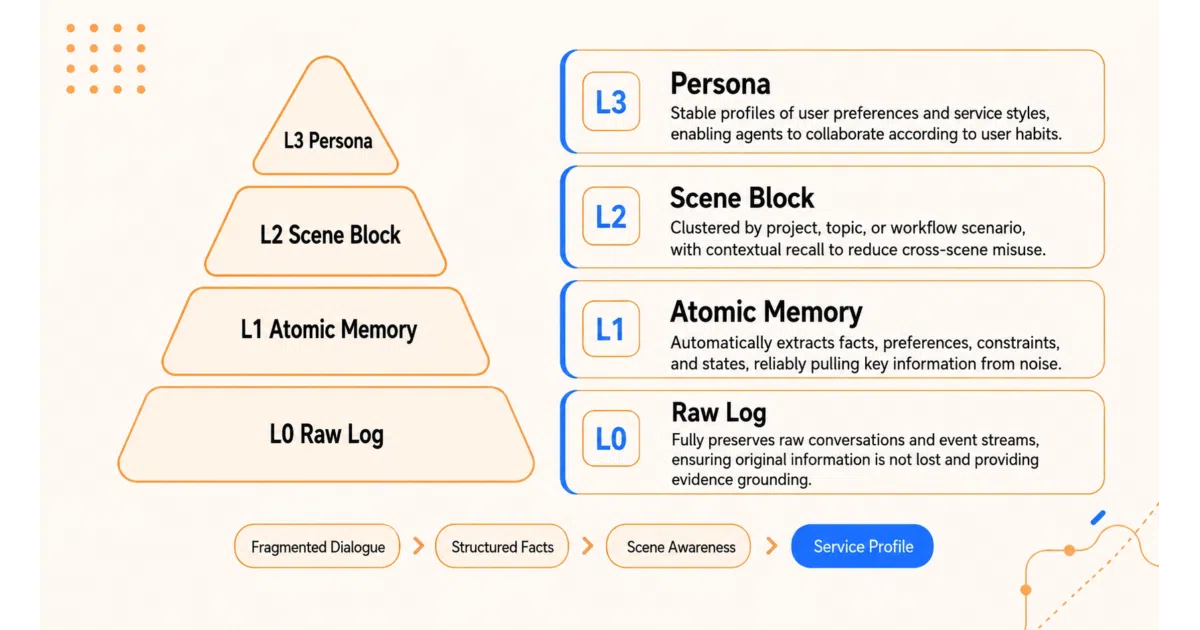
Instead of shredding everything into a flat vector pile, the system organizes memory like a pyramid with a clear chain of custody. Raw evidence lives at the bottom in databases; human-readable personas and Mermaid canvases sit at the top as Markdown files. Because every high-level symbol carries a node_id, the agent can drill down from a distilled persona or canvas straight back to the original log without irreversible compression loss.
Key highlights
- Runs fully offline via a local
SQLite + sqlite-vecbackend with zero external API dependencies. - Reduces token usage by up to 61.38% and improves pass rates by up to 51.52% in OpenClaw long-horizon benchmarks.
- Long-term memory stacks in four tiers: L0 raw conversation → L1 atomic facts → L2 scenario blocks → L3 persona profiles.
- Short-term state is encoded as Mermaid syntax, replacing thousands of tokens of verbose logs with a compact symbol graph.
- Upper layers are stored as Markdown for white-box inspection; lower layers remain in databases for robust full-text retrieval.
Caveats
- Short-term compression on OpenClaw requires applying a runtime patch script that must be re-applied after gateway upgrades.
- Published benchmarks are tied to OpenClaw integration; numbers for other frameworks are not provided.
Verdict A solid fit for developers running long-horizon agents that need cross-session recall without leaking data or burning tokens on repetitive context. Skip it if your use case is effectively stateless.
Frequently asked
- What is TencentCloud/TencentDB-Agent-Memory?
- It replaces flat vector dumps with a four-tier semantic pyramid and Mermaid symbol graphs so agents remember workflows without drowning in their own tool logs.
- Is TencentDB-Agent-Memory open source?
- Yes — TencentCloud/TencentDB-Agent-Memory is an open-source project tracked on heatdrop.
- What language is TencentDB-Agent-Memory written in?
- TencentCloud/TencentDB-Agent-Memory is primarily written in TypeScript.
- How popular is TencentDB-Agent-Memory?
- TencentCloud/TencentDB-Agent-Memory has 29.9k stars on GitHub and is currently cooling off.
- Where can I find TencentDB-Agent-Memory?
- TencentCloud/TencentDB-Agent-Memory is on GitHub at https://github.com/TencentCloud/TencentDB-Agent-Memory.