TencentCloud/CubeSandbox
Micro-VMs for AI agents that cold-start in under 60 ms
CubeSandbox gives every AI agent its own hardware-isolated kernel without paying the usual VM boot penalty.
Velocity · 7d
+9.4
★ / day
Trend
↘cooling
star history
What it does
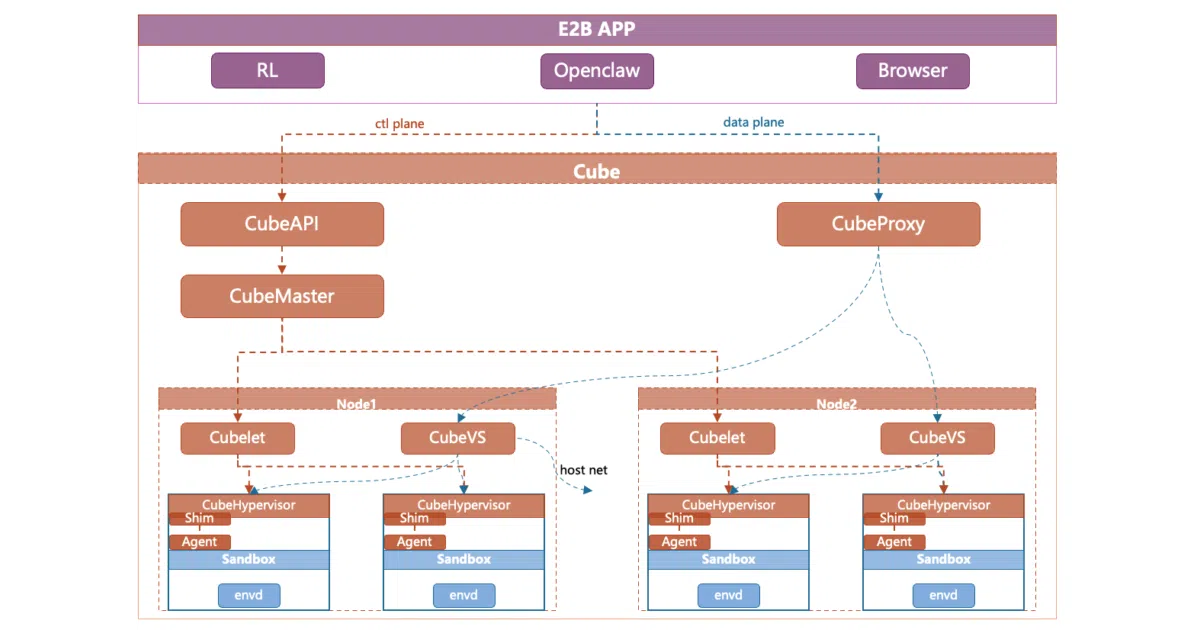
CubeSandbox is a Rust-based sandbox service built on RustVMM and KVM that spins up fully isolated, E2B-compatible execution environments for AI agents. Each sandbox runs its own guest OS kernel rather than sharing the host kernel like Docker, and the system supports both single-node and clustered deployments. It targets the same use case as the E2B closed-source sandbox, but claims sub-60-millisecond cold starts and less than 5 MB of memory overhead per instance.
The interesting bit
The project achieves its speed through resource pool pre-provisioning and a Copy-on-Write snapshot engine called CubeCoW, which lets it fork and roll back running sandboxes at millisecond granularity. That means you get the isolation of a traditional VM—dedicated kernel, eBPF-enforced network policies via CubeVS, and no container escape risks—with a footprint and boot time that rival containers.
Key highlights
- Drop-in E2B SDK compatibility: change a URL and existing agent code runs unmodified.
- Sub-60 ms cold starts on bare metal (P99 under 150 ms at 50 concurrent creations).
- Per-instance memory overhead below 5 MB for configurations up to 32 GB, enabling thousands of agents per node.
- Event-level snapshots and instant cloning via the
CubeCoWengine. - Production-hardened: Tencent Cloud runs it at scale, and the stack is Apache 2.0 licensed.
Caveats
- Requires x86_64 Linux with KVM; WSL2 and ordinary cloud VMs (via PVM) are supported workarounds, but the README never mentions macOS or ARM.
- Memory overhead claims are benchmarked against sandboxes sized at 32 GB or less; larger specs may cost marginally more.
- The nested-QEMU development environment is explicitly flagged as low-performance and not recommended for real workloads.
Verdict
Teams running untrusted LLM-generated code at high density should look here, especially if they are already paying for E2B. If you are not on x86_64 Linux or unwilling to use KVM, look elsewhere.
Frequently asked
- What is TencentCloud/CubeSandbox?
- CubeSandbox gives every AI agent its own hardware-isolated kernel without paying the usual VM boot penalty.
- Is CubeSandbox open source?
- Yes — TencentCloud/CubeSandbox is an open-source project tracked on heatdrop.
- What language is CubeSandbox written in?
- TencentCloud/CubeSandbox is primarily written in Go.
- How popular is CubeSandbox?
- TencentCloud/CubeSandbox has 13k stars on GitHub and is currently cooling off.
- Where can I find CubeSandbox?
- TencentCloud/CubeSandbox is on GitHub at https://github.com/TencentCloud/CubeSandbox.