Snailclimb/interview-guide
An AI interviewer built from Redis streams and good intentions
A Java 21 and Spring AI learning project that parses resumes, runs voice-and-text mock interviews, and manages your job hunt calendar.
Not currently ranked — collecting fresh signals.
star history
What it does
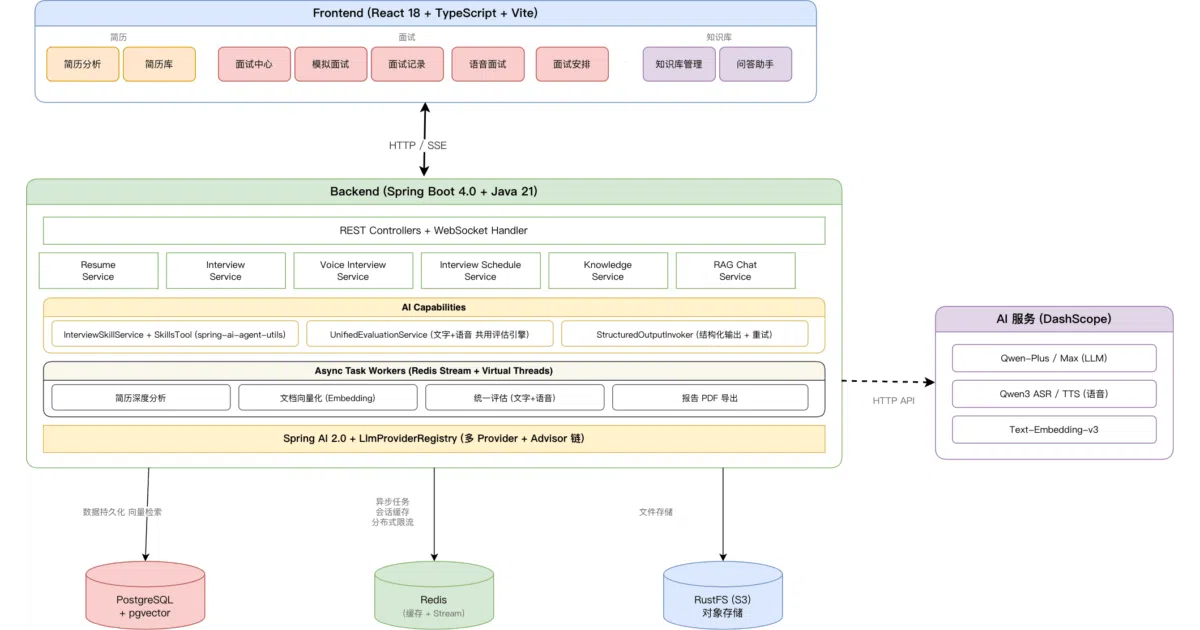
InterviewGuide is a full-stack AI interview platform. The Java 21 backend uses Spring Boot 4.0.1, Spring AI 2.0.0-M4, and virtual threads to parse resumes, conduct mock interviews, and serve a RAG knowledge base over PostgreSQL and pgvector. A React frontend provides calendars, chat, and a control panel for swapping LLM providers without touching code.
The interesting bit
The author deliberately keeps the stack minimal: Redis Stream handles async resume analysis and vectorization instead of Kafka, and PostgreSQL with pgvector doubles as both relational store and vector database. The voice pipeline is surprisingly deep—server-side VAD, sentence-level concurrent TTS, and echo protection—but the README openly notes it still struggles with latency and audio leakage without headphones.
Key highlights
- Unified evaluation engine for text and voice interviews, with structured scoring and PDF report export via iText 8.
- Skill-driven question generation using
SKILL.mdfiles for 10+ interview tracks, plus automatic deduplication against past sessions. - Interview scheduling that parses Feishu, Tencent Meeting, and Zoom invites with a rule-plus-AI engine, then renders them in a drag-and-drop calendar.
- Runtime model switching and encrypted API-key storage in
~/.interview-guide/, supporting DashScope, DeepSeek, Kimi, GLM, and LM Studio. - Async processing with Redis Stream, including automatic retries and content-hash deduplication for resume analysis.
Caveats
- The voice interview module currently has noticeable end-to-end delay, single-voice TTS, and echo leakage without headphones; WebRTC and client-side VAD are listed as future work.
- Several major integrations—such as connecting mock interviews directly to the knowledge base—remain on the TODO list.
Verdict
Great for Java developers who want a credible, resume-worthy project that demonstrates Spring AI, RAG, and async architecture without hiding behind buzzwords. Skip it if you need a polished, production-ready voice agent today.
Frequently asked
- What is Snailclimb/interview-guide?
- A Java 21 and Spring AI learning project that parses resumes, runs voice-and-text mock interviews, and manages your job hunt calendar.
- Is interview-guide open source?
- Yes — Snailclimb/interview-guide is open source, released under the AGPL-3.0 license.
- What language is interview-guide written in?
- Snailclimb/interview-guide is primarily written in Java.
- How popular is interview-guide?
- Snailclimb/interview-guide has 3.4k stars on GitHub.
- Where can I find interview-guide?
- Snailclimb/interview-guide is on GitHub at https://github.com/Snailclimb/interview-guide.