Skytliang/Multi-Agents-Debate
MAD science: making LLMs argue with each other
This project explores whether two arguing LLMs—plus a judge—can reason better than one model quietly second-guessing itself.
Not currently ranked — collecting fresh signals.
star history
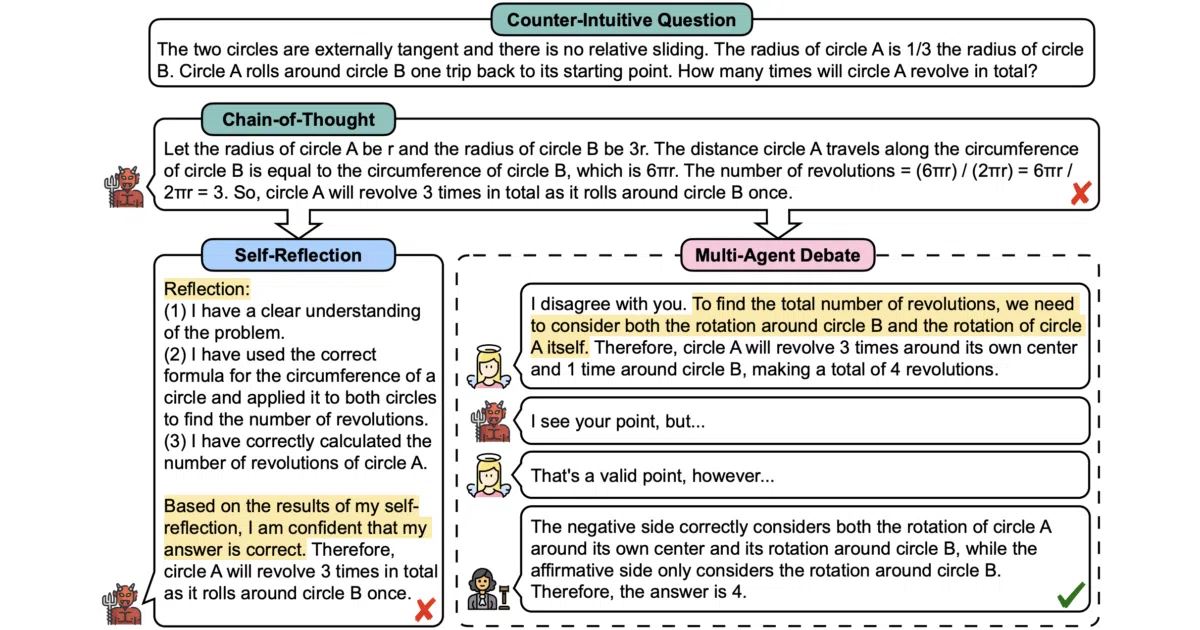
What it does MAD is a research framework that orchestrates a three-role panel of LLMs—an affirmative “devil,” a negative “angel,” and a judge—to tackle reasoning and translation problems. Instead of relying on a single model’s internal self-reflection, it forces agents to argue in rounds, with the judge stepping in to verify or pick a winner. The authors claim this structure avoids the “degeneration of thoughts” they identify in solo reflection loops.
The interesting bit The core insight is that self-reflection can trap a model in its own biases, whereas an adversarial opponent is contractually obligated to disagree. By literally role-playing devil’s advocate against an angel, the framework externalizes error correction into a structured argument.
Key highlights
- Targets two specific benchmarks: Counterintuitive QA and Commonsense Machine Translation (Chinese idiom translation).
- Uses a “tit for tat” debate structure where the angel corrects the devil’s mistakes and a judge mediates.
- Ships with an interactive Gradio demo and a lightweight Python script for translation experiments.
- Built atop the OpenAI API; the README shows setup via shell scripts and
interactive.py.
Caveats
- Evaluation is limited to the two narrow tasks shown in screenshot tables; broader generalization is unproven.
- It is essentially glue code around OpenAI API calls, so it requires external API keys and cannot run fully offline.
- The README presents results as static images without accompanying data tables or detailed methodology.
Verdict Worth a look if you are researching multi-agent prompting or adversarial reasoning. Skip it if you need a general-purpose, offline, or production-ready agent framework.
Frequently asked
- What is Skytliang/Multi-Agents-Debate?
- This project explores whether two arguing LLMs—plus a judge—can reason better than one model quietly second-guessing itself.
- Is Multi-Agents-Debate open source?
- Yes — Skytliang/Multi-Agents-Debate is open source, released under the GPL-3.0 license.
- What language is Multi-Agents-Debate written in?
- Skytliang/Multi-Agents-Debate is primarily written in Python.
- How popular is Multi-Agents-Debate?
- Skytliang/Multi-Agents-Debate has 617 stars on GitHub.
- Where can I find Multi-Agents-Debate?
- Skytliang/Multi-Agents-Debate is on GitHub at https://github.com/Skytliang/Multi-Agents-Debate.