SWE-agent/SWE-ReX
Your AI agent's shell, now with 30x parallelism and zero infrastructure tantrums
SWE-ReX decouples agent logic from where the code actually runs, so you can ship your agent to Docker, AWS, or Modal without rewriting a line.
Not currently ranked — collecting fresh signals.
star history
What it does SWE-ReX is a runtime interface that lets AI agents execute shell commands inside sandboxed environments. The agent code stays identical whether commands run locally, inside Docker, on AWS remote machines, or via serverless platforms like Modal. It handles the messy parts—detecting when commands finish, extracting output and exit codes, managing multiple concurrent shell sessions—so you don’t have to build yet another remote execution layer from scratch.
The interesting bit The real trick is disentangling what the agent wants to do from where it happens. SWE-ReX grew out of the SWE-agent team’s pain running large benchmark evaluations; they needed to spin up dozens or hundreds of isolated environments without the agent logic caring about Docker sockets, AWS credentials, or Modal deployments. The result is infrastructure that scales horizontally while the agent remains blissfully ignorant.
Key highlights
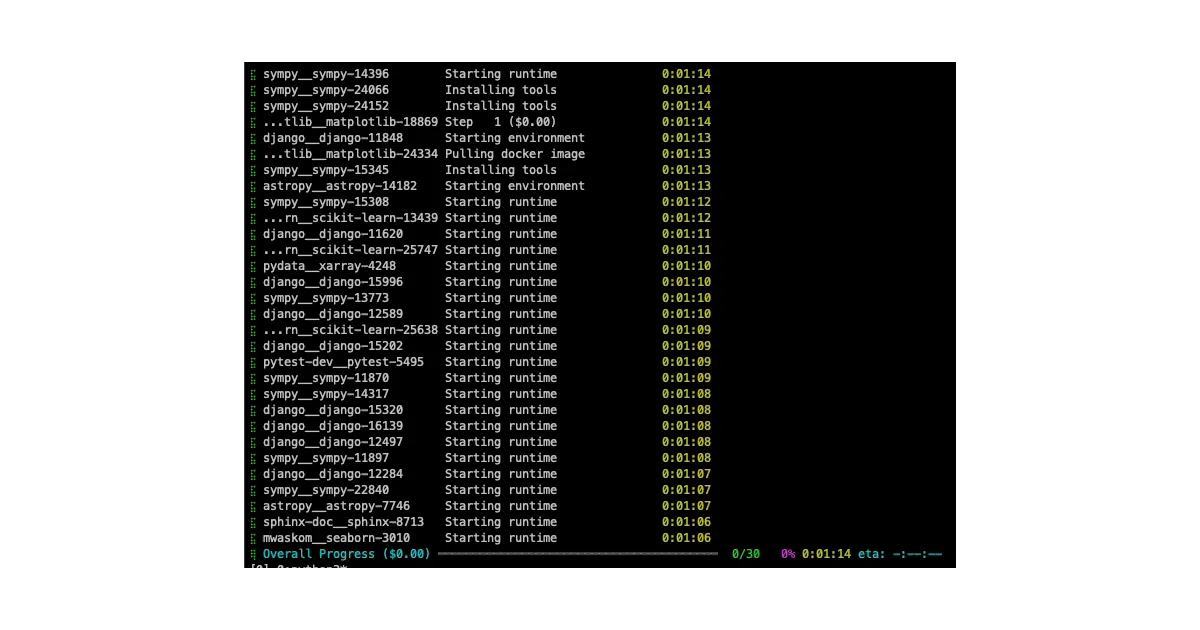
- Massively parallel by design: The README explicitly calls out running 100 agents in parallel as a non-problem, with a demo of 30 SWE-bench instances running concurrently.
- Interactive tool support: Agents can use
ipython,gdb, and other REPL-style tools across multiple simultaneous shell sessions. - Broad platform coverage: Works on non-Linux machines without Docker, plus AWS Fargate, Modal, and Daytona (the latter marked WIP).
- Clean abstraction: Same agent code regardless of backend; swap local execution for cloud without touching agent logic.
- Battle-tested: Powers SWE-agent and emerged from real-world benchmark evaluation needs.
Caveats
- Some backends are explicitly work-in-progress: Daytona support is marked “WIP” in the install instructions.
- The “broad range of platforms” claim includes non-Linux without Docker, but the README doesn’t specify exactly which platforms or how fallback execution works.
Verdict Worth a look if you’re building coding agents and tired of hand-rolling Docker orchestration or cloud deployment logic for every new project. Skip it if you only need single-machine local execution and don’t anticipate scaling beyond one sandbox.
Frequently asked
- What is SWE-agent/SWE-ReX?
- SWE-ReX decouples agent logic from where the code actually runs, so you can ship your agent to Docker, AWS, or Modal without rewriting a line.
- Is SWE-ReX open source?
- Yes — SWE-agent/SWE-ReX is open source, released under the MIT license.
- What language is SWE-ReX written in?
- SWE-agent/SWE-ReX is primarily written in Python.
- How popular is SWE-ReX?
- SWE-agent/SWE-ReX has 625 stars on GitHub.
- Where can I find SWE-ReX?
- SWE-agent/SWE-ReX is on GitHub at https://github.com/SWE-agent/SWE-ReX.