Rath-Team/OpenRath
OpenRath swaps chat logs for tensor-like agent state
It gives multi-agent clusters a PyTorch-like dataflow model where sessions are tensors, agents are layers, and lineage is first-class.
Not currently ranked — collecting fresh signals.
star history
What it does
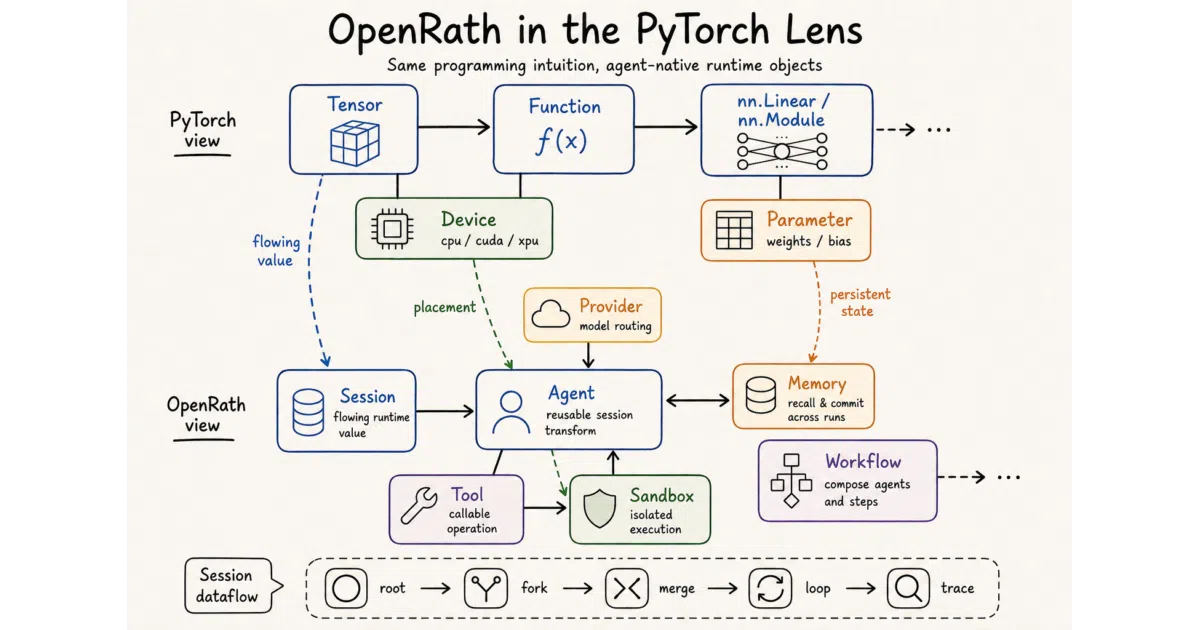
OpenRath is a Python framework that models multi-agent workflows as explicit, composable objects. Session carries runtime state and collaboration lineage; Agent acts as a reusable transformation layer on that session; Workflow nests these layers into larger systems; and Selector routes between them at runtime. The design explicitly mirrors PyTorch concepts—Session is a Tensor, Agent is an nn.Linear layer, Sandbox is a Device, Memory is a Parameter—so you build agent clusters by composing dataflow rather than piping chat strings.
The interesting bit
The framework treats Session as the single flowing runtime value rather than an agent-owned message history, which means you can fork, merge, detach, and trace branches across a cluster of agents without losing provenance. This shifts the problem from prompting a model to routing and transforming state—a distinction that matters when you stop building chatbots and start building agent clusters.
Key highlights
Sessionis a first-class, forkable and mergeable data structure with lineage tracking, not just a conversation transcript.Agent,Tool,Memory,Sandbox, andWorkfloware decoupled primitives that plug together like neural-net layers.- Memory persists across runs via local BM25 recall (with optional embeddings) or external backends such as OpenViking.
- Sandbox placement determines where tools execute—local process or containerized OpenSandbox—without hardcoding execution to the host.
Selectorprovides LLM-backed runtime routing between self-describing workflows, keepingif/whilelogic in plain Python.
Caveats
- The README targets massive agent clusters, but evidence of production hardening at that scale isn’t visible in the sources.
- Key backends like OpenSandbox and OpenViking are optional or external, so out-of-the-box coverage depends on which integrations you bring.
Verdict
Worth a look if you’re building non-trivial agent orchestration where traceability, branching, and memory matter more than a single chat loop. Skip it if you just need a thin wrapper around one model call.
Frequently asked
- What is Rath-Team/OpenRath?
- It gives multi-agent clusters a PyTorch-like dataflow model where sessions are tensors, agents are layers, and lineage is first-class.
- Is OpenRath open source?
- Yes — Rath-Team/OpenRath is open source, released under the BSD-3-Clause license.
- What language is OpenRath written in?
- Rath-Team/OpenRath is primarily written in Python.
- How popular is OpenRath?
- Rath-Team/OpenRath has 960 stars on GitHub.
- Where can I find OpenRath?
- Rath-Team/OpenRath is on GitHub at https://github.com/Rath-Team/OpenRath.