PhoebusSi/Alpaca-CoT
Taming the instruction-tuning zoo with a single interface
To stop researchers from rewriting the same boilerplate every time they want to instruction-tune a new model or dataset.
Not currently ranked — collecting fresh signals.
star history
What it does
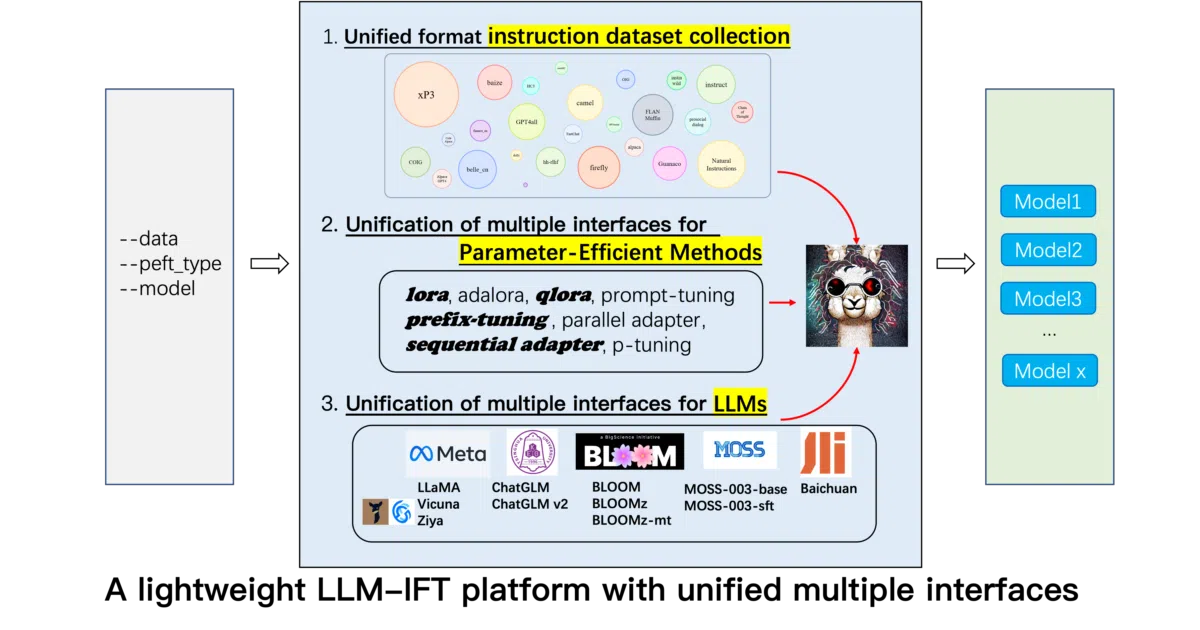
Alpaca-CoT is essentially integration glue: it wires together a growing list of open-source LLMs (LLaMA, ChatGLM, Baichuan, MOSS, InternLM), parameter-efficient fine-tuning methods from PEFT (LoRA, QLoRA, p-tuning, adapters), and a curated collection of instruction-tuning datasets—especially chain-of-thought (CoT) data—into a single, shared interface. Instead of maintaining one-off scripts for each model-and-method pair, you swap components by changing a hyper-parameter. The project also hosts formatted datasets and model checkpoints on HuggingFace, and maintains a side branch for tabular-data tasks.
The interesting bit
The value is in the plumbing. The authors treat the fine-tuning pipeline like a modular operating system: new LLMs and new PEFT methods are “merged” via pull requests and exposed through the same API. It is a community-driven attempt to standardize a corner of the LLM ecosystem that is otherwise a maze of incompatible repositories.
Key highlights
- Supports a wide roster of LLMs including LLaMA, ChatGLM v2, Baichuan, MOSS, and InternLM.
- Wraps multiple parameter-efficient methods—LoRA, QLoRA, AdaLoRA, p-tuning, sequential and parallel adapters—with 4-bit quantization available for some.
- Maintains an expanding instruction-tuning dataset collection (emphasizing CoT and Chinese CoT data) on HuggingFace.
- Includes extras like multi-turn conversation, local chatting, batch prediction, web service scaffolding, and evaluation scripts (BELLE, MMCU).
- A separate
tabular_llmbranch targets table-intelligence tasks.
Caveats
- Non-LoRA PEFT methods require installing an edited, in-tree version of the
peftlibrary rather than the upstream package. - The README reads like a rapid-fire changelog of merged PRs; long-term stability and API compatibility across so many moving parts are unclear.
- It is glue code: if you need deep customization of a specific model’s internals, you may still outgrow the abstraction.
Verdict
Worth a look if you are an NLP researcher who wants to benchmark or instruction-tune several models without writing custom loaders for each. Skip it if you are building a production system around one specific model and need tight control over every layer.
Frequently asked
- What is PhoebusSi/Alpaca-CoT?
- To stop researchers from rewriting the same boilerplate every time they want to instruction-tune a new model or dataset.
- Is Alpaca-CoT open source?
- Yes — PhoebusSi/Alpaca-CoT is open source, released under the Apache-2.0 license.
- What language is Alpaca-CoT written in?
- PhoebusSi/Alpaca-CoT is primarily written in Jupyter Notebook.
- How popular is Alpaca-CoT?
- PhoebusSi/Alpaca-CoT has 2.8k stars on GitHub.
- Where can I find Alpaca-CoT?
- PhoebusSi/Alpaca-CoT is on GitHub at https://github.com/PhoebusSi/Alpaca-CoT.