Peterande/D-FINE
DETR meets probability theory for tighter bounding boxes
D-FINE reframes DETR bounding-box regression as iterative probability-distribution refinement, chasing better localization accuracy in real-time detectors without extra inference overhead.
Velocity · 7d
+1.9
★ / day
Trend
→steady
star history
What it does
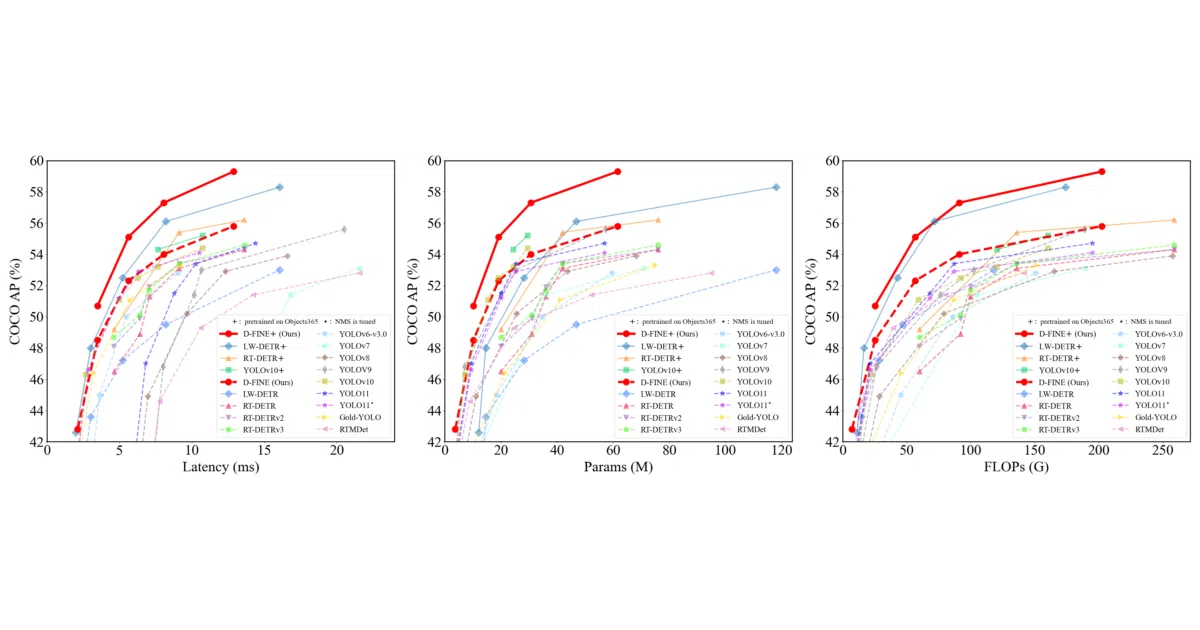
D-FINE is a real-time object detector built on the DETR architecture. Instead of predicting bounding-box coordinates directly, it recasts regression as Fine-grained Distribution Refinement (FDR). It also employs Global Optimal Localization Self-Distillation (GO-LSD). The repo ships a family of models—from a 4M-parameter N variant up to a 62M X—with published COCO and Objects365 checkpoints.
The interesting bit
The hook is treating box coordinates as probability distributions that get iteratively smoothed, plus a self-distillation mechanism that the authors say improves localization without adding training or inference overhead. They also provide a side-by-side video against YOLO11, claiming notably better confidence and edge precision under motion blur and dense crowds.
Key highlights
- ICLR 2025 Spotlight paper with official implementation
- Five model sizes (
N/S/M/L/X) scaling from 4M to 62M parameters D-FINE-Nreaches 42.8% AP on COCO at 2.12 ms latency (472 FPS on a T4 with TensorRT FP16)- Pre-trained Objects365 weights available; authors recommend them for complex scenes
- Apache 2.0 license and a Hugging Face demo space
Caveats
- The authors warn that Objects365 pre-training can overfit if your target categories are very simple
- The YOLO11 comparison in the README comes from the authors’ own video demo, not an independent benchmark
- The documentation is a standard academic model-zoo page; long-term maintenance and API stability are unclear
Verdict
Worth evaluating if you need a recent DETR-based detector with strong COCO metrics and ready-made TensorRT latency numbers. Look elsewhere if you want a battle-hardened production framework with extensive API documentation beyond training configs and checkpoints.
Frequently asked
- What is Peterande/D-FINE?
- D-FINE reframes DETR bounding-box regression as iterative probability-distribution refinement, chasing better localization accuracy in real-time detectors without extra inference overhead.
- Is D-FINE open source?
- Yes — Peterande/D-FINE is open source, released under the Apache-2.0 license.
- What language is D-FINE written in?
- Peterande/D-FINE is primarily written in Python.
- How popular is D-FINE?
- Peterande/D-FINE has 3.4k stars on GitHub and is currently holding steady.
- Where can I find D-FINE?
- Peterande/D-FINE is on GitHub at https://github.com/Peterande/D-FINE.