PaddlePaddle/PaddleClas
The CV toolkit that takes Chinese silicon seriously
PaddleClas exists to get image classification and recognition out of the lab and onto factory floors, checkout cameras, and elevators—especially if that hardware is made in China.
Not currently ranked — collecting fresh signals.
star history
What it does
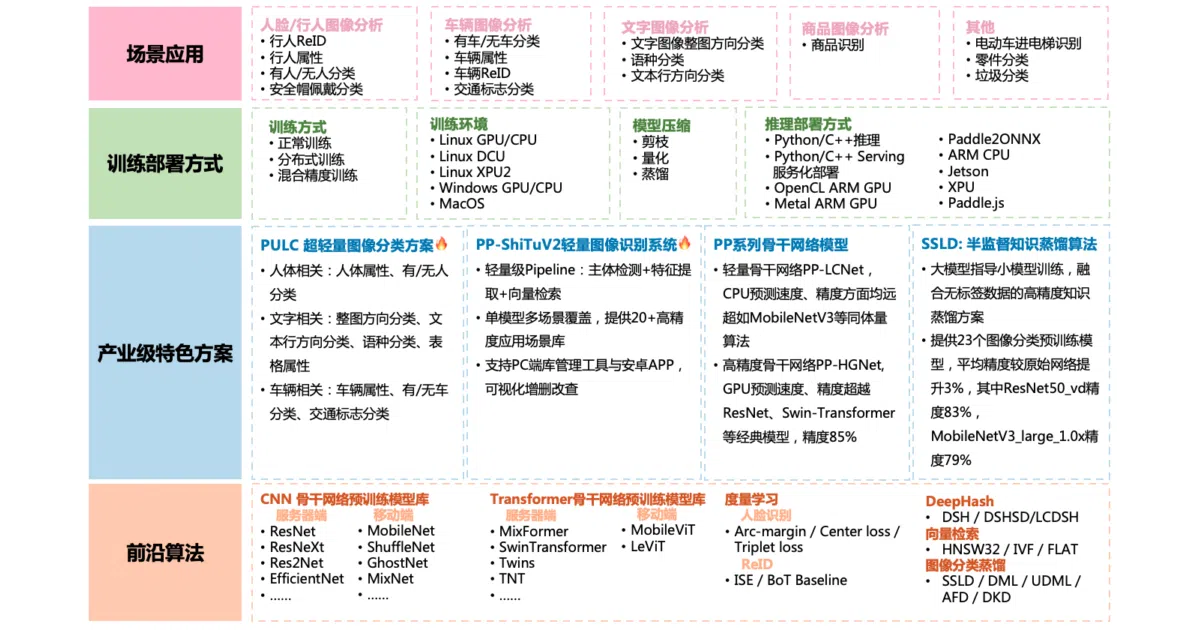
PaddleClas is Baidu’s comprehensive vision toolkit for image classification and recognition, built atop the PaddlePaddle framework. It bundles 98 core models into six production lines covering classification, multi-label tagging, image retrieval, and face recognition, with deployment paths for Python, C++, mobile, and server runtimes. The project targets industrial use cases—grocery self-checkout, elevator safety monitoring, personnel access control—rather than pure research benchmarks.
The interesting bit
The “PP” model family is hardware-conscious in a way most Western toolkits aren’t: PP-LCNet is tuned for Intel CPUs with MKLDNN, PP-HGNet chases GPU accuracy, and the deployment stack explicitly supports Chinese silicon like Kunlun, Ascend, Cambricon, and Hygon. The recent PaddleX integration wraps the entire zoo into low-code APIs and a GUI, which feels like an admission that even “easy” deep learning is still too hard for most enterprises.
Key highlights
- 98 vision models across classification, recognition, and face identification exposed through unified Python APIs
- Hardware-aware zoo: CPU-optimized
PP-LCNet, GPU-optimizedPP-HGNet, and lightweightPP-ShiTuV2for edge recognition - Explicit support for domestic Chinese AI accelerators alongside NVIDIA GPUs
- Low-code tooling via PaddleX with both command-line and graphical interfaces
- Pre-built industry scenarios including fresh-food checkout, retail product recognition, and e-bike detection in elevators
Caveats
- Documentation is Chinese-first; English docs exist, but the project clearly optimizes for Chinese-speaking developers
- The low-code PaddleX layer and some newer models (MobileNetV4, StarNet, FasterNet) live in the separate PaddleX repository, not PaddleClas itself
- The advertised breadth of 200+ models spanning OCR, detection, and segmentation is delivered through PaddleX, so you’re signing up for the broader PaddlePaddle ecosystem
Verdict
Worth evaluating if you’re shipping production vision pipelines in China or targeting non-NVIDIA edge hardware. Skip it if you’re already entrenched in PyTorch and don’t need the deployment-specific optimizations.
Frequently asked
- What is PaddlePaddle/PaddleClas?
- PaddleClas exists to get image classification and recognition out of the lab and onto factory floors, checkout cameras, and elevators—especially if that hardware is made in China.
- Is PaddleClas open source?
- Yes — PaddlePaddle/PaddleClas is open source, released under the Apache-2.0 license.
- What language is PaddleClas written in?
- PaddlePaddle/PaddleClas is primarily written in Python.
- How popular is PaddleClas?
- PaddlePaddle/PaddleClas has 5.9k stars on GitHub.
- Where can I find PaddleClas?
- PaddlePaddle/PaddleClas is on GitHub at https://github.com/PaddlePaddle/PaddleClas.