OpenSPG/KAG
Symbolic Reasoning for RAG That Goes Beyond Vector Search
KAG exists because vector-similarity RAG stumbles on multi-hop questions and GraphRAG chokes on OpenIE noise.
Not currently ranked — collecting fresh signals.
star history
What it does
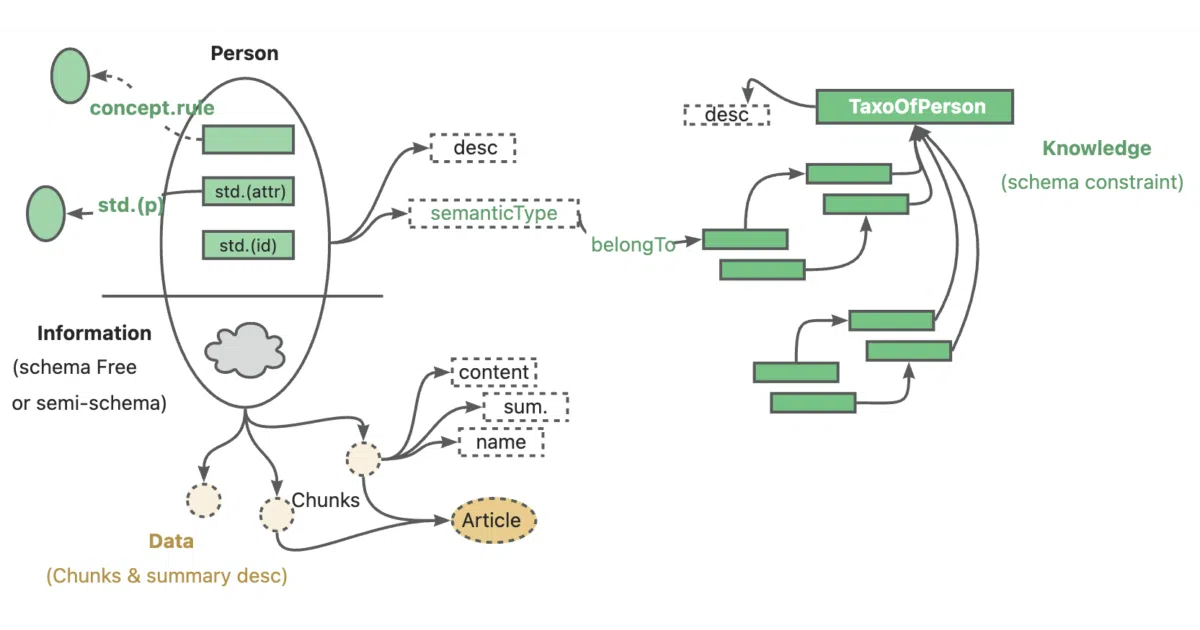
KAG is a framework layered on the OpenSPG knowledge-graph engine and LLMs, aimed at vertical-domain Q&A. It ingests everything from news and logs to transactions and expert rules, then unifies them into a business knowledge graph via schema-free extraction or schema-constrained construction. At query time, its kg-solver translates natural-language questions into symbolic logical forms and executes a hybrid pipeline of exact-match retrieval, text retrieval, graph traversal, and numerical calculation.
The interesting bit
Rather than betting everything on embedding similarity, KAG uses a logical-form-guided solver with planning, reasoning, and retrieval operators. It also cross-indexes graph nodes with raw text chunks, letting the system hop between symbolic reasoning and language-based evidence without losing the original context.
Key highlights
- Supports both schema-free information extraction and schema-constrained expert-knowledge construction on the same entity or event types.
- Organizes knowledge along a DIKW hierarchy (data, information, knowledge, wisdom) designed to be LLM-friendly.
- The solver mixes four problem-solving modes: vector/text retrieval, knowledge-graph reasoning, language reasoning, and numerical calculation.
- Release notes cite an 89% reduction in knowledge-construction token costs in “Lightweight Build” mode, and an
open_benchmarkdirectory for SOTA comparisons. - Offers an MCP interface for agent workflows and decouples knowledge bases from applications so one app can query multiple KBs.
Caveats
- The
kag-modelcomponent is still closed-source; onlykg-builderandkg-solverare available so far. - It is tightly coupled to the OpenSPG engine and expects Docker-based deployment, so it is not a drop-in library for existing RAG stacks.
- The README claims “significantly better than the current SOTA method” but does not show specific benchmark figures in the provided text.
Verdict
If you are building professional-domain Q&A—finance, legal, operations—and need multi-hop logical reasoning rather than vector guesswork, KAG is worth evaluating. If you need a quick, framework-agnostic RAG plug-in, look elsewhere.
Frequently asked
- What is OpenSPG/KAG?
- KAG exists because vector-similarity RAG stumbles on multi-hop questions and GraphRAG chokes on OpenIE noise.
- Is KAG open source?
- Yes — OpenSPG/KAG is open source, released under the Apache-2.0 license.
- What language is KAG written in?
- OpenSPG/KAG is primarily written in Python.
- How popular is KAG?
- OpenSPG/KAG has 8.9k stars on GitHub.
- Where can I find KAG?
- OpenSPG/KAG is on GitHub at https://github.com/OpenSPG/KAG.