OpenMOSS/MOSS-Image
A 5B DiT that actually spells things right — and lets you place them
MOSS-Image is a compact open text-to-image model whose selling point is legible in-image text plus JSON layout control over where every word and object lands.
Feature · 19 Oct 2026
The Image Model That Takes Instructions Literally
OpenMOSS's 5B text-to-image model treats prompts as typesetting briefs — bounding boxes, rendered text, and all — in a field addicted to 20-billion-parameter flagships.
Read the in-depth article →
Collecting fresh signals — velocity needs a few days of history.
collecting data…
star history
What it does
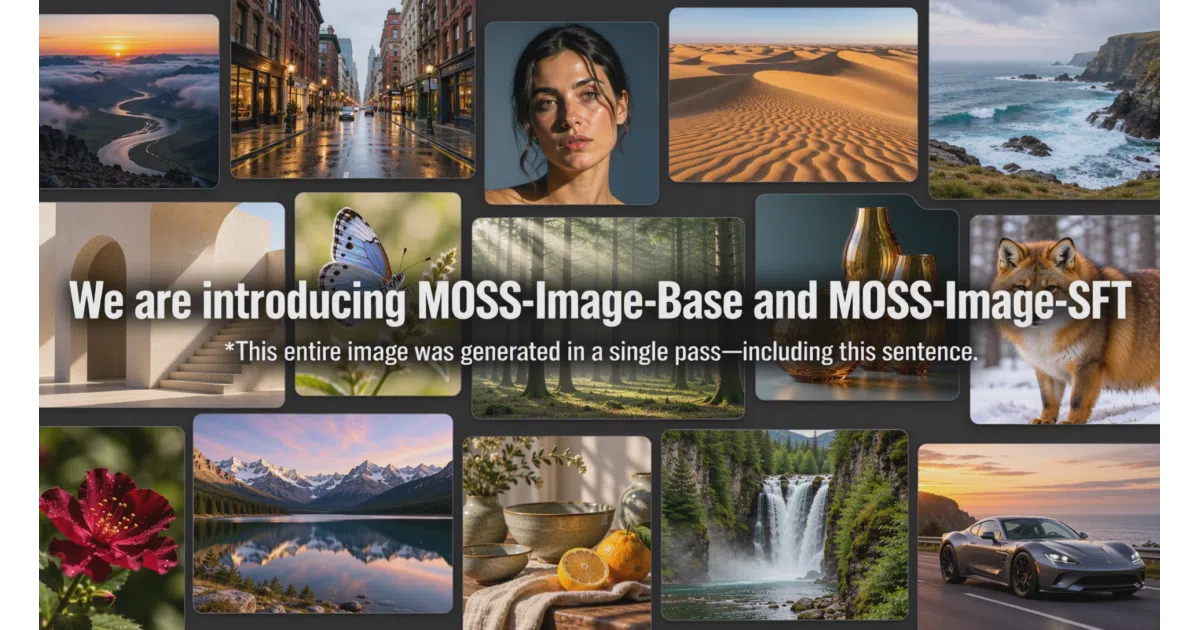
MOSS-Image is a 5B-parameter diffusion transformer for text-to-image generation, released in two flavors: a Base model and an SFT variant fine-tuned on curated data. Its two headline abilities are rendering clear, accurate text inside images (posters, sticky notes, signage) and accepting JSON layout inputs that specify each text and object element with a bounding box. It also handles long prompts up to 4K tokens and covers both anime and photorealistic styles.
The interesting bit
The layout system is the clever part: you describe a scene in a summary.caption, then list items with labels, captions, and bounding boxes in a slightly unusual coordinate scheme — pixel coordinates relative to canvas center, in yxyx order. Edit the text or move a box, and the image regenerates with the change in place. There’s also a bundled “prompt enhancer” skill that converts rough pixel-coordinate drafts into this JSON format for agent use.
Key highlights
- Strong in-image text rendering, including Chinese (the README’s own demo is a handwritten shopping note on a fridge)
- Structured layout-to-image generation with editable bounding boxes for text and objects
- 5B backbone with memory modes in Gradio: GPU-resident, component offloading, or a slower sequential fallback
- Native ComfyUI plugin, available via ComfyUI Manager
- Weights on Hugging Face and ModelScope; pipeline code under Apache 2.0
Caveats
- The README notes the model uses a Qwen3.5-9B text encoder and a FLUX.2 VAE only in an HTML comment — architecture details live in the technical report PDF, not the docs proper
- The prompt-enhancer skill is aimed at “GPT-6-family agents,” a narrow audience
- Compile DiT is disabled by default and unavailable in the low-memory Sequential mode
Verdict
Anyone who’s cursed at a diffusion model producing gibberish pseudo-text — especially for posters, mockups, or anything with Chinese text — should try this. If you just want pretty landscapes and don’t care where the words go, plenty of larger models will do.
Frequently asked
- What is OpenMOSS/MOSS-Image?
- MOSS-Image is a compact open text-to-image model whose selling point is legible in-image text plus JSON layout control over where every word and object lands.
- Is MOSS-Image open source?
- Yes — OpenMOSS/MOSS-Image is open source, released under the Apache-2.0 license.
- What language is MOSS-Image written in?
- OpenMOSS/MOSS-Image is primarily written in Python.
- How popular is MOSS-Image?
- OpenMOSS/MOSS-Image has 1.3k stars on GitHub.
- Where can I find MOSS-Image?
- OpenMOSS/MOSS-Image is on GitHub at https://github.com/OpenMOSS/MOSS-Image.