OpenMOSS/MOSS-Image · 19 Oct 2026 · Feature
The Image Model That Takes Instructions Literally

Mateo Vargas
Contributing Editor
OpenMOSS's 5B text-to-image model treats prompts as typesetting briefs — bounding boxes, rendered text, and all — in a field addicted to 20-billion-parameter flagships.
OpenMOSS/MOSS-Image
★1.3k stars
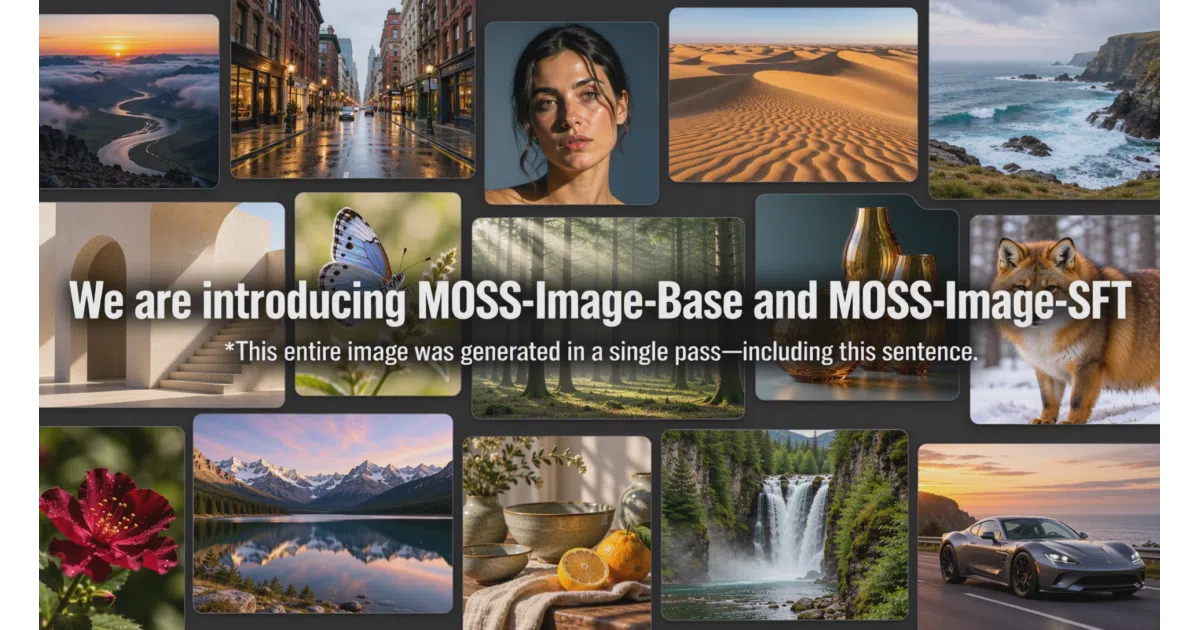
On October 16, 2026, the OpenMOSS team published something the text-to-image scene doesn’t see often: a compact, open-weights image generator whose headline feature isn’t aesthetic grandeur but obedience. MOSS-Image, released as a base model and a supervised-fine-tuned variant, is a 5B-parameter diffusion model that accepts prompts up to 4K tokens, renders legible text inside images, and — most unusually — takes structured layout instructions telling it exactly where every headline, sticky note, and mountain illustration should sit on the canvas.
The timing matters. The open image-model conversation of the past two years has been dominated by a size arms race. Qwen-Image, released in August 2025, carries roughly 20.4B parameters in its generator alone plus an 8.3B text encoder — about 28.85B total, per the parameter tables compiled in a recent survey of diffusion architecture evolution. FLUX.1-Dev sits near 17B. Against that backdrop, a 5B model from the team behind the MOSS open-LLM lineage reads less like a lag and more like a thesis: that the next gains in image generation come from control and instruction-following, not from stacking more transformer blocks.
Prompts as typesetting briefs
The core idea is deceptively boring, which is usually where the value hides. Instead of a free-form caption, MOSS-Image accepts a JSON document describing a scene the way an art director would: a summary caption for the overall composition, then a list of items, each with a label (text or object), its own caption, the literal words to render if it’s text, and a bounding box.
The bounding-box scheme is the part that reveals the engineering care. Coordinates are specified in a yxyx format — vertical extents first, then horizontal — and expressed in what the repository calls absolute centralized space: pixel offsets relative to the canvas center, so a 1024×1024 canvas runs from −512 to +512 on each axis, with y increasing downward. It’s the kind of convention that sounds pedantic until you’ve watched two layout systems disagree about which corner is the origin. Because layouts are just structured data, editing an image becomes editing a document: move a headline, resize a panel, swap a caption, regenerate. The repository explicitly frames this as enabling controlled editing and user-friendly layout tools, not just one-shot generation.
This is a meaningful departure from how most people interact with image models. The standard workflow — type a vibe, roll the dice, reroll — has survived because models couldn’t reliably honor spatial instructions anyway. As the Wikipedia overview of text-to-image models traces, the field’s whole history has been a crawl from “visually plausible birds” toward faithful instruction-following. Layout control is the logical end of that crawl: the prompt stops being a wish and becomes a spec.
Text rendering, the unglamorous differentiator
The other headline capability is rendering clear, accurate text inside generated images — a Chinese shopping list on a refrigerator door, a poster title, a whiteboard of notes. This has historically been the embarrassment of diffusion models. Garbled pseudo-lettering was so endemic it became a meme, and it’s also the capability that separates toy generators from production tools: posters, slides, mockups, and product pages are mostly typography with pictures attached.
The repository’s own comparison of its base and SFT models is telling. The fine-tuned variant, trained on curated data, produces “clearer text grouping and a more organized whiteboard layout” — which is a polite way of saying the base model still sometimes scatters its letters. The SFT release exists largely to close that gap, and the team is upfront that the two models differ in exactly this dimension.
The 4K-token prompt support compounds the point. Long prompts are where instruction-following models live or die; a model that can hold a multi-paragraph brief in working memory and still place the third sentence’s contents in the lower-left quadrant is doing something qualitatively different from one that pattern-matches the first noun it sees.
Small on purpose
Architecturally, MOSS-Image is a conventional modern citizen. A comment in the repository notes a 42-layer diffusion transformer backbone, a Qwen3.5-9B text encoder, and a FLUX.2 VAE — the standard three-piece latent-diffusion arrangement that the architectural surveys describe: a VAE compressing pixels to latents, a pretrained language model converting prompts to embeddings, and a DiT denoiser in the middle. The team credits the Diffusers, Qwen, and FLUX projects directly, and the pipeline ships as Diffusers custom code under Apache 2.0.
The interesting choices are in the sampling defaults. Flow-matching Euler at 50 steps with CFG of 3 is mainstream; the quirk is negative-branch layer skipping at layer 22 — a technique that drops transformer layers on the unconditional pass to save compute, a trick popularized in the post-FLUX efficiency wave. The memory story is similarly pragmatic: the model offers GPU-resident, component-swapping, and sequential modes, trading speed for VRAM so the same weights can serve a workstation or a thinner card.
The 5B scale also aligns with a visible trend. The SeFi-Image paper from mid-2026 makes the case explicitly: its own 5B flagship was trained with roughly 125K A800 GPU-hours — an estimated 10–20% of the compute behind Z-Image, which itself was billed as resource-friendly at 314K H800 hours. The field is discovering that a well-trained 5B model with good data and good conditioning can hang with the giants on instruction-following benchmarks. MOSS-Image arrives squarely in that current, though unlike SeFi-Image, the repository discloses no training-compute figures, no benchmark tables, and no dataset details — the technical report is a PDF badge, and the README is the public face.
The line about the GPUs
One bullet in the release notes deserves more attention than its four words suggest: “heterogeneous GPU training — trained on alternative GPU platforms.” That’s all the repository says. No vendor, no cluster size, no hours.
Read plainly, it’s a claim that the model was not trained exclusively on NVIDIA hardware — a statement that carries weight given the export-control environment Chinese AI labs operate under, and given that OpenMOSS is a Shanghai-backed effort with a history of releasing open models under constrained compute. But the README is terse enough that the specifics remain genuinely unclear: whether “alternative platforms” means domestic accelerators end-to-end, a mixed cluster, or something looser. It’s the most geopolitically loaded sentence in the document and also the least documented. Treat it as a signal, not a specification.
Built for the agentic era
The strangest and most forward-looking artifact in the repository is the prompt enhancer skill. It’s a packaged agent skill — designed for GPT-6-family agents with local file and Python tools — that converts an image idea into either a detailed caption or a full spatial layout prompt, translating pixel-coordinate drafts into the compact JSON the model consumes. Notably, it does not call an image-generation service itself; it’s a compiler from intent to spec.
That design choice slots MOSS-Image into a shift that’s bigger than image generation. Google Cloud’s 2026 catalog of production gen-AI use cases identifies “gen media as a low-marginal-cost factory” as a defining enterprise pattern — brands spinning hundreds of personalized creative variations in hours — and describes an industry-wide move from assistants to agentic teams. An image model with a machine-writable input format is an image model an agent can actually use. Free-form prompts are for humans; JSON layouts are for pipelines.
The ComfyUI plugin points the same direction from the human side. A native node set, installable through ComfyUI Manager, with official-repository integration described as in progress, puts MOSS-Image where the working creative community actually lives. The market context is not subtle: industry statistics put Stable Diffusion’s open ecosystem at roughly 80% of all AI-generated imagery worldwide — some 12.6 billion cumulative images — with over 150 million people using AI image generators monthly and 86% of surveyed creators incorporating generative AI into their workflows. Open-weights models aren’t a niche; they’re the volume layer of the entire category.
What the README doesn’t tell you
The honest caveats are mostly omissions. There are no public benchmark numbers in the repository — no GenEval, no DPG, nothing comparable to the tables SeFi-Image publishes — so the model’s competitive standing rests on showcase images and the team’s word. The Apache 2.0 grant covers the pipeline code; the license terms governing the model weights themselves aren’t spelled out in the README, which matters for commercial adoption and deserves checking before anyone builds on it. The base-versus-SFT comparison suggests text grouping is still a work in progress on the base model. And the “heterogeneous GPU training” claim, whatever its substance, is unverifiable from the provided materials.
There’s also the fair question of how much here is novel versus well-assembled. The architecture is standard parts — DiT, Qwen encoder, FLUX VAE — and the team says as much in its acknowledgements. The genuine contributions are the layout conditioning, the text-rendering focus, and the packaging: an agent skill, a ComfyUI plugin, dual base/SFT releases, and bilingual everything. That’s glue, but it’s glue in the best sense — the work that makes a model usable rather than merely publishable.
Outlook
MOSS-Image’s bet is that image generation is graduating from a slot machine to a layout engine. If prompts become specs, the winners won’t be the biggest models but the most literal ones — the ones that put the headline where you said, spell the headline correctly, and do it in 5B parameters on hardware you already own. The open questions are whether the unbenchmarked quality holds up under third-party scrutiny, what the weights’ actual license says, and whether layout control stays a differentiator or becomes table stakes the way long prompts and text rendering are rapidly becoming.
For now, the release stands as a compact, opinionated entry in a field that needed one: an image model that reads the brief.
Sources
- From U-Nets to DiTs: The Architectural Evolution of Text ...
- AI Image Generation Statistics 2026: Market Size, Adoption
- Moss Images – Browse 3635862 Stock Photos, Vectors, ...
- Text-to-image model
- Generative AI & Content Creation: Use Cases and Adoption
- Moss Images - Free Download on Magnific (formerly Freepik)
- A Text-to-Image Foundation Model with Semantic-First ...
- Perceptions and Realities of Text-to-Image Generation
- 500+ Moss Pictures | Download Free Images on Unsplash
- Diffusion Transformers Explained: The Beginner's Guide
- Real-world gen AI use cases from the world's leading ...
- The secret world of moss Beautifully capture by @mossranger