OpenBMB/MiniCPM
A 1B model that thinks twice—when you ask it to
To deliver a family of tiny language models that squeeze as much capability as possible into edge-friendly checkpoints, with the latest 1B release claiming open-source SOTA in its class and a switchable reasoning mode.
Velocity · 7d
+12
★ / day
Trend
↘cooling
star history
What it does
MiniCPM5-1B is a dense 1B-parameter Transformer released by OpenBMB for on-device and resource-constrained use. The repository hosts model weights, training recipes, and single-page cookbooks for deploying and fine-tuning across major inference backends. It also includes “Agent Skills”—reproducible workflow snippets—and a desktop pet demo that runs the model entirely locally.
The interesting bit
The same checkpoint serves both chat and reasoning modes via a built-in chat template toggled with enable_thinking, so you do not need separate models for quick answers and deliberate chain-of-thought. The project also publishes sparse-attention variants like MiniCPM-SALA for million-token contexts, though the current spotlight is on the 1B dense model.
Key highlights
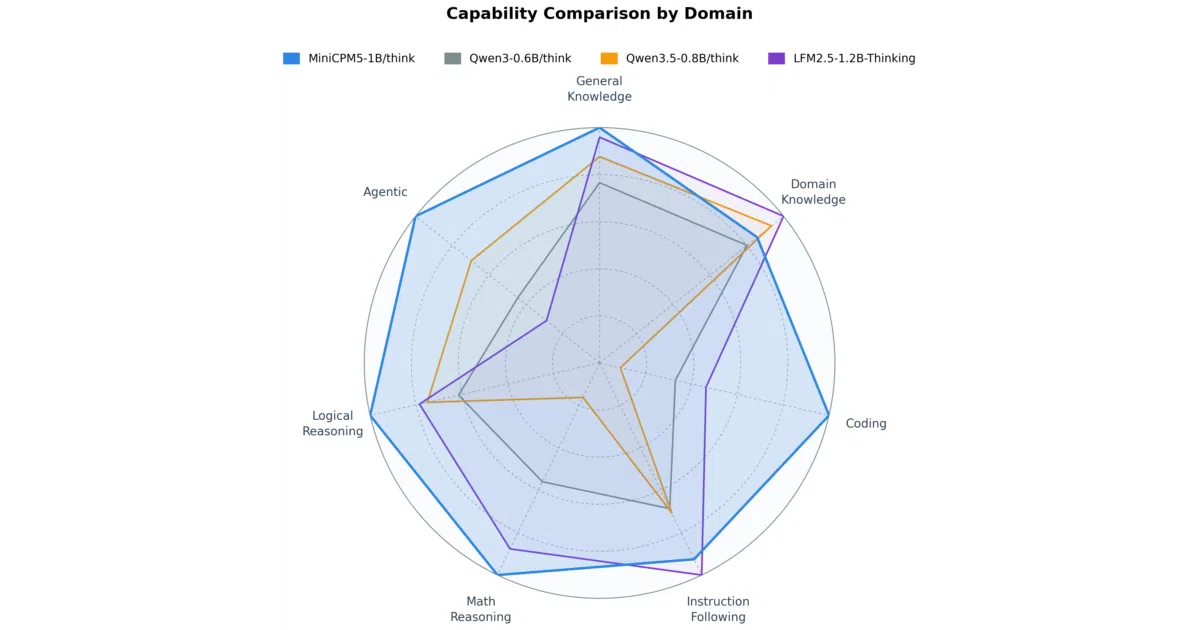
- Claims 1B-class open-source SOTA with an average benchmark score of 42.57, versus a prior high of 35.61 in the same size class, with its best results in agentic tool use, code, and competition math.
- Ships with deployment and fine-tuning cookbooks paired with Agent Skills in
./skills/to help developers reproduce workflows. - Supports both “Think” and “No Think” chat modes from a single checkpoint.
- Available in multiple formats for local deployment: BF16, GGUF, and MLX.
- Includes a desktop pet demo driven entirely by the local 1B model.
Caveats
- Benchmark scores are project-reported averages across reasoning, knowledge, code, and other domains; independent verification is not discussed in the visible README.
- The repository is organized around published weights, deployment cookbooks, and agent skills rather than a from-scratch training framework.
Verdict
Developers building local assistants, edge agents, or low-latency tools should look here—especially if you want a single small checkpoint that can toggle between fast chat and slower reasoning. If you need large-scale cloud inference or training foundation models from scratch, this is not your stop.
Frequently asked
- What is OpenBMB/MiniCPM?
- To deliver a family of tiny language models that squeeze as much capability as possible into edge-friendly checkpoints, with the latest 1B release claiming open-source SOTA in its class and a switchable reasoning mode.
- Is MiniCPM open source?
- Yes — OpenBMB/MiniCPM is open source, released under the Apache-2.0 license.
- What language is MiniCPM written in?
- OpenBMB/MiniCPM is primarily written in Jupyter Notebook.
- How popular is MiniCPM?
- OpenBMB/MiniCPM has 11.7k stars on GitHub and is currently cooling off.
- Where can I find MiniCPM?
- OpenBMB/MiniCPM is on GitHub at https://github.com/OpenBMB/MiniCPM.