Onelevenvy/flock
A desktop multi-agent workbench built on a homegrown LangGraph port
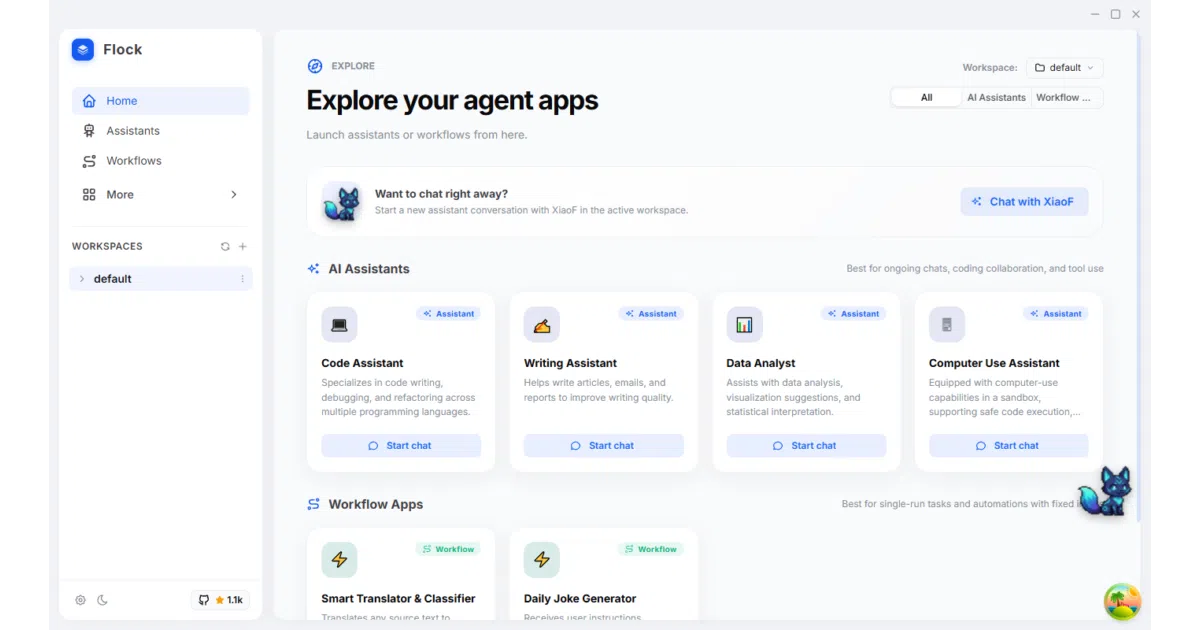
Flock rewrote its own Python backend in Rust and Tauri to turn a web-based agent stack into a native desktop control panel for sandboxed tools and visual workflows.
Not currently ranked — collecting fresh signals.
star history
What it does
Flock is a desktop control panel for wrangling AI agents. It connects to OpenAI-compatible APIs, Anthropic, AWS Bedrock, and Google Vertex, then equips them with file tools, MCP integrations, and cloud sandbox containers for isolated execution. A React frontend sits on a Rust backend split into crates like flock-agent and flock-tools, with SQLite keeping conversations persistent.
The interesting bit
The author got tired of shipping a Python backend, so they wrote langgraph-rust, a from-scratch personal port of LangGraph, to drive state management and graph execution inside a Tauri shell. It is explicitly not the official Rust implementation, but it powers the agent engine, checkpointing, and workflow orchestration all the same.
Key highlights
- Cloud sandbox execution via Daytona with VNC desktop streaming, Playwright browser automation, and xdotool GUI control.
- ReactFlow-based workflow builder with ten node types, conditional routing, and human-in-the-loop streaming.
- Skills system using YAML-frontmatter templates with hot-reload support.
- Persistent cross-session memory (user, feedback, project, reference) alongside SQLite-backed chat history.
- Scheduled task execution with cron-like automation.
Caveats
- The roadmap leaves the visual workflow builder unchecked despite listing it as a current feature, so its completeness is unclear.
- True multi-agent collaboration and third-party agent extensions are still on the todo list.
langgraph-rustis a solo-maintained, unofficial port, meaning the project shoulders its own framework upkeep.
Verdict Worth a look if you want a native desktop hub for visual agent orchestration and sandboxed automation. Pass if you need a mature, community-vetted orchestration core or a headless server stack.
Frequently asked
- What is Onelevenvy/flock?
- Flock rewrote its own Python backend in Rust and Tauri to turn a web-based agent stack into a native desktop control panel for sandboxed tools and visual workflows.
- Is flock open source?
- Yes — Onelevenvy/flock is open source, released under the Apache-2.0 license.
- What language is flock written in?
- Onelevenvy/flock is primarily written in Rust.
- How popular is flock?
- Onelevenvy/flock has 1.1k stars on GitHub.
- Where can I find flock?
- Onelevenvy/flock is on GitHub at https://github.com/Onelevenvy/flock.