NucleoidAI/Nucleoid
A logic runtime that treats code as a living knowledge graph
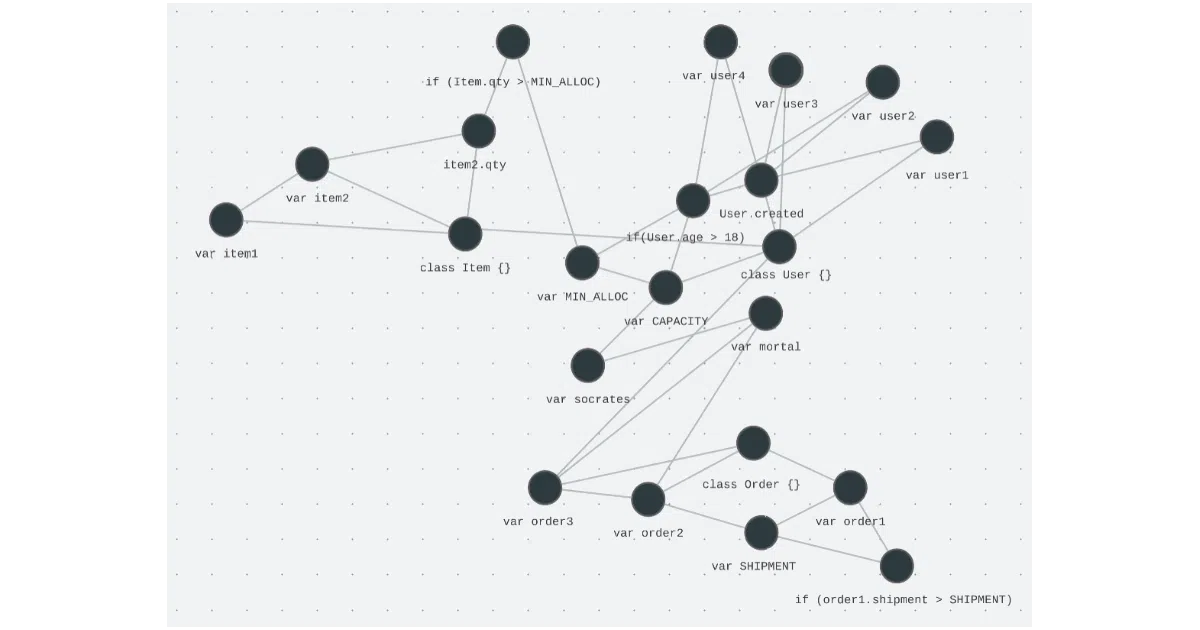
Nucleoid blurs the line between data and logic by tracking every statement in a dynamic graph that reevaluates itself as new facts arrive.
Not currently ranked — collecting fresh signals.
star history
What it does
Nucleoid is a declarative runtime for TypeScript that builds a knowledge graph from your code. Every statement—whether it defines a class, sets a property, or asserts a rule—becomes a node in a “Logic Graph” that the runtime continuously reevaluates as new information arrives. It runs on Bun and exposes both an IDE and a chat interface for interacting with the system.
The interesting bit
The runtime doesn’t separate data from logic. Declare $Human.mortal = true and later instantiate new Human('Socrates'), and the mortality property propagates automatically through the graph. The system cites Kahneman’s “thinking, fast and slow” as inspiration: it aims to combine quick, context-driven responses with deliberate logical deduction from the same underlying representation.
Key highlights
- IPL-inspired declarative syntax; runtime tracks relationships between logic and data statements
- Built-in knowledge graph updates and reevaluates conclusions as new statements arrive (“plasticity”)
- Runs on Bun; distributed via npm as
@nucleoidai/ideand@nucleoidai/expert - Includes web-based chat interface at nucleoid.ai/chat
- Apache 2.0 licensed
Caveats
- The README is heavy on vision and light on API specifics; exact performance characteristics and graph scaling limits aren’t quantified
- “Neuro-Symbolic AI” framing promises neural network integration, but the actual neural component appears to be aspirational—the current implementation is symbolic AI with a graph store
- The TypeScript examples mix
'use declarative'and'use imperative'pragmas without clarifying when each mode is required or what the runtime does differently under the hood
Verdict
Worth a look if you’re building expert systems, rule engines, or RAG pipelines where explainability matters and you want logic to propagate like data in a reactive store. Skip it if you need battle-tested graph databases or actual neural network integration today—the neural side of “neuro-symbolic” is more roadmap than reality.
Frequently asked
- What is NucleoidAI/Nucleoid?
- Nucleoid blurs the line between data and logic by tracking every statement in a dynamic graph that reevaluates itself as new facts arrive.
- Is Nucleoid open source?
- Yes — NucleoidAI/Nucleoid is open source, released under the Apache-2.0 license.
- What language is Nucleoid written in?
- NucleoidAI/Nucleoid is primarily written in Rust.
- How popular is Nucleoid?
- NucleoidAI/Nucleoid has 765 stars on GitHub.
- Where can I find Nucleoid?
- NucleoidAI/Nucleoid is on GitHub at https://github.com/NucleoidAI/Nucleoid.