NirDiamant/agents-towards-production
The engineering gap between agent demos and production deployments
Twenty-eight code-first notebooks that teach the unglamorous work of shipping GenAI agents to production.
Velocity · 7d
+6.1
★ / day
Trend
↘cooling
star history
What it does
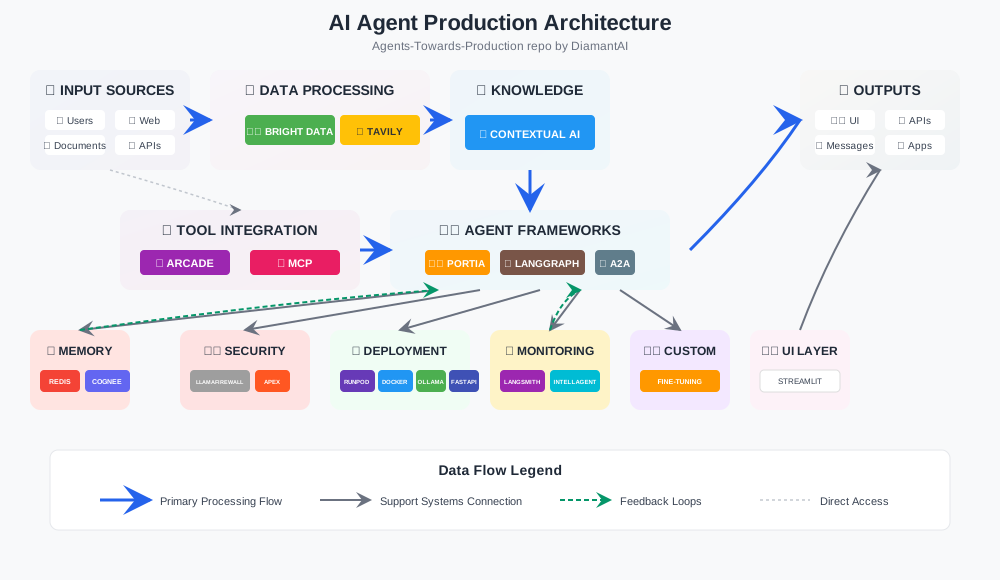
This repository is a curated curriculum of Jupyter notebooks—28 at last count—each tackling a specific production concern for GenAI agents. Topics range from stateful workflows and vector memory to Docker packaging, FastAPI serving, security guardrails, GPU scaling, and observability. It is explicitly educational: sponsored contributors like LangChain, Redis, and Tavily provide step-by-step tutorials showing how to integrate their tools into a production agent stack.
The interesting bit
Most agent repos hand you a framework; this one hands you homework. The value is in the breadth of the syllabus rather than a single abstraction, treating production deployment as a cross-cutting concern that spans orchestration, memory, retrieval, and infrastructure.
Key highlights
- 28 tutorials covering the full lifecycle from prototype to enterprise deployment
- Heavy focus on operational concerns: observability, evaluation, guardrails, and scaling
- Sponsor-contributed integrations (LangGraph, Redis, Contextual AI, Tavily, Arcade, etc.)
- Includes adjacent skills like browser automation, fine-tuning, and UI development
- Code-first, notebook-based format aimed at learning by doing
Caveats
- This is a tutorial collection, not a framework or unified library; expect to stitch patterns together yourself
- The README is upfront about its sponsorship model and promotes the author’s commercial books and hiring board
Verdict
Grab this if you are a developer or AI engineer who can build an agent prototype but keeps getting stuck on the “now what” of deployment, monitoring, and scaling. Skip it if you are hunting for a unified agent framework or a plug-and-play library.
Frequently asked
- What is NirDiamant/agents-towards-production?
- Twenty-eight code-first notebooks that teach the unglamorous work of shipping GenAI agents to production.
- Is agents-towards-production open source?
- Yes — NirDiamant/agents-towards-production is an open-source project tracked on heatdrop.
- What language is agents-towards-production written in?
- NirDiamant/agents-towards-production is primarily written in Jupyter Notebook.
- How popular is agents-towards-production?
- NirDiamant/agents-towards-production has 21.8k stars on GitHub and is currently cooling off.
- Where can I find agents-towards-production?
- NirDiamant/agents-towards-production is on GitHub at https://github.com/NirDiamant/agents-towards-production.