NervanaSystems/ngraph
Intel's nGraph is now a museum piece inside OpenVINO
A C++ deep-learning compiler that once bridged TensorFlow, PyTorch, and ONNX to Intel hardware has been absorbed into OpenVINO.
Not currently ranked — collecting fresh signals.
star history
What it does
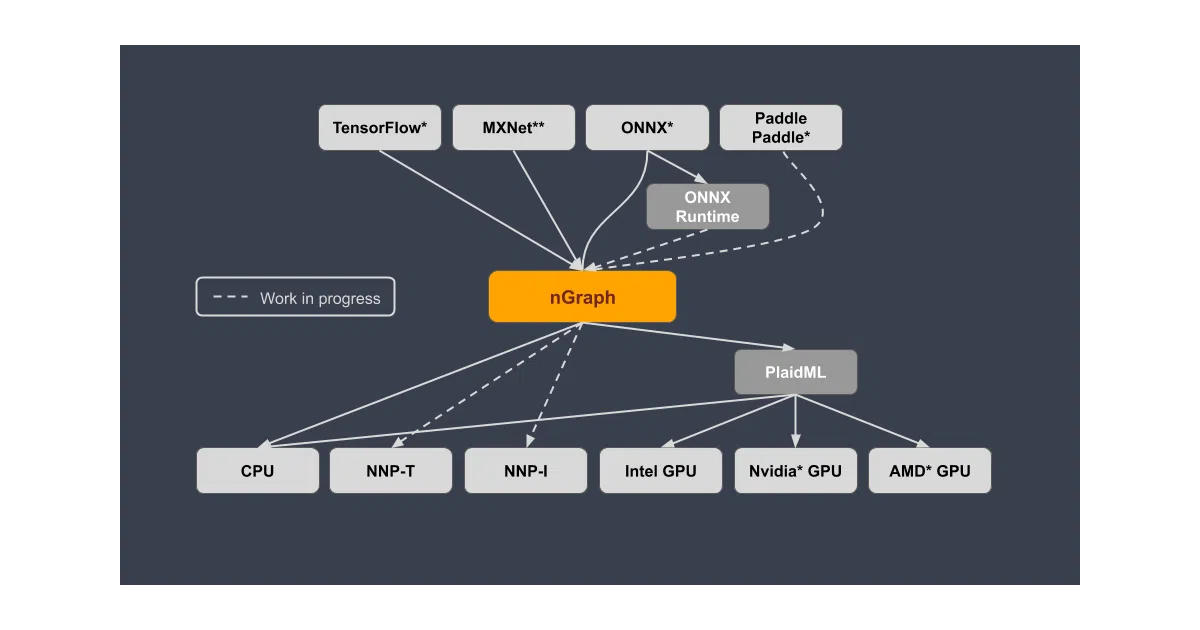
nGraph was Intel’s attempt to build a universal middle layer for deep learning: write your model in TensorFlow, ONNX, or another framework, and nGraph would compile it down to run on CPUs, GPUs, or Intel’s now-canceled Nervana NNP accelerators. It shipped as a Python wheel and promised performance boosts through subgraph pattern matching.
The interesting bit
The README now functions as a forwarding address. Every page leads to the same punchline: “nGraph has moved to OpenVINO.” The project still advertises a 45× performance claim and support for hardware (NNP-T, NNP-I) that Intel killed years ago, which gives the repo a distinctly ghost-ship quality.
Key highlights
- Supported TensorFlow, ONNX, MXNet, PyTorch, and PaddlePaddle as frontends
- Integrated with PlaidML for GPU acceleration across Intel, NVIDIA, and AMD cards
- Provided validated workload lists (20 for TensorFlow, 17 for ONNX at the time)
- Apache 2.0 licensed; build system used standard
make checkfor CI - Now lives entirely inside OpenVINO; this repo is archived in place
Caveats
- The “up to 45X” performance claim links to a 2019 Intel blog post; no reproducible benchmarks are in the repo itself
- macOS support stopped at Mojave (10.14.3), and pip requirements pin to versions from 2019
- NNP-T and NNP-I hardware references are historical artifacts; Intel discontinued the Nervana line
Verdict
Worth a look if you’re tracing the genealogy of OpenVINO or studying how ML compilers evolved. Active developers should head straight to the OpenVINO repository instead; this one is a well-preserved signpost, not a destination.
Frequently asked
- What is NervanaSystems/ngraph?
- A C++ deep-learning compiler that once bridged TensorFlow, PyTorch, and ONNX to Intel hardware has been absorbed into OpenVINO.
- Is ngraph open source?
- Yes — NervanaSystems/ngraph is open source, released under the Apache-2.0 license.
- What language is ngraph written in?
- NervanaSystems/ngraph is primarily written in C++.
- How popular is ngraph?
- NervanaSystems/ngraph has 1.3k stars on GitHub.
- Where can I find ngraph?
- NervanaSystems/ngraph is on GitHub at https://github.com/NervanaSystems/ngraph.