NVlabs/DoRA
Fine-tuning LLMs by splitting weights into magnitude and direction
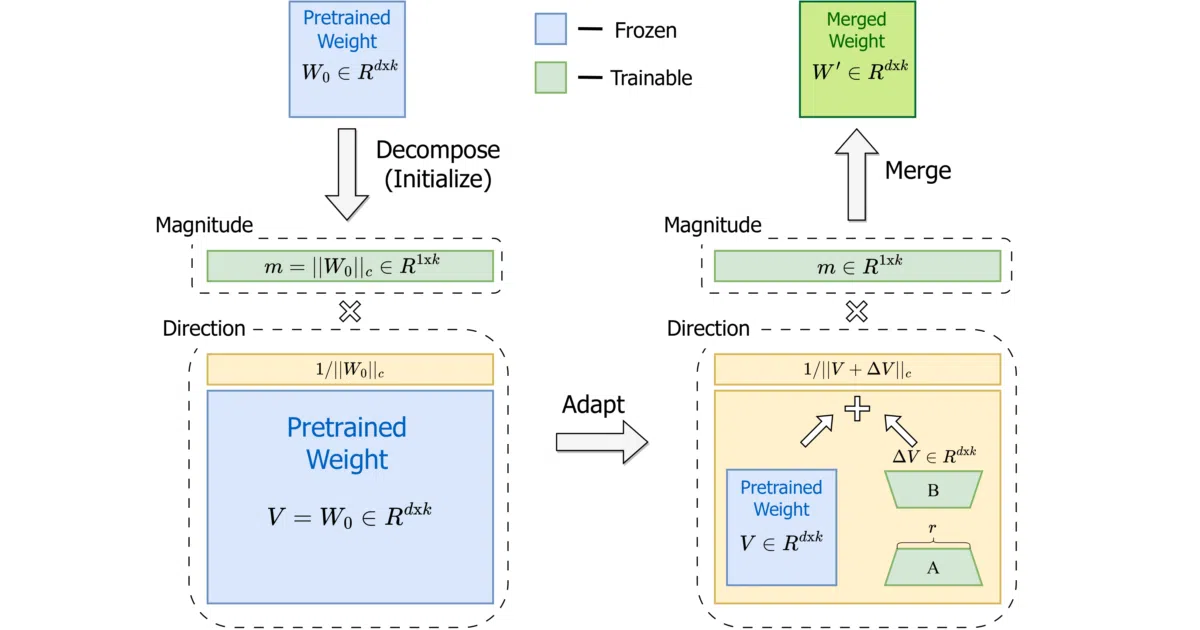
DoRA decomposes pre-trained weights into magnitude and direction to make low-rank fine-tuning more capable and stable without extra inference cost.
Not currently ranked — collecting fresh signals.
star history
What it does DoRA is a parameter-efficient fine-tuning method that splits each pre-trained weight matrix into two components: magnitude (scale) and direction (orientation). It freezes the magnitude and applies low-rank updates only to the direction, aiming to increase learning capacity and training stability while keeping inference identical to standard LoRA. The bundled benchmarks show higher accuracy than LoRA across LLaMA, LLaVA, and VL-BART on commonsense reasoning and vision-language tasks.
The interesting bit The insight is geometric: by treating weight updates as directional nudges rather than full matrix perturbations, DoRA extracts more expressive power from fewer trainable parameters. The authors note you can often start with half the rank of a comparable LoRA config and still match or exceed its accuracy.
Key highlights
- Benchmark tables in the repo show gains on LLaMA-7B/13B, LLaMA2-7B, LLaMA3-8B, LLaVA-1.5-7B, and VL-BART for commonsense reasoning, visual instruction tuning, and image/video-text understanding.
- Zero inference overhead; the decomposition is a training-time technique, so deployed weights remain standard low-rank adapters.
- Already merged into HuggingFace PEFT (
use_dora=TrueinLoraConfig) with support for quantized linear layers via bitsandbytes. - Includes reproduction scripts for four paper tasks, plus QDoRA/FSDP recipes for consumer-level GPUs.
- Experimental support in HuggingFace Diffusers for diffusion fine-tuning, though the authors warn it converges slower and needs different hyperparameters than LoRA.
Caveats
- Released under the NVIDIA Source Code License-NC, which restricts commercial use.
- The repository is primarily a set of four task-specific training scripts layered atop existing codebases (LLM-Adapter, LLaVA, etc.); it is research reproduction glue rather than a standalone library.
- Diffusion fine-tuning is explicitly labeled experimental and appears sensitive to rank and learning-rate choices.
Verdict A solid upgrade path for researchers and practitioners already using LoRA on LLMs or vision-language models who want better accuracy without touching inference code. Avoid if you need a permissive commercial license or a one-size-fits-all training framework.
Frequently asked
- What is NVlabs/DoRA?
- DoRA decomposes pre-trained weights into magnitude and direction to make low-rank fine-tuning more capable and stable without extra inference cost.
- Is DoRA open source?
- Yes — NVlabs/DoRA is an open-source project tracked on heatdrop.
- What language is DoRA written in?
- NVlabs/DoRA is primarily written in Python.
- How popular is DoRA?
- NVlabs/DoRA has 1k stars on GitHub.
- Where can I find DoRA?
- NVlabs/DoRA is on GitHub at https://github.com/NVlabs/DoRA.