MadryLab/photoguard
Inoculating images so diffusion models mangle edits
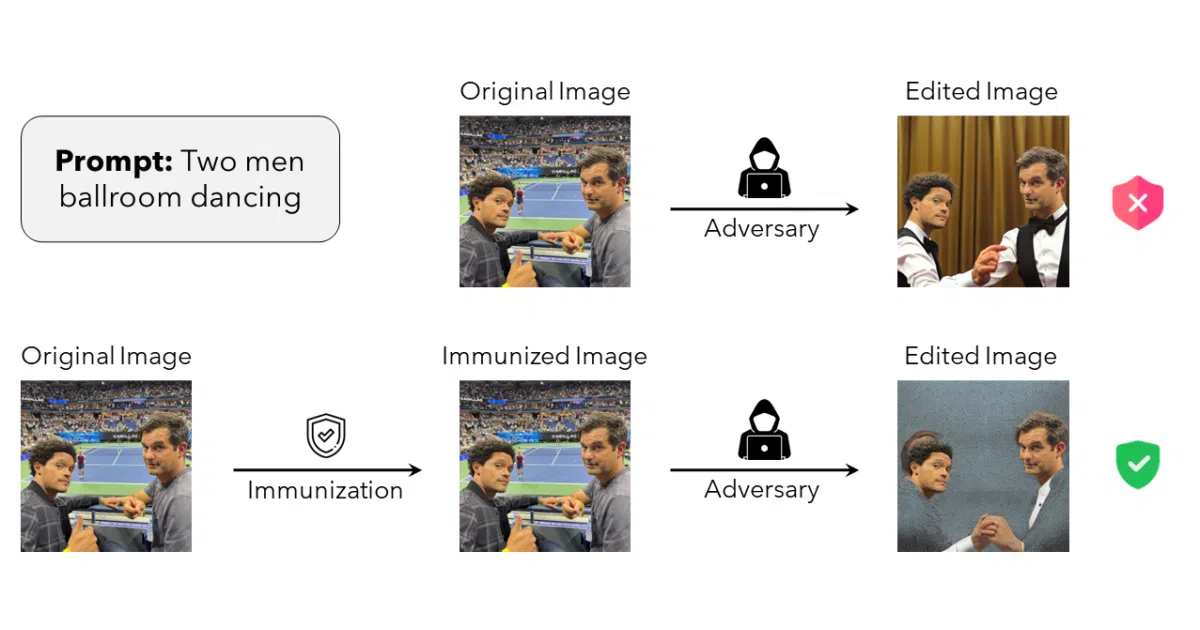
PhotoGuard adds adversarial noise to images so that Stable Diffusion-based editing tools produce unrealistic or unrelated output, raising the cost of malicious manipulation.
Not currently ranked — collecting fresh signals.
star history
What it does
This research tool protects photos from AI-powered editing by adding adversarial perturbations that corrupt Stable Diffusion outputs. When a diffusion model tries to edit, inpaint, or restyle a treated image, it generates obviously fake or irrelevant results instead of a convincing forgery. The repository provides Jupyter notebooks demonstrating both simple encoder-level attacks and more complex end-to-end diffusion attacks.
The interesting bit
The clever twist is using offense as defense: instead of detecting manipulations after the fact, the project proactively breaks the generative model itself by attacking the image embedding space or the full diffusion process. It is a bit like giving a photo a mild poison pill that only harms the AI trying to digest it.
Key highlights
- Implements two adversarial immunization strategies: a lightweight encoder attack and a stronger end-to-end diffusion attack
- Targets both image-to-image translation and inpainting pipelines
- Ships with an interactive Gradio demo and Colab-ready notebooks
- Built on top of the Hugging Face
diffusersStable Diffusion stack - Accompanies the research paper Raising the Cost of Malicious AI-Powered Image Editing
Verdict
Worth exploring if you study adversarial defenses, deepfake mitigation, or content provenance. If you need a drop-in production API to guard user uploads, this is research code with notebooks, not a finished service.
Frequently asked
- What is MadryLab/photoguard?
- PhotoGuard adds adversarial noise to images so that Stable Diffusion-based editing tools produce unrealistic or unrelated output, raising the cost of malicious manipulation.
- Is photoguard open source?
- Yes — MadryLab/photoguard is open source, released under the MIT license.
- What language is photoguard written in?
- MadryLab/photoguard is primarily written in Jupyter Notebook.
- How popular is photoguard?
- MadryLab/photoguard has 703 stars on GitHub.
- Where can I find photoguard?
- MadryLab/photoguard is on GitHub at https://github.com/MadryLab/photoguard.