MIV-XJTU/JanusVLN
When your robot needs a left and right brain to navigate
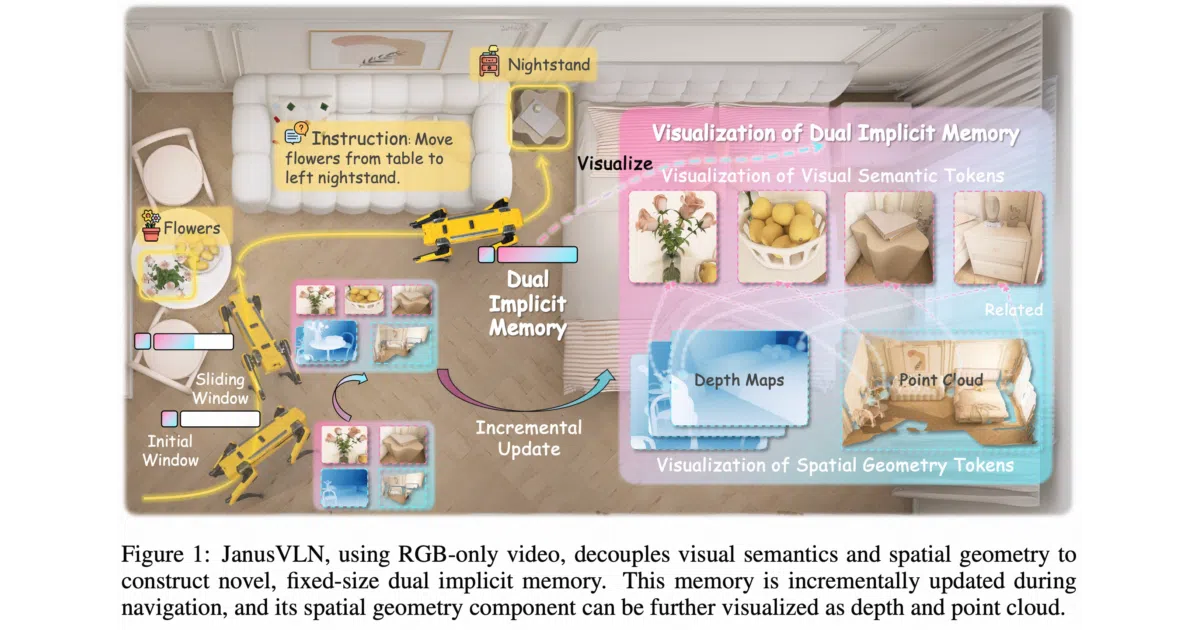
Most VLN models conflate meaning and location; JanusVLN splits them into two compact neural memories to keep spatial reasoning from drowning in semantics.
Not currently ranked — collecting fresh signals.
star history
What it does
JanusVLN is a research framework for Vision-Language Navigation—essentially, getting a robot to follow natural-language directions through 3D environments like houses. It builds on Qwen2.5-VL and VGGT to fuse visual and linguistic inputs, but its defining feature is a pair of fixed-size, complementary neural memory banks that separately encode semantic understanding and spatial cognition. The project provides training and evaluation pipelines for standard VLN-CE benchmarks (R2R, RxR) and the larger ScaleVLN dataset, along with pre-collected trajectory data and DAgger bootstrapping.
The interesting bit
The authors explicitly borrow the “left brain / right brain” analogy from human navigation, giving the model a literal split personality: one memory for what things mean, another for where things are. By decoupling these into compact, fixed-size implicit representations, they aim to push the field past 2D semantics-heavy maps toward genuine 3D spatial-semantic synergy.
Key highlights
- Dual implicit memory architecture explicitly splits semantic and spatial reasoning into two compact modules.
- Built atop existing bricks—Qwen2.5-VL, VGGT, StreamVLN, and Habitat-sim—rather than a from-scratch pipeline.
- Two published checkpoints:
JanusVLN_Base(standard training) andJanusVLN_Extra(includes DAgger and ScaleVLN data). - Transparent reproducibility: the authors publish their own Conda and Docker test results, showing minor metric drift against the paper.
- Accepted at ICLR 2026; model weights and trajectory data are hosted on ModelScope.
Caveats
- The authors warn that incorrect weights were briefly uploaded for
JanusVLN_Extra; early downloads may need replacing. - The citation section accidentally references “FSDrive” instead of JanusVLN—a copy-paste fossil still lurking in the README.
- This is a full-bore research artifact, not a lightweight library: the README details extensive dependencies on Habitat-sim, MP3D/HM3D scenes, and pre-collected trajectory data.
Verdict
Worth cloning if you are an embodied-AI researcher looking for a strong VLN baseline with an explicit memory decoupling to experiment on. Everyone else—especially product developers hunting for a plug-and-play navigation module—should keep scrolling.
Frequently asked
- What is MIV-XJTU/JanusVLN?
- Most VLN models conflate meaning and location; JanusVLN splits them into two compact neural memories to keep spatial reasoning from drowning in semantics.
- Is JanusVLN open source?
- Yes — MIV-XJTU/JanusVLN is an open-source project tracked on heatdrop.
- What language is JanusVLN written in?
- MIV-XJTU/JanusVLN is primarily written in Python.
- How popular is JanusVLN?
- MIV-XJTU/JanusVLN has 589 stars on GitHub.
- Where can I find JanusVLN?
- MIV-XJTU/JanusVLN is on GitHub at https://github.com/MIV-XJTU/JanusVLN.