Lumen-Labs/brainapi2
AI memory that shows its work — answers traced, not guessed
BrainAPI points a swarm of specialist agents at your text and gets back an event-centric knowledge graph, so answers arrive with a walkable path instead of a similarity guess.
Not currently ranked — collecting fresh signals.
star history
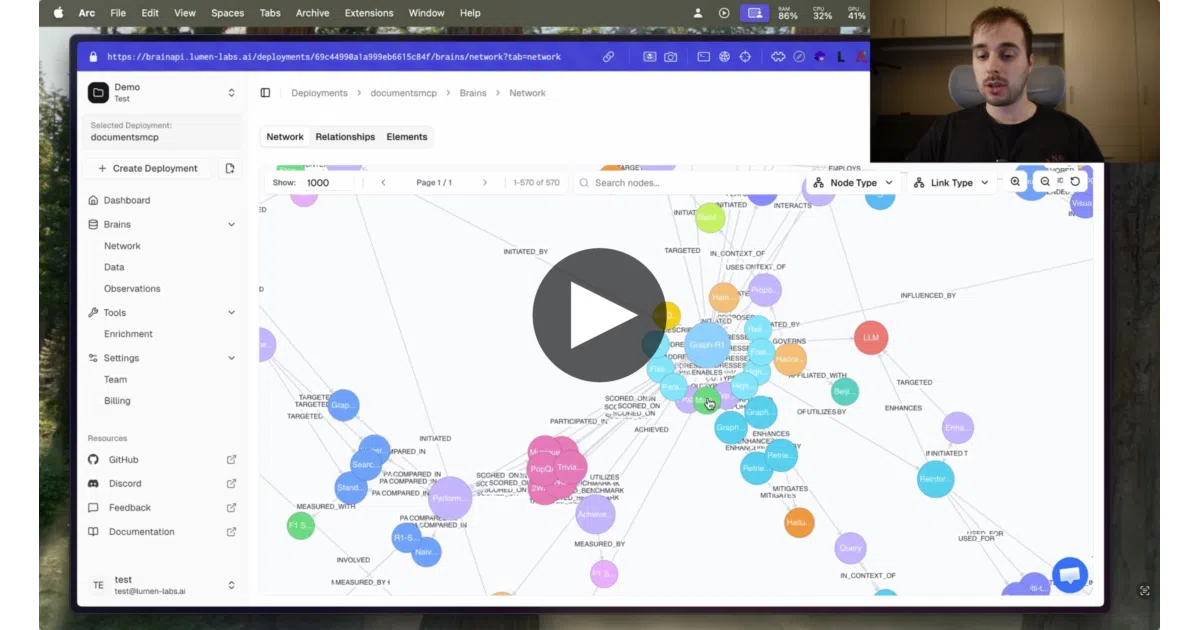
What it does You feed it documents, notes, messages, or events. A pipeline of specialized agents reads everything, extracts entities, writes observations, and wires the facts into a queryable knowledge graph. You then ask questions in plain language and get answers grounded in the graph’s actual connections — the response includes the triples used to derive it. It’s pitched as a memory layer for AI agents and apps, with an MCP server for integration and a web console for browsing the graph, chunks, vectors, and tasks.
The interesting bit The graph is event-centric: instead of flat “A relates to B” edges, every action becomes an Event Hub linking actor, target, and context — which is what makes multi-hop questions answerable and the derivation traceable. Better still, the pipeline audits itself: a Janitor agent checks the Architect’s relationships for errors and duplicates, sends back corrections, and loops until the output is clean. And the graph is append-only — facts are never overwritten or merged away, so you can reconstruct how they evolved over time.
Key highlights
- Four-agent swarm: Scout extracts entities, the Observations agent writes notes using prior context, Architect builds relationships, Janitor validates and dedupes in a correction loop.
- Triangle of Attribution: the actor
:MADEthe event, which:TARGETEDa target and:OCCURRED_WITHINa context — actions are first-class nodes, not edges. - Append-only by design: nothing is deleted, so history and provenance survive ingestion after ingestion.
- Two pipeline modes:
accurateruns the full swarm;lightweightkeeps only key entities and skips heavy validation for speed and cost. - Self-hostable from a light Postgres profile up to a heavy Neo4j/Milvus/Mongo stack, with a hosted cloud option; hybrid BM25+dense search (RRF fusion, sub-200 ms p50 excluding embedding) is available but opt-in.
Caveats
- Licensed under BUSL-1.1, which is not a standard open-source license — read the terms before building on it.
- The version badge reads 2.19.0-dev, and the README’s console screenshot is literally captioned “screenshot coming soon” — polish is still catching up to ambition.
- Search is off by default and BM25 requires PostgreSQL; without opting in,
/retrieve/contextfalls back to dense-plus-ILIKE retrieval.
Verdict If you’re building agents that need explainable, auditable memory, the traceable-path retrieval is a genuine differentiator from vector-only stores. If you want a permissive license or a cheap drop-in chunker, this is not that.
Frequently asked
- What is Lumen-Labs/brainapi2?
- BrainAPI points a swarm of specialist agents at your text and gets back an event-centric knowledge graph, so answers arrive with a walkable path instead of a similarity guess.
- Is brainapi2 open source?
- Yes — Lumen-Labs/brainapi2 is an open-source project tracked on heatdrop.
- What language is brainapi2 written in?
- Lumen-Labs/brainapi2 is primarily written in Python.
- How popular is brainapi2?
- Lumen-Labs/brainapi2 has 551 stars on GitHub.
- Where can I find brainapi2?
- Lumen-Labs/brainapi2 is on GitHub at https://github.com/Lumen-Labs/brainapi2.