Liuhong99/Sophia
A second-order optimizer brave enough to pre-train GPT-2
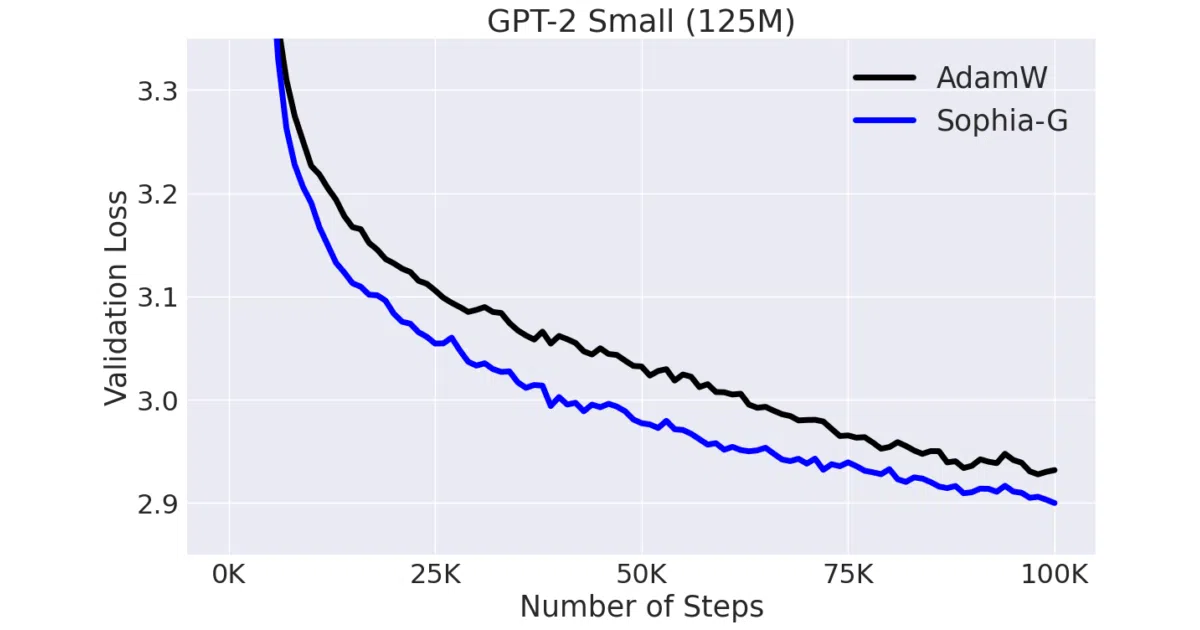
Sophia estimates diagonal Hessians via cheap sampling and clipped updates to push LLM pre-training faster than first-order rivals.
Not currently ranked — collecting fresh signals.
star history
What it does
Sophia-G is a stochastic second-order optimizer built for language model pre-training. Every k steps it runs an extra forward-backward pass with labels sampled from the model’s own predictions to update a diagonal Hessian EMA. The parameter update clips first-order momentum by that curvature estimate, which the authors say permits learning rates comparable to AdamW and several times larger than Lion’s.
The interesting bit
Instead of treating second-order information as prohibitively expensive, Sophia treats it as a cheap periodic diagnostic. The README tracks train/win_rate—the fraction of parameters where the update isn’t clipped—to guide hyperparameter tuning, turning a black-box optimizer knob into a visible telemetry signal.
Key highlights
- Implements the Sophia-G update rule with per-coordinate clipping against a diagonal Hessian estimate
- Ships with nanoGPT-based training scripts for GPT-2 Small (125M), Medium (355M), and 1.5B via levanter
- Hyperparameters (except learning rate) are claimed to transfer across model sizes
- Requires serious hardware: 10× A5000 or 8× A100 for the smaller models, TPUs for 1.5B
- Tuning centers on the clipping threshold ρ, which is adjusted until
win_ratestays in the 0.1–0.5 range
Caveats
- Hyperparameter tuning is involved and non-standard; you must monitor
win_rateto keep ρ in range, and the learning-rate scale differs from both AdamW and Lion - The 1.5B reproduction requires editing levanter’s
optim.pysource and launching via gcloud TPU VMs - The README notes results were updated for the latest PyTorch version, implying earlier published curves may have shifted
Verdict
Worth a look if you’re pre-training transformers at scale and have the GPU/TPU budget to experiment. If you’re fine-tuning 7B models on a single A100 or looking for a drop-in AdamW replacement, this is not your tool.
Frequently asked
- What is Liuhong99/Sophia?
- Sophia estimates diagonal Hessians via cheap sampling and clipped updates to push LLM pre-training faster than first-order rivals.
- Is Sophia open source?
- Yes — Liuhong99/Sophia is open source, released under the MIT license.
- What language is Sophia written in?
- Liuhong99/Sophia is primarily written in Python.
- How popular is Sophia?
- Liuhong99/Sophia has 1k stars on GitHub.
- Where can I find Sophia?
- Liuhong99/Sophia is on GitHub at https://github.com/Liuhong99/Sophia.