KimGLee/Cambium
Cambium makes LLM agents file their paperwork
Because letting LLM agents loose on a knowledge corpus raises uncomfortable questions — who changed what, on whose authority, and how work resumes after an interruption — Cambium supplies the missing governance layer: rules, evidence, and resumable state.
Collecting fresh signals — velocity needs a few days of history.
collecting data…
star history
What it does
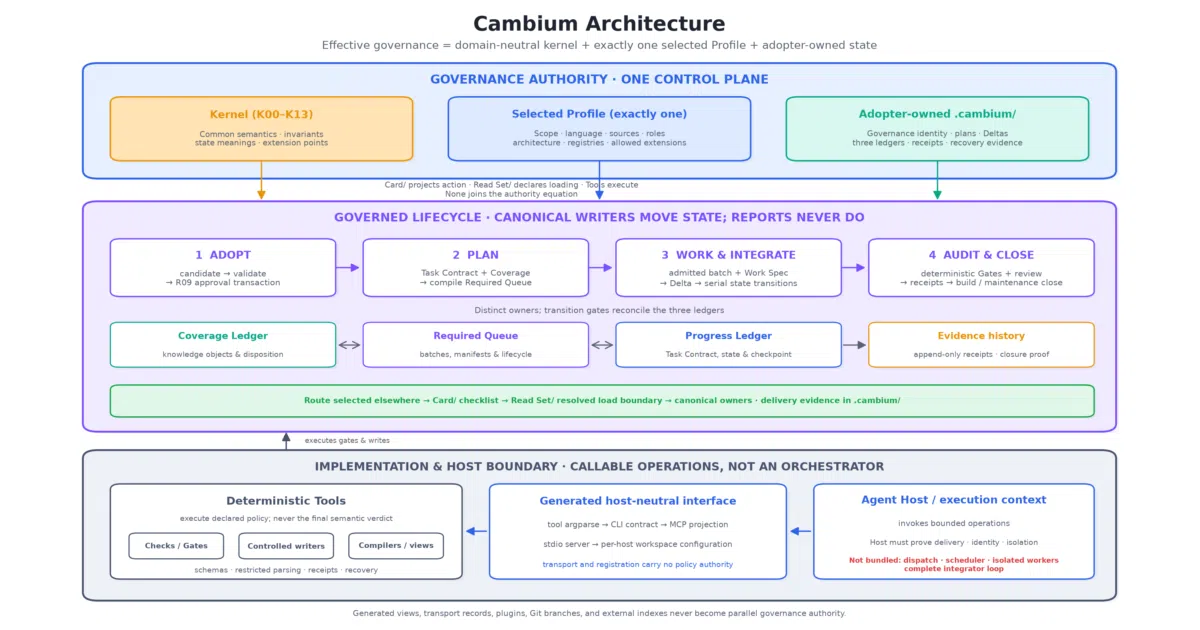
Cambium is a governance standard plus a reference Python toolset for knowledge repositories that LLM agents help maintain. It splits governance into a normative kernel (cross-domain invariants and state meanings), exactly one selected profile per repository (scope, roles, sources, priorities), and adopter-owned runtime state under .cambium/. Deterministic tools handle the mechanics — task and batch transitions, controlled edits, append-only receipts, interruption recovery — and a generated MCP surface lets agent hosts call them. The framing is refreshingly practical: what rules apply, who may change shared state, what evidence closes work, how an interrupted task resumes, and which decisions stay with the human.
The interesting bit
The bet here is that the valuable part of agent-maintained knowledge isn’t the agent — it’s the bookkeeping. Three ledgers (Coverage, Required Queue, Progress) must agree but answer different questions; the Runner derives exactly one identity-bound next action and stops at every semantic boundary rather than scheduling autonomously; and a profile can tighten a kernel extension point but never disable a kernel rule. The README’s own honesty is the tell: “a host may add capabilities, but it must not claim evidence for a capability it cannot prove.”
Key highlights
- Normative kernel plus one selected profile per repo — profiles tighten extension points, never override kernel rules.
- Three runtime ledgers — Coverage, Required Queue, Progress — that must agree but are not interchangeable task lists.
- Append-only receipts, Terminal Proof bindings, and deterministic checks for pages, structure, vocabulary, links, boundaries, and freshness.
- A generated MCP projection with a bounded Task Runtime Runner: one next action at a time, stopping at every semantic boundary — explicitly not a scheduler.
- Resumable by design:
check_queue.py’s resume status reports locks, holds, in-flight batches, and the exactnext_actionbefore anyone writes a line.
Caveats
- The README reads like the specification it is — R09s, K00/19s, “residual-scan witnesses” — so expect a real learning curve before any of this feels practical.
- The repo is intentionally uninstantiated: one empty profile template, no working adopter example, and adoption is a multi-step ceremony (agent-assisted interview, validation, an explicit adoption transaction) before anything runs.
- No authenticated actor or reviewer identity yet, and no agent dispatch or scheduling — the audit trail is structural, and you bring your own agent.
Verdict
Worth a close look if agents edit a long-lived knowledge corpus and the work must be auditable, resumable, and signed off by a human. Skip it if you wanted a knowledge base, a RAG engine, or anything that works out of the box — this is the compliance department, not the workforce.
Frequently asked
- What is KimGLee/Cambium?
- Because letting LLM agents loose on a knowledge corpus raises uncomfortable questions — who changed what, on whose authority, and how work resumes after an interruption — Cambium supplies the missing governance layer: rules, evidence, and resumable state.
- Is Cambium open source?
- Yes — KimGLee/Cambium is an open-source project tracked on heatdrop.
- What language is Cambium written in?
- KimGLee/Cambium is primarily written in Python.
- How popular is Cambium?
- KimGLee/Cambium has 501 stars on GitHub.
- Where can I find Cambium?
- KimGLee/Cambium is on GitHub at https://github.com/KimGLee/Cambium.