Justin0504/Aegis
A firewall that sits between your agent and its worst ideas
AEGIS intercepts every tool call before execution, classifies it, and blocks the ones your agent shouldn't be making — no agent code changes required.
Not currently ranked.
star history
What it does
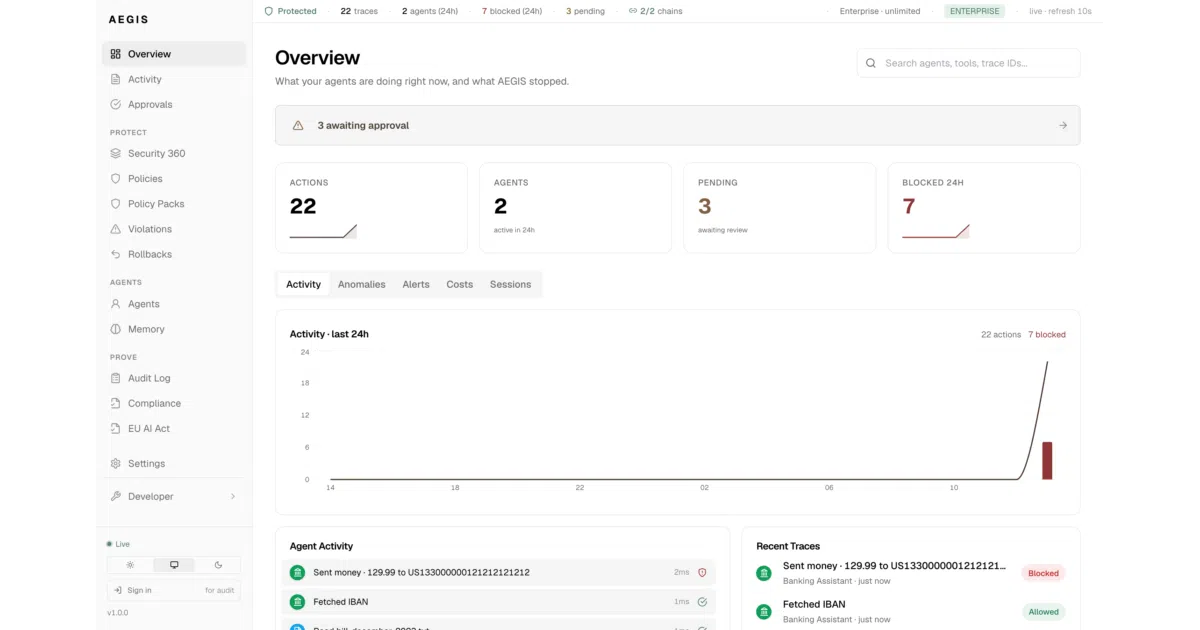
AEGIS is a pre-execution gateway for AI agents. It sits between your agent and its tools, classifies every tool call in real time, checks it against your policies, and blocks violations before they run. Integration is a single agentguard.auto(...) call — your existing agent code stays untouched. Everything that happens gets written to a tamper-evident audit trail, and a “Compliance Cockpit” dashboard shows traces, blocked actions, approvals, and cost tracking.
The interesting bit Beyond per-call blocking, it watches for signals that don’t fit a single activity row: tainted memory recall (a poisoned item pulled from the agent’s knowledge base), undeclared agent-to-agent data crossings, and PII appearing in tool arguments before any prompt mentioned it. It also ships its own threat taxonomy — 10 tactics × 40 techniques (AAT-T*) — with a MITRE-ATLAS-style coverage matrix showing which attack techniques your deployment actually defends against.
Key highlights
- Pre-execution interception: policy checks and blocks happen before the tool runs, not after the damage report.
- Human-in-the-loop approvals and a kill switch for actions that need a human decision.
- Agent registry with real identity — status, declared tool scope, per-agent budgets, optional Ed25519 authentication — instead of a free-form
agent_idstring. - Detector plugin contract so security teams can register custom detectors alongside the built-ins.
- LLM egress proxy: point
OPENAI_BASE_URLat the gateway and every LLM call flows through the same detector and audit chain. - Ships as a desktop app (macOS today, Windows planned), Docker, or one-click deploys to Render/Railway/DO.
Caveats
- Windows support is “coming in 0.2” — the README suggests WSL2 in the meantime.
- At version 0.1.0, this is early software; the README is long on capability claims and the threat-coverage matrix is only as good as the detectors you actually configure.
- The README is truncated, so details on the policy DSL, cryptographic audit trail, and approval workflow are thinner than the marketing suggests.
Verdict Worth a look if you’re running tool-wielding agents anywhere near production data and want a policy layer you didn’t have to build yourself. If your agents are read-only toys, it’s a lot of machinery for a problem you don’t have yet.
Frequently asked
- What is Justin0504/Aegis?
- AEGIS intercepts every tool call before execution, classifies it, and blocks the ones your agent shouldn't be making — no agent code changes required.
- Is Aegis open source?
- Yes — Justin0504/Aegis is open source, released under the MIT license.
- What language is Aegis written in?
- Justin0504/Aegis is primarily written in TypeScript.
- How popular is Aegis?
- Justin0504/Aegis has 524 stars on GitHub.
- Where can I find Aegis?
- Justin0504/Aegis is on GitHub at https://github.com/Justin0504/Aegis.