JDAI-CV/FaceX-Zoo
PyTorch face recognition built to swap backbones, not collect dust
It provides a standardized PyTorch training, evaluation, and SDK pipeline so researchers can plug in new backbones and supervisory heads without rewriting boilerplate.
Not currently ranked — collecting fresh signals.
star history
What it does
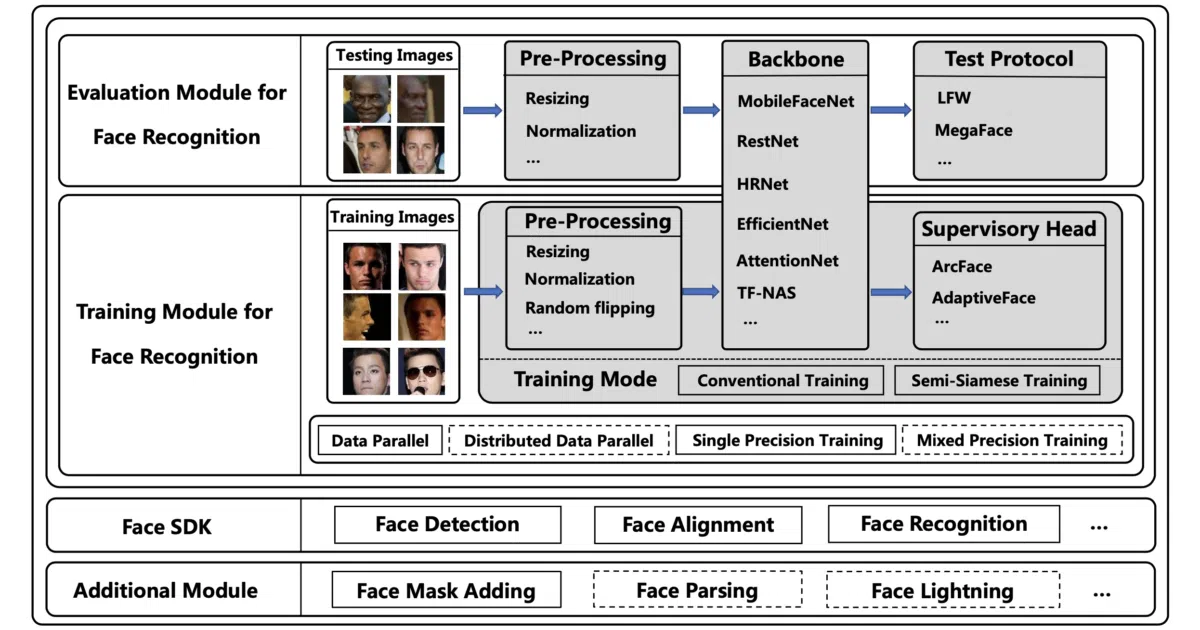
FaceX-Zoo is a PyTorch-based workbench for training and evaluating face recognition models. It bundles a training module with pluggable backbones and supervisory heads, a standardized evaluation harness for benchmarks like LFW and MegaFace, and a lightweight face SDK that handles detection, alignment, and recognition. The project also branches into adjacent territory—facial expression recognition, knowledge distillation, and even 3D face-mask synthesis—though face recognition remains the core occupant.
The interesting bit
The authors explicitly avoid the “kitchen sink” anti-pattern. Instead of cramming in every published trick, they optimize for upgradeability: new backbones (Swin Transformer, RepVGG, ResNeSt) and heads (MagFace) are added as modular citizens, not invasive patches. That philosophy turns the repository from a model zoo into something closer to infrastructure.
Key highlights
- Supports a wide roster of backbones and supervisory heads, including Swin-S, RepVGG, and MagFace.
- Evaluates against most standard benchmarks—LFW, CPLFW, IJB-C, MegaFace, and others—via configuration files rather than custom scripts.
- Ships a functional face SDK for detection, alignment, and recognition, plus tools to export models to ONNX and the SDK’s native format.
- Includes side modules for semi-siamese training, knowledge distillation, mixed-precision training, and 3D face-mask adding.
- Apache 2.0 licensed and openly acknowledges its debt to InsightFace and face.evoLVe.
Caveats
- The README offloads nearly all detail to sub-directory files, so expect to click around for training recipes and evaluation protocols.
- Typos and formatting slips (“easilyupgrade”, “Dockfile”, “PyTorh”) hint that polish is not the project’s top priority.
Verdict
Researchers and engineers who need a modular PyTorch starting point for face recognition—and who don’t mind spelunking through sub-READMEs—will find a well-structured menagerie. If you want a single turnkey model or extensive hand-holding documentation, look elsewhere.
Frequently asked
- What is JDAI-CV/FaceX-Zoo?
- It provides a standardized PyTorch training, evaluation, and SDK pipeline so researchers can plug in new backbones and supervisory heads without rewriting boilerplate.
- Is FaceX-Zoo open source?
- Yes — JDAI-CV/FaceX-Zoo is an open-source project tracked on heatdrop.
- What language is FaceX-Zoo written in?
- JDAI-CV/FaceX-Zoo is primarily written in Python.
- How popular is FaceX-Zoo?
- JDAI-CV/FaceX-Zoo has 2k stars on GitHub.
- Where can I find FaceX-Zoo?
- JDAI-CV/FaceX-Zoo is on GitHub at https://github.com/JDAI-CV/FaceX-Zoo.