GoGoDuck912/Self-Correction-Human-Parsing
Parsing people pixel by pixel, with three pretrained vocabularies
This repo exists to give developers ready-made, top-ranked human segmentation without locking them into a single, rigid taxonomy.
Not currently ranked — collecting fresh signals.
star history
What it does
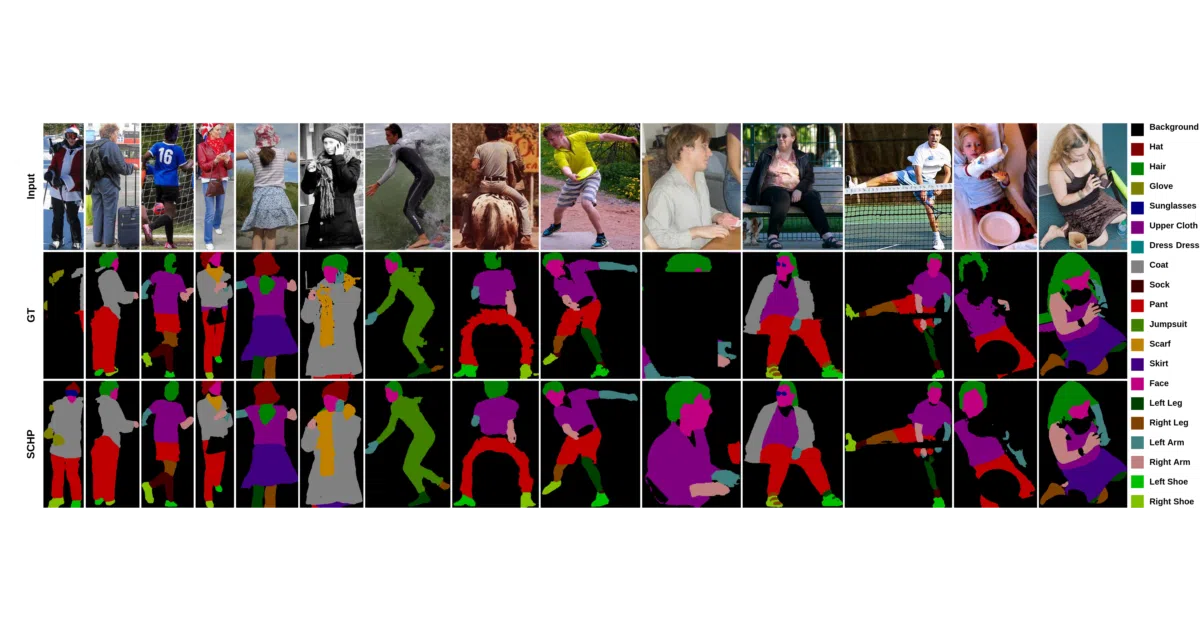
Self-Correction for Human Parsing (SCHP) takes an image containing a person and classifies every pixel into semantic categories—hat, hair, shoes, arms, legs, and so on. It ships with pretrained models trained on three distinct datasets, each using its own label vocabulary: a 20-class fashion-heavy set (LIP), an 18-class style-focused set (ATR), and a 7-class body-parts set (Pascal-Person-Part). You pick the taxonomy that matches your application, feed it an image, and get back a same-size mask where each pixel value is a predicted label; add the --logits flag and it also emits the raw pre-softmax feature maps for downstream use.
The interesting bit
The repo treats label granularity as a user-configurable dial rather than a fixed constant. Most segmentation projects pick one taxonomy and force you to adapt; this one offers three pretrained specialists under the same roof, plus extensions for multi-person scenes and video. It also exposes the internal feature representations, which is rarer than it should be for a research artifact.
Key highlights
- Ranked 1st in all human parsing tracks (single, multiple, and video) at the third LIP challenge.
- Pretrained models for three datasets with different label systems: LIP (20 labels), ATR (18 labels), and Pascal-Person-Part (7 labels).
- Can output final parsing masks or pre-softmax logits for downstream feature extraction.
- Includes extensions for multi-person and video human parsing tasks.
- Published in IEEE TPAMI; code is MIT licensed.
Caveats
- The README still advertises Python 3.6 and contains a typo (“inferecne”).
- It never explains what “self-correction” actually means; you will need the TPAMI paper to understand the method.
- Multi-person parsing details live in a separate file, leaving that extension largely undescribed in the main README.
Verdict
Worth a look if you need off-the-shelf human segmentation for fashion, body-part analysis, or feature extraction and can tolerate a 2020-era research codebase. Skip it if you want an actively maintained framework with a unified API or a single, universal label taxonomy.
Frequently asked
- What is GoGoDuck912/Self-Correction-Human-Parsing?
- This repo exists to give developers ready-made, top-ranked human segmentation without locking them into a single, rigid taxonomy.
- Is Self-Correction-Human-Parsing open source?
- Yes — GoGoDuck912/Self-Correction-Human-Parsing is open source, released under the MIT license.
- What language is Self-Correction-Human-Parsing written in?
- GoGoDuck912/Self-Correction-Human-Parsing is primarily written in Jupyter Notebook.
- How popular is Self-Correction-Human-Parsing?
- GoGoDuck912/Self-Correction-Human-Parsing has 1.3k stars on GitHub.
- Where can I find Self-Correction-Human-Parsing?
- GoGoDuck912/Self-Correction-Human-Parsing is on GitHub at https://github.com/GoGoDuck912/Self-Correction-Human-Parsing.