GlitterKill/sdl-mcp
Feed your agent symbols, not whole files
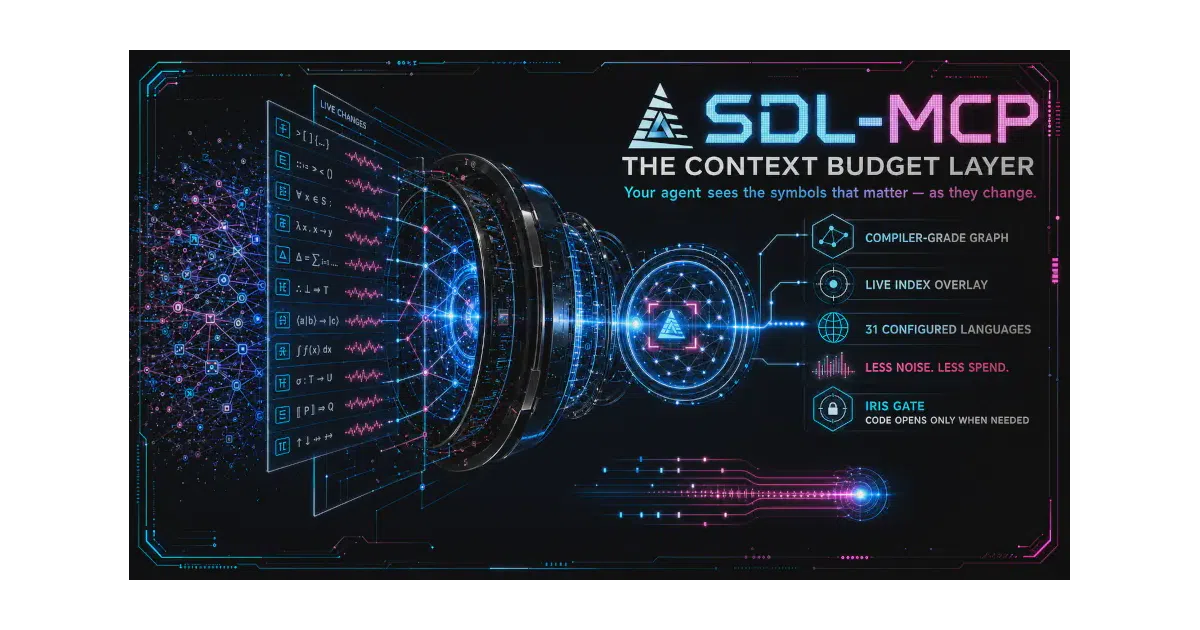
SDL-MCP indexes a repo into a symbol graph so coding agents escalate from compact cards to source code only when they actually need it.
Too new to rank. Velocity needs a few days of history.
star history
What it does
SDL-MCP is an MCP server that indexes a repository into a symbol graph — symbols, relationships, and compact metadata — and exposes it to coding agents over stdio or HTTP. Instead of an agent slurping full files, it searches symbols, reads compact “cards” (identity, signature, summary, relationships), builds a task-scoped subgraph, and only then requests a bounded source window. Everything runs locally.
The interesting bit
The “Iris Gate Ladder” makes escalation explicit: cards, skeletons, hot paths, and policy-gated source windows form a ladder where the agent asks for the least code that can answer its question. It’s a token-budget discipline baked into the retrieval protocol rather than left to the agent’s goodwill.
Key highlights
- Graph slicing follows code relationships, not directory boundaries, returning budgeted subgraphs with spillover for expansion
- Delta packs compare indexed versions, identify changed symbols, and trace blast radius;
sdl.pr.risk.analyzepackages PR review evidence - Live indexing overlays unsaved draft-buffer changes, with background SCIP/LSP/parser reconciliation after saves
- Provider-first indexing ingests SCIP and language-provider facts for precise cross-references, falling back to tree-sitter elsewhere
- Multiple tool surfaces: 38 flat tools, a 6-tool Gateway mode, or a 7-tool Code Mode — pick per client
- Policy guardrails govern raw source windows and runtime execution (executables, working directory, timeouts); HTTP deployments get a graph viewer and observability dashboard
Caveats
- Requires Node.js 24 or later — a fairly fresh runtime
- Source-available, not open source: internal business use is fine, but embedding or distributing it in a monetized product requires a commercial license
- The README doesn’t quantify token savings or benchmarks, so the “saves tokens” claim rests on the design, not published numbers
Verdict
Worth a look if you run coding agents on large repos and your context budget hurts. If your codebase fits in the window anyway, the ladder is ceremony without payoff.
Frequently asked
- What is GlitterKill/sdl-mcp?
- SDL-MCP indexes a repo into a symbol graph so coding agents escalate from compact cards to source code only when they actually need it.
- Is sdl-mcp open source?
- Yes — GlitterKill/sdl-mcp is an open-source project tracked on heatdrop.
- What language is sdl-mcp written in?
- GlitterKill/sdl-mcp is primarily written in TypeScript.
- How popular is sdl-mcp?
- GlitterKill/sdl-mcp has 503 stars on GitHub.
- Where can I find sdl-mcp?
- GlitterKill/sdl-mcp is on GitHub at https://github.com/GlitterKill/sdl-mcp.