Gen-Verse/ReasonFlux
A three-headed post-training suite for LLM reasoning and code
ReasonFlux bundles template-guided reasoning, trajectory-aware PRMs, and co-evolved coder RL into one post-training repository with trained model checkpoints.
Not currently ranked — collecting fresh signals.
star history
What it does
The repository collects a family of post-training algorithms and released model checkpoints built by Princeton, PKU, UIUC, Chicago, and ByteDance Seed. It covers three distinct lines: ReasonFlux-Zero/F1, which uses hierarchical “thought templates” to guide long chain-of-thought reasoning; ReasonFlux-PRM, a trajectory-aware process reward model that scores intermediate reasoning steps for both offline data curation and online reinforcement learning; and ReasonFlux-Coder, which trains code-generation models alongside co-evolved unit-test generators via reinforcement learning. Each component ships with trained weights on Hugging Face.
The interesting bit
The suite treats post-training as a stack of complementary scaffolding: thought templates compress reasoning patterns into reusable structure, the PRM assigns dense, step-level rewards that cleanly separate DeepSeek-R1 and Gemini trajectories, and the coder/tester pair learns to catch each other’s bugs through mutual RL rather than static benchmarks. It is unusual to see these three disparate techniques—reasoning templates, process rewards, and co-evolutionary coding—distributed from a single repository with shared authorship.
Key highlights
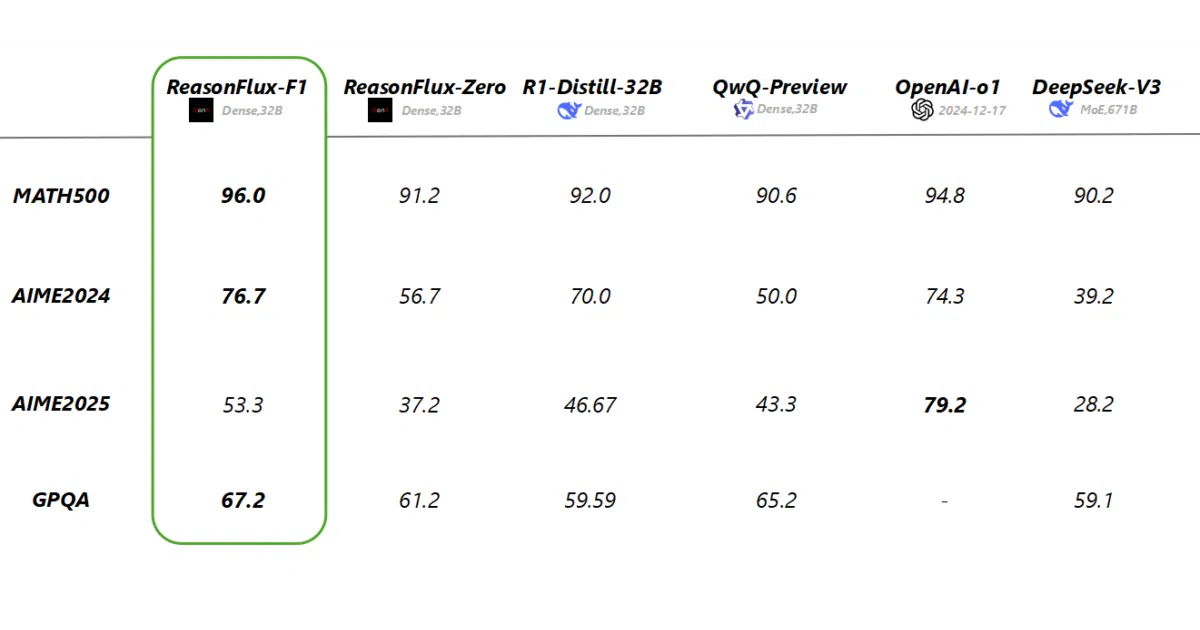
- ReasonFlux-F1-32B outperforms R1-Distill-32B, OpenThinker-32B, and LIMO-32B on AIME2024, AIME2025, MATH500, and GPQA according to the project’s benchmark tables.
- ReasonFlux-PRM-7B surpasses the human-curated s1k dataset for offline data selection plus SFT, and beats rule-based and other PRM baselines during online GRPO optimization.
- ReasonFlux-Coder-14B and 7B are claimed to outperform similarly sized Qwen and DeepSeek coder models, while the 4B variant achieves 64.8% efficiency in unit-test generation.
- The PRM checkpoints (1.5B and 7B) and tuned reasoning models are available on Hugging Face, not just paper weights.
- All three methods were accepted to NeurIPS 2025, with ReasonFlux-Coder and the preliminary thought-template work earning Spotlight distinctions.
Caveats
- The README trumpets strong performance claims but does not disclose training compute budgets or full evaluation protocols, so treat benchmark tables as project-reported.
- ReasonFlux-Coder’s detailed implementation and figures reside in a separate
Gen-Verse/CURErepository; this repo functions partly as an index. - The Hugging Face link for ReasonFlux-Zero-32B is a placeholder (
#), so that specific checkpoint may not yet be available.
Verdict
Researchers and practitioners building post-training pipelines for math, coding, or long-CoT reasoning should dig in, especially if they want ready-made PRM checkpoints. If you are looking for a single, unified training framework with one consistent API across all three methods, this is more of a curated model zoo and paper index than a monolithic toolkit.
Frequently asked
- What is Gen-Verse/ReasonFlux?
- ReasonFlux bundles template-guided reasoning, trajectory-aware PRMs, and co-evolved coder RL into one post-training repository with trained model checkpoints.
- Is ReasonFlux open source?
- Yes — Gen-Verse/ReasonFlux is an open-source project tracked on heatdrop.
- What language is ReasonFlux written in?
- Gen-Verse/ReasonFlux is primarily written in Python.
- How popular is ReasonFlux?
- Gen-Verse/ReasonFlux has 545 stars on GitHub.
- Where can I find ReasonFlux?
- Gen-Verse/ReasonFlux is on GitHub at https://github.com/Gen-Verse/ReasonFlux.