GCWing/BitFun
A desktop OS that agents can actually live inside
BitFun is a Rust-based runtime shipping four built-in agents—code, cowork, computer-use, and personal assistant—meant to run locally and stay running.
Velocity · 7d
+3.3
★ / day
Trend
↘cooling
star history
What it does
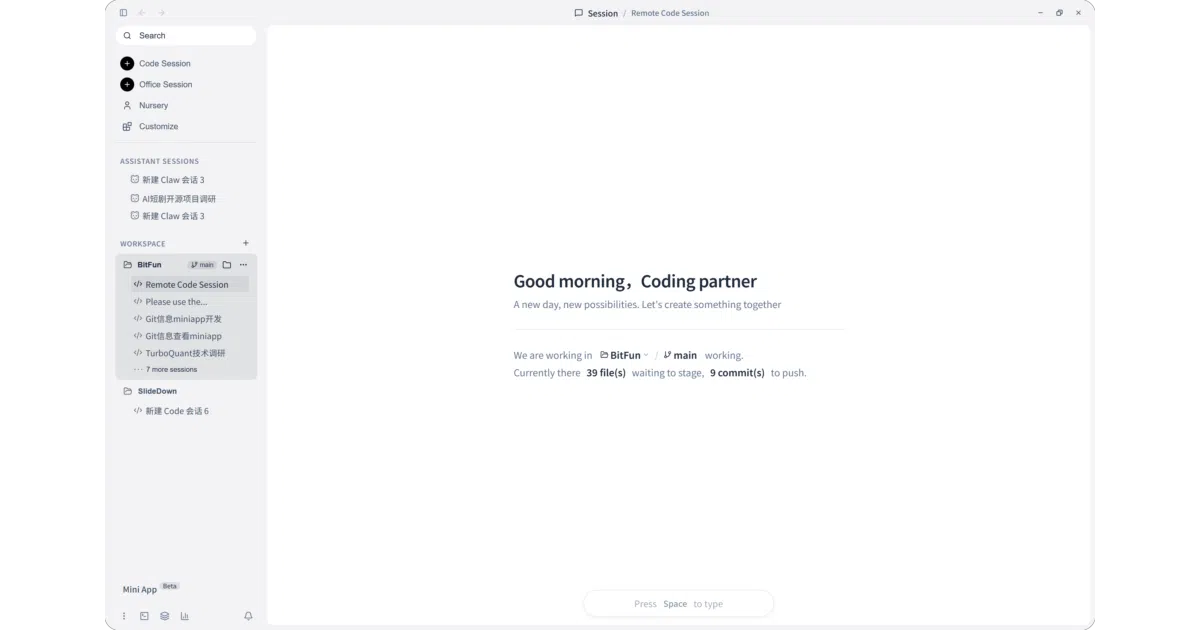
BitFun is a desktop application built in Rust with a Tauri frontend that acts as both an agent runtime and a bundle of ready-made AI agents. Install it once and you get autonomous coding, document workflows, computer-use screen control, and a personal assistant with long-term memory. Everything runs locally under .bitfun/sessions/; your data doesn’t leave the machine unless you want it to.
The interesting bit
The project leans hard into self-modification: the authors claim 97%+ of the codebase was written by BitFun’s own Code Agent via “Vibe Coding,” and they encourage users to extend the tool by asking its built-in agent to edit its own source. Custom agents can be defined with a single Markdown file (prompt + tool registry), or you can fork the whole repo and reshape it entirely.
Key highlights
- Four official agents out of the box: Code (with four modes including autonomous and debug), Cowork (PDF/DOCX/XLSX/PPTX), Computer Use (screen + input control), and Personal Assistant (scheduling, memory, personality)
- Built-in protocol stack: MCP, LSP, filesystem, terminal, Git, remote SSH—no manual wiring
- Remote control via phone QR pairing, Telegram, Feishu Bot, or WeChat Bot
- Customization tiers from “one Markdown file” (L1) to “fork the repo” (L4), with the Code Agent able to perform L3/L4 changes on itself
- Flashgrep + ripgrep integration claiming ~94.6% search time reduction on very large repos like Chromium
- Cross-platform desktop: Windows, macOS, Linux
Caveats
- The “97%+ Vibe Coding” claim and the 94.6% flashgrep speedup are stated without independent verification or methodology details
- The project is explicitly described as “spare-time exploration and research,” not a commercial product
- Self-modification loops are neat in theory; how well they work in practice for non-trivial architectural changes is unclear from the README
Verdict
Worth a look if you want a single local desktop app that bundles most current agent paradigms without cloud dependencies or subscription juggling. Probably premature for teams needing vendor support, SLAs, or audited security claims. The Markdown-defined agent layer is genuinely low-friction for experimentation.
Frequently asked
- What is GCWing/BitFun?
- BitFun is a Rust-based runtime shipping four built-in agents—code, cowork, computer-use, and personal assistant—meant to run locally and stay running.
- Is BitFun open source?
- Yes — GCWing/BitFun is open source, released under the MIT license.
- What language is BitFun written in?
- GCWing/BitFun is primarily written in Rust.
- How popular is BitFun?
- GCWing/BitFun has 1.4k stars on GitHub and is currently cooling off.
- Where can I find BitFun?
- GCWing/BitFun is on GitHub at https://github.com/GCWing/BitFun.