Fractal-Compute-Orchestrations/FractalWorkspace
Your phone fleet as a training cluster: Fractal slices models across Androids
A workspace that pairs a Python federated-learning server with a Kotlin edge app so spare phones can train and even run LLM inference in parallel.
Collecting fresh signals — velocity needs a few days of history.
star history
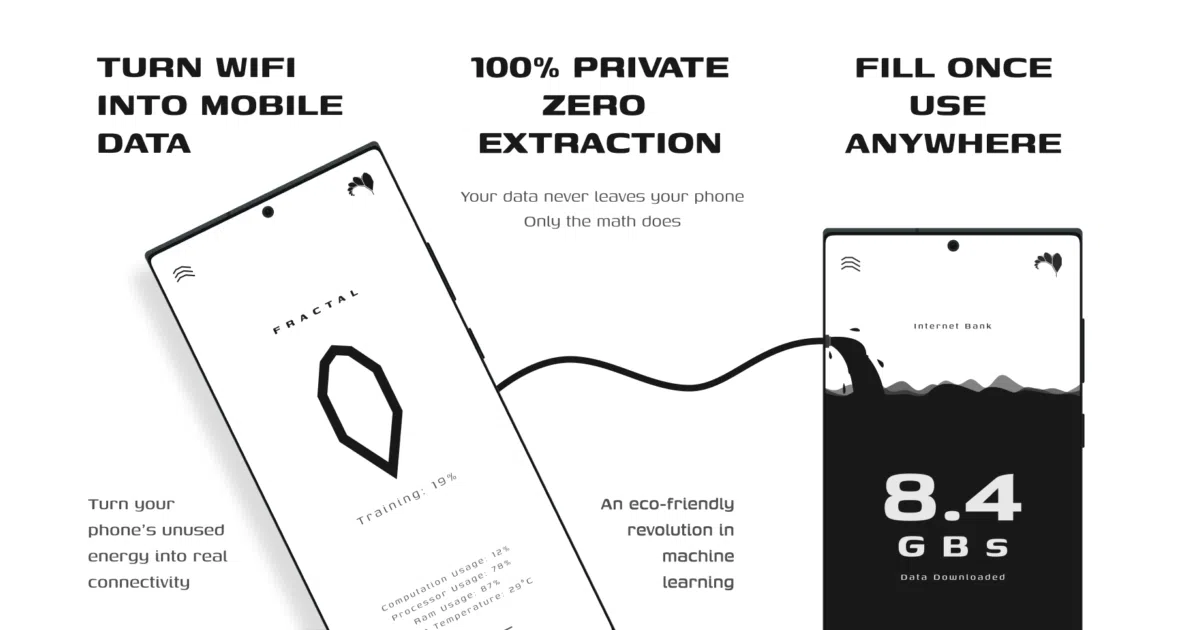
What it does Fractal is a two-part ecosystem: FractalCore, a Python/Flask control plane that handles multi-tenant task dispatch, dataset segmentation, and FedAvg weight aggregation; and FractalAndroid, a native Kotlin app that does on-device TFLite training and memory-mapped inference. Phones poll the server for tasks, train locally on their own data bins, and upload only checkpoint deltas — raw data never leaves the device. The server credits nodes with tokenized rewards tracked in Firestore.
The interesting bit
The second mode is the unusual one: for foundation models like Llama 3 8B, the server quantizes to INT4 (via torchao), traces the graph with torch.export, delegates to XNNPACK, and slices the result into ≤150MB layer_[N].pte partitions. Each Android node mmaps one slice and passes ≤4.1KB INT8 activation tensors to the next phone over a Wi-Fi socket — pipeline parallelism across a mesh of handsets, sized specifically to dodge Android’s Low Memory Killer.
Key highlights
- Federated learning with strict telemetry gates: training pauses unless battery ≥50%, charging, and ≤40°C
- Hard contracts everywhere — partition size, activation frame size, and single-use
task_Iduploads are all enforced, with defined failure behavior - Zero raw-data ingress: only weight checkpoints cross the wire
- Multi-tenant sandboxing at the directory level (
data/tenants/{username}/) - Stateless
X-Auth-Tokenauth, deliberately isolated from browser cookies
Caveats
- Proprietary, source-available, non-commercial license — read it before building anything on top
- Requires physical Android devices (API 24+, ARM64 recommended), Firebase/Firestore, and a GCP project; not a laptop-friendly demo
- The README describes architecture in detail but offers no benchmarks on training throughput or inference latency
Verdict Worth a look if you’re into federated learning or genuinely novel edge-inference tricks — the phone-mesh pipeline parallelism is a rare design. Skip it if you need a permissively licensed, production-ready FL stack.
Frequently asked
- What is Fractal-Compute-Orchestrations/FractalWorkspace?
- A workspace that pairs a Python federated-learning server with a Kotlin edge app so spare phones can train and even run LLM inference in parallel.
- Is FractalWorkspace open source?
- Yes — Fractal-Compute-Orchestrations/FractalWorkspace is an open-source project tracked on heatdrop.
- What language is FractalWorkspace written in?
- Fractal-Compute-Orchestrations/FractalWorkspace is primarily written in Python.
- How popular is FractalWorkspace?
- Fractal-Compute-Orchestrations/FractalWorkspace has 2.9k stars on GitHub.
- Where can I find FractalWorkspace?
- Fractal-Compute-Orchestrations/FractalWorkspace is on GitHub at https://github.com/Fractal-Compute-Orchestrations/FractalWorkspace.