Fractal-Compute-Orchestrations/FractalCore
A Flask server that turns Android phones into a federated learning fleet
FractalCore schedules training tasks across mobile nodes, averages their checkpoints with FedAvg, and pays them in "Liquid MBs" — plus it slices Llama-class models into phone-sized pieces.
Collecting fresh signals — velocity needs a few days of history.
star history
What it does
FractalCore is the control plane for a decentralized compute setup: a fleet of Android devices (FractalAndroid) does the actual training on-device, and this server hands out tasks, collects checkpoints, and stitches them back together. It’s a multi-tenant Flask app — each tenant gets sandboxed storage paths, a TFLOPs compute budget, and its own training rounds. When enough nodes upload valid checkpoints, the server runs Federated Averaging (FedAvg) over the weights and issues a new global model for the next round.
The interesting bit
The second, less obvious half is the model slicer: it takes monolithic Hugging Face models (Llama 3 8B, TinyLlama), quantizes them to INT4 with torchao, traces them through torch.export into static ATen graphs, and lowers them to XNNPACK-backed .pte files — layer partitions small enough (under 150MB) for mmap on a phone. So it’s both the trainer coordinator and the compiler that makes the models fit the fleet.
Key highlights
- Multi-tenant isolation at the filesystem level (
data/tenants/{username}/), with per-tenant TFLOPs caps and round tracking. - Header-only auth via
X-Auth-Token(secrets.token_hex(32)) — no cookies, so no cross-tab session bleeding. - Single-use
task_Idassignment blocks replayed or stale checkpoint uploads. - Reward ledger credits “Liquid MBs” to Firestore profiles after checkpoint verification.
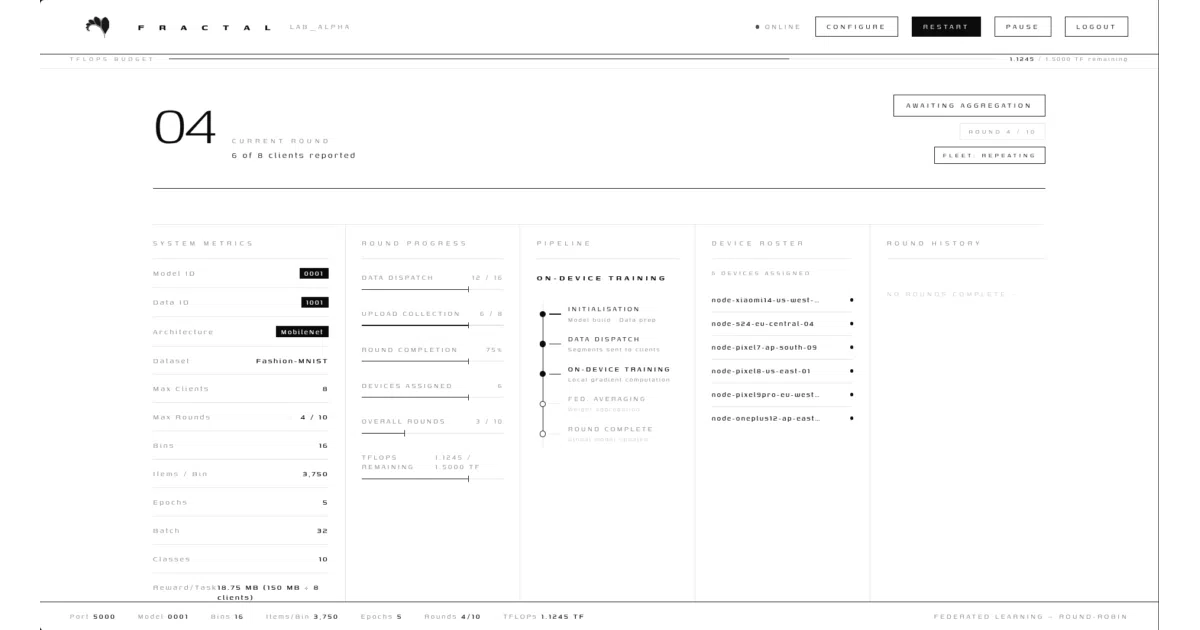
- Ships with a web dashboard: live TFLOPs gauges, node telemetry, and an admin console for provisioning tenants.
Caveats
- Proprietary, source-available, non-commercial license — commercial use is explicitly prohibited without written authorization, which rules out most business adoption.
- The server never touches raw data (all training happens on-device), but the README doesn’t say how node identity or telemetry “proofs” are actually verified beyond device IDs and task receipts.
- It’s a single-maintainer project; the “security hardened” badge is a claim, not an audit.
Verdict
Worth a look if you’re building federated learning on edge devices and want a working reference for task dispatch, FedAvg, and mobile model slicing. Skip it if you need a commercial license or a battle-tested multi-tenant backend — it’s an ambitious one-person ecosystem, not a product.
Frequently asked
- What is Fractal-Compute-Orchestrations/FractalCore?
- FractalCore schedules training tasks across mobile nodes, averages their checkpoints with FedAvg, and pays them in "Liquid MBs" — plus it slices Llama-class models into phone-sized pieces.
- Is FractalCore open source?
- Yes — Fractal-Compute-Orchestrations/FractalCore is an open-source project tracked on heatdrop.
- What language is FractalCore written in?
- Fractal-Compute-Orchestrations/FractalCore is primarily written in Python.
- How popular is FractalCore?
- Fractal-Compute-Orchestrations/FractalCore has 2.9k stars on GitHub.
- Where can I find FractalCore?
- Fractal-Compute-Orchestrations/FractalCore is on GitHub at https://github.com/Fractal-Compute-Orchestrations/FractalCore.