FoundationVision/LlamaGen
Proof that Llama can paint, given three billion parameters
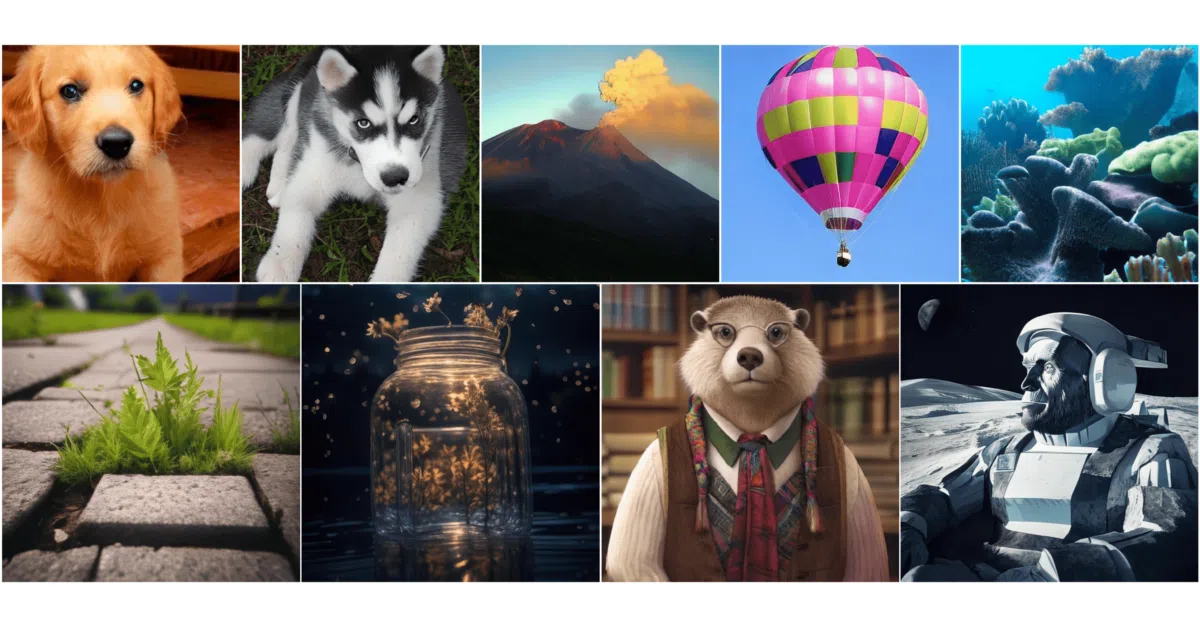
LlamaGen repurposes plain Llama next-token prediction for images, betting that autoregressive models can beat diffusion simply by scaling to billions of parameters.
Not currently ranked — collecting fresh signals.
star history
What it does
LlamaGen is a family of image generation models that repurposes standard Llama architecture for visual token prediction. It trains autoregressive transformers on discrete image tokens from custom VQ-VAE tokenizers, releasing pre-trained weights for both class-conditional ImageNet generation and text-to-image synthesis. The repository includes PyTorch training and sampling code, plus integration with the vLLM serving stack.
The interesting bit
The project deliberately strips out visual inductive biases—no diffusion, no U-Net, just next-token prediction scaled to 3B parameters. The authors claim that re-examining tokenizers, scalability, and data quality is enough to make a vanilla LLM architecture competitive at generating images. They also borrow LLM serving infrastructure to speed up inference.
Key highlights
- Seven class-conditional checkpoints from 111M to 3.1B parameters, with reported ImageNet FID scores down to 2.18
- Two text-conditional models trained on LAION COCO and internal data for 256×256 and 512×512 output
- Custom VQ-VAE image tokenizers with 8× and 16× downsampling ratios
- vLLM integration for serving, with claimed 300%–400% throughput speedups
- Hugging Face demo and MIT-licensed code
Caveats
- Text-to-image generation requires additional language-model dependencies documented in a separate readme
- The repository offers far more class-conditional checkpoints (seven) than text-conditional ones (two)
- The “beats diffusion” claim rests on the authors’ FID tables; direct baseline comparisons are not shown in the README
Verdict
Worth a look if you’re curious whether LLM architectures can transfer cleanly to vision, or if you want pre-trained autoregressive image generators with vLLM serving. Less compelling if you need a wide selection of text-to-image models out of the box.
Frequently asked
- What is FoundationVision/LlamaGen?
- LlamaGen repurposes plain Llama next-token prediction for images, betting that autoregressive models can beat diffusion simply by scaling to billions of parameters.
- Is LlamaGen open source?
- Yes — FoundationVision/LlamaGen is open source, released under the MIT license.
- What language is LlamaGen written in?
- FoundationVision/LlamaGen is primarily written in Python.
- How popular is LlamaGen?
- FoundationVision/LlamaGen has 2k stars on GitHub.
- Where can I find LlamaGen?
- FoundationVision/LlamaGen is on GitHub at https://github.com/FoundationVision/LlamaGen.