Fission-AI/OpenSpec
A spec layer for when AI coding goes off-script
It adds a lightweight spec layer to AI coding workflows so humans and models agree on what to build before any code is written.
Feature · 07 Jul 2026
OpenSpec and the Brownfield Rebellion Against Vibe Coding
A Y Combinator-backed framework treats agent-generated specifications as version-controlled living documents to make AI coding predictable across sessions and tools.
Read the in-depth article →
Velocity · 7d
+90
★ / day
Trend
↘cooling
star history
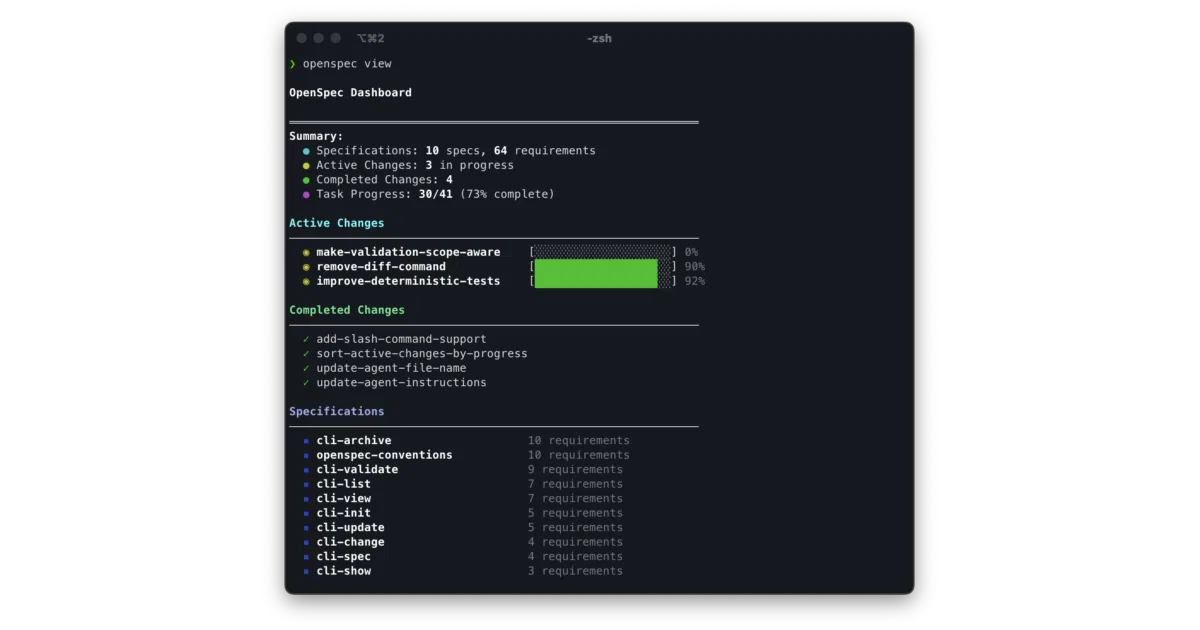
What it does OpenSpec structures the conversation between you and an AI coding assistant by turning feature requests into a folder of documents. For each change, it produces a proposal, technical design, requirements, and a task checklist that both sides review before implementation begins. Finished work is archived with a dated folder name, so the next feature starts from a clean, documented state.
The interesting bit Rather than enforcing rigid phase gates, it treats specs as living documents you can update anytime. It also explicitly targets brownfield projects—existing codebases—instead of assuming every repo is a fresh greenfield playground.
Key highlights
- Supports 25+ AI assistants and tools via slash commands without locking you into a specific IDE or model
- Generates per-change artifact folders containing
proposal.md,specs/,design.md, andtasks.md - Fluid iteration: update any artifact anytime rather than waiting for phase-gate approval
- Explicitly designed for brownfield projects, not just new repositories
- Community schemas extend the workflow via third-party bundles
Caveats
- Works best with high-reasoning models; the authors specifically recommend Codex 5.5 and Opus 4.7 for planning and implementation
- Benefits from careful context hygiene, so you may need to clear your assistant’s context window before starting implementation
- Collects anonymous telemetry (command names and version only), though it can be disabled
Verdict Worth a look if you use AI coding assistants but find yourself debugging requirements that vanished into chat history. Skip it if you prefer ad-hoc prompting or your workflow already lives entirely inside a locked-down IDE like Kiro.
Frequently asked
- What is Fission-AI/OpenSpec?
- It adds a lightweight spec layer to AI coding workflows so humans and models agree on what to build before any code is written.
- Is OpenSpec open source?
- Yes — Fission-AI/OpenSpec is open source, released under the MIT license.
- What language is OpenSpec written in?
- Fission-AI/OpenSpec is primarily written in TypeScript.
- How popular is OpenSpec?
- Fission-AI/OpenSpec has 73k stars on GitHub and is currently cooling off.
- Where can I find OpenSpec?
- Fission-AI/OpenSpec is on GitHub at https://github.com/Fission-AI/OpenSpec.