Fission-AI/OpenSpec · 07 Jul 2026 · Feature
OpenSpec and the Brownfield Rebellion Against Vibe Coding

Eleanor Hughes
Senior Editor
A Y Combinator-backed framework treats agent-generated specifications as version-controlled living documents to make AI coding predictable across sessions and tools.
Fission-AI/OpenSpec
★71.3k stars Velocity · 7d +67 ★/day ↘cooling
star history
The Hype Cycle Meets the Planning Cycle
OpenSpec appeared at the precise moment when developers were tiring of their own optimism. Founded in 2025 and accelerated through Y Combinator’s Winter 2026 batch, the project arrived just as “vibe coding” — the practice of iteratively prompting an AI until something compiles — was revealing its invoice. According to the project’s Y Combinator profile, OpenSpec has accumulated more than twenty thousand GitHub stars and claims thousands of developers and teams as users within its first six months. Whether those figures reflect organic traction or the amplifying effect of a well-timed launch, the timing is undeniable. AI-assisted development has shifted from novelty to infrastructure, and infrastructure that behaves unpredictably becomes expensive fast.
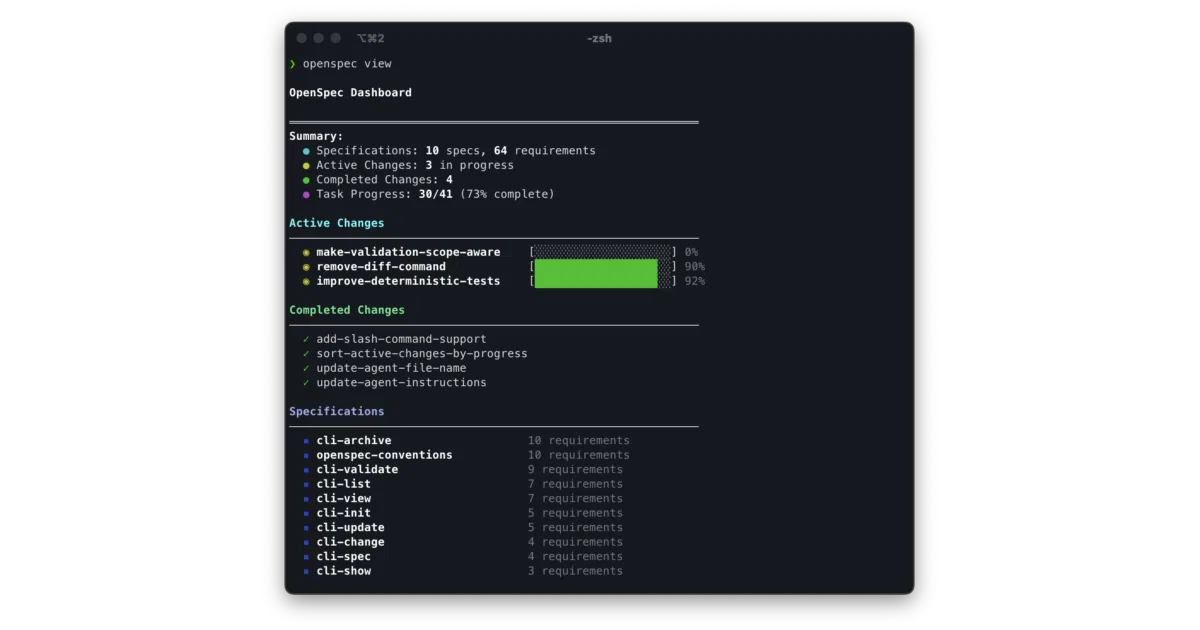
The economic argument against unstructured prompting is straightforward. As consumption-based pricing replaces flat subscriptions for tools like GitHub Copilot and Amazon Q, every clarification loop and context reset burns tokens. One analysis argues that vibe coding is becoming economically unsustainable because requirement-clarification sessions compound costs without producing durable assets. OpenSpec’s response is to insert a lightweight planning layer between intent and execution: a folder of Markdown files that outlives the chat session and can be fed to cheaper agents without rewriting the prompt from scratch.
Agent-Generated Paperwork
Here is the first subtlety that separates OpenSpec from traditional spec-driven development: the human does not necessarily write the specification. In classical interpretations, a specification is a structured, behavior-oriented natural-language artifact that humans craft to guide AI agents, distinct from the ephemeral “memory banks” that agents construct internally. Thoughtworks distinguished engineer Birgitta Böckeler outlines three ascending levels of rigor — spec-first, spec-anchored, and spec-as-source — in which the specification is the primary artifact and code is merely a generated secondary product.
OpenSpec occupies a curious middle ground. As one early adopter observed after a month of use, the framework is not truly spec-driven in the traditional sense because humans do not hand-write product requirements documents. Instead, the agent generates the specification during an initial brainstorming session. The user describes a feature — optionally feeding in a JIRA ticket, an image, or even voice dictation — and the framework’s explore capability interrogates the requirement, probes the existing codebase, sketches ASCII architectural diagrams, and outlines multiple implementation options with trade-offs. Only then does it emit the familiar artifacts: a proposal, a technical design, a task checklist, and structured requirements in a given-when-then format.
These documents land in a directory parallel to the source code, organized under an openspec folder. A spec library documents existing system capabilities, while a changes directory holds ephemeral feature packages. When the feature ships, the framework archives the change and merges the deltas back into the permanent spec library. Everything is Markdown, everything is version-controlled in Git, and everything remains readable by both humans and agents. The result is not a human-authored contract so much as a machine-generated minutes-of-meeting that persists across sessions.
Brownfield-First Architecture
Most AI coding tools are optimized for the blank canvas. They assume a greenfield repository where the agent can establish conventions unilaterally. OpenSpec explicitly markets itself as brownfield-first, targeting mature codebases where the greatest risk is not getting started but accidentally breaking what already works.
The framework enforces this focus through a root-level configuration file that acts as a standards layer. This document defines domain context, technology stack, architectural patterns, and validation requirements. One described example involves an AWS cloud billing platform built with Terraform, where the configuration mandates explicit variable passing to child modules, prohibits data lookups inside components, bans generic resource labels, and requires validation through a specific toolchain. By scoping ownership and encoding constraints upfront, the spec becomes a guardrail rather than a suggestion.
This approach addresses a genuine pain point. Existing agent plan modes are typically chat-bound: they vanish when the context window fills or the session ends. OpenSpec’s documents, by contrast, live in the repository. The framework claims native integration with more than thirty coding agents and tools — including Claude Code, Cursor, GitHub Copilot, Codex, Windsurf, Gemini CLI, and others — without requiring API keys or Model Context Protocol adapters. Because the spec is a file on disk rather than a thread in a vendor’s cloud, it can be passed between tools, allowing teams to plan with a high-reasoning model and execute with a cheaper one.
The Competitive Landscape: Lighter than Kit, Freer than Kiro
OpenSpec does not exist in a vacuum. GitHub’s Spec Kit, launched as an open-source toolkit for spec-driven development, treats the specification as a living, executable artifact with four explicit phases — Specify, Plan, Tasks, and Implement — each gated by human verification. AWS’s Kiro offers a lightweight, three-step markdown workflow inside Visual Studio Code, using user stories and acceptance criteria. Both are serious attempts to impose structure on agentic coding.
OpenSpec’s positioning is deliberately antagonistic. Against Spec Kit, it argues that GitHub’s approach is thorough but heavyweight, burdened by rigid phase gates and Python setup. Against Kiro, it notes that AWS’s tool locks users into a specific IDE and, at least initially, limited model support. OpenSpec’s counter-offer is portability: a framework that runs inside the repository rather than atop a specific editor or cloud platform.
The deeper comparison is against doing nothing. Unstructured AI coding produces plausible-looking code built on erroneous unstated assumptions, a failure mode that one practitioner survey terms “vibe coding” and another academic treatment describes as the natural consequence of large language models excelling at pattern completion while failing at intent inference. OpenSpec’s bet is that a little ceremony — a directory of Markdown, a configuration file, a review package — is cheaper than debugging a hallucinated architecture at two in the morning.
Where the Edges Show
For all its pragmatism, OpenSpec inherits the unresolved tensions of the spec-driven movement. The most immediate is maintenance. A generated specification is only a living document if someone keeps it alive. One early user notes the explicit risk that specs become stale as the codebase drifts. This aligns with broader industry observations that most current tools are spec-first but few clarify long-term spec maintenance once the code has evolved.
There is also a conceptual fuzziness around the term “spec-driven.” If the human writes only a brief prompt and the agent produces the specification, the framework is arguably spec-anchored at best: the spec persists, but it is not the human-authored source of truth that drives development. Another commentator highlights the fragmentation risk in tools that lack a unified top-level spec, where feature-level documents scatter system intent across subfolders and unintentional cross-feature regressions become likely. OpenSpec attempts to mitigate this through its spec library and delta-merge workflow, but the burden of cohesion still falls on the team.
Finally, the framework’s own documentation acknowledges that it works best with high-reasoning models for planning, even if execution can be delegated downward. This implies that the cost savings are real but partial: the expensive model is still required for the initial exploration and design stages, precisely where ambiguity is highest.
The Road Ahead
OpenSpec’s maintainers are building toward team workspaces for large codebases and multi-repo planning, capabilities that would push the framework from personal productivity into enterprise workflow. Whether it can make that jump without accumulating the rigidity it criticizes in Spec Kit is an open question. There is an inherent tension between fluid iteration and organizational governance: the former requires looseness, the latter demands gates.
For now, the project collects only anonymous telemetry — command names and version numbers, no content or paths — and publishes its artifacts under an MIT license. Its philosophy remains deliberately modest: fluid not rigid, iterative not waterfall, easy not complex. In a landscape crowded with agents promising to replace thinking, OpenSpec offers a quieter proposition: write the plan down, keep it in Git, and make the agent read it first. It is a small discipline, but in an era of infinite context windows and finite attention spans, small disciplines sometimes survive longer than revolutions.
Sources
- Understanding Spec-Driven-Development: Kiro, spec-kit ...
- Real-world gen AI use cases from the world's leading ...
- OpenSpec — A lightweight spec‑driven framework
- Spec-driven development with AI: Get started with a new ...
- Spec-Driven Development: OpenSpec | by Hari Krishnan - Medium
- What Is Spec-Driven Development? A Complete Guide
- OpenSpec: Spend your Tokens on Code - Not on Context
- OpenSpec: Plan mode for complex features - Y Combinator
- From Code to Contract in the Age of AI Coding Assistants
- Identifying and scaling AI use cases
- OpenSpec - a lightweight AI-driven spec framework - Dan Clarke
- Spec-driven development - Thoughtworks - Medium