Edward1Chou/SentimentAnalysis
LSTM sentiment analysis: when "not bad" finally makes sense
A Chinese-language notebook that tackles the classic sentiment-analysis trap—sarcasm and negation—by adding a third "neutral" class built from sentences with semantic pivots like "however" and "but."
Not currently ranked — collecting fresh signals.
star history
What it does
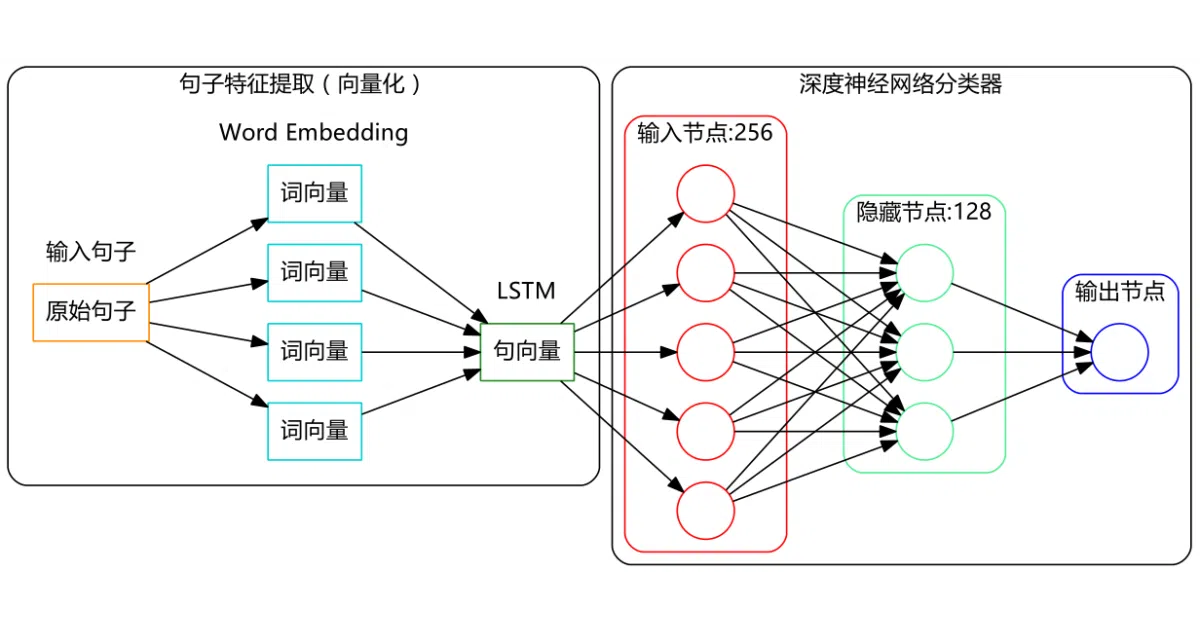
This is a Keras/LSTM notebook for Chinese text sentiment classification into positive, neutral, and negative. The author trains Word2Vec embeddings with jieba segmentation, feeds them through a single LSTM layer, and outputs softmax probabilities across three classes instead of the usual two.
The interesting bit
The neutral class isn’t hand-labeled by sentiment lexicons. The author extracts sentences containing pivot words like “然而” (however) and “但” (but), reasoning that semantic reversal creates a distinct emotional zone between pure praise and criticism. It’s a pragmatic heuristic—cheap to implement, and the README shows it actually catches phrases like “不是太好” (not too good) that binary classifiers mishandle.
Key highlights
- Three-class output using
softmax+categorical_crossentropy; labels are one-hot encoded withkeras.utils.to_categorical - Word2Vec embeddings trained via Gensim on custom corpus, with jieba for Chinese segmentation
- Neutral class bootstrapped from sentences containing adversative conjunctions
- Single LSTM (50 units, tanh) with 0.5 dropout; model serialized to YAML + HDF5 weights
- Author explicitly frames this as a baseline, not a production system
Caveats
- Neutral predictions are sparse because the neutral dataset is “less than half” the size of the others and quality is uneven
- Code shown uses Python 2 print syntax (
print '...'), suggesting stale dependencies - No quantitative metrics, training curves, or reproducible dataset links provided
Verdict
Worth a skim if you’re building Chinese NLP baselines and need a concrete example of three-class LSTM setup in Keras. Skip if you want modern transformers, multilingual coverage, or battle-tested code; this is educational glue code from 2016-era deep learning, honestly labeled as such.
Frequently asked
- What is Edward1Chou/SentimentAnalysis?
- A Chinese-language notebook that tackles the classic sentiment-analysis trap—sarcasm and negation—by adding a third "neutral" class built from sentences with semantic pivots like "however" and "but."
- Is SentimentAnalysis open source?
- Yes — Edward1Chou/SentimentAnalysis is an open-source project tracked on heatdrop.
- What language is SentimentAnalysis written in?
- Edward1Chou/SentimentAnalysis is primarily written in Jupyter Notebook.
- How popular is SentimentAnalysis?
- Edward1Chou/SentimentAnalysis has 876 stars on GitHub.
- Where can I find SentimentAnalysis?
- Edward1Chou/SentimentAnalysis is on GitHub at https://github.com/Edward1Chou/SentimentAnalysis.