Dong90/oh-my-taiyiforge
A State Machine for When AI Won't Read the Spec
TaiyiForge corrals Claude, Codex, Cursor, and OpenCode through a nine-stage engineering pipeline with mandatory human gates, because unsupervised agents skip design and ship untested code.
Not currently ranked — collecting fresh signals.
star history
What it does
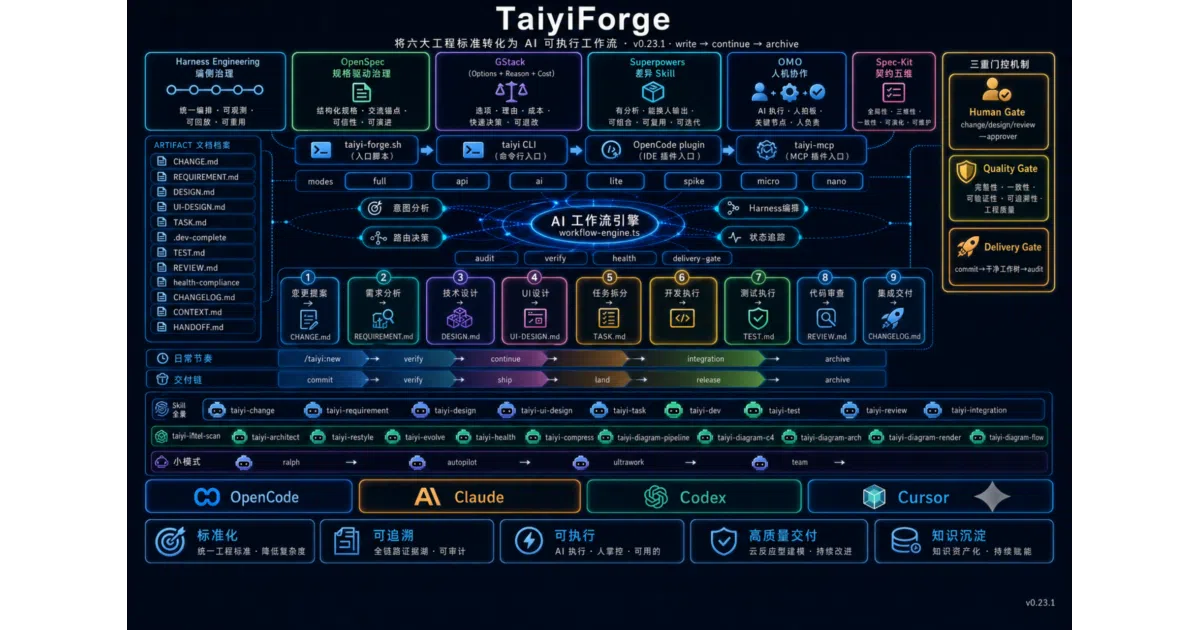
TaiyiForge is a plugin system that installs into four AI coding terminals and imposes a rigid nine-stage workflow on every change. The engine moves each feature through change, requirement, design, task, dev, test, review, and integration stages, stopping at key milestones until a human explicitly approves. It treats AI agents like junior developers who can write code but cannot greenlight their own designs or skip verification.
The interesting bit
The project enforces a canonical vocabulary of 28 slash commands and six umbrella concepts that behave identically across all four terminals, so switching tools does not mean relearning rituals. It also auto-generates compressed context files to survive long sessions and maintains a ChangeGraph knowledge map to track how edits ripple across the codebase.
Key highlights
- Nine-stage state machine with hard human gates at the change, design, and review phases
- Cross-terminal parity: the same commands and behavior in Claude, Codex, Cursor, and OpenCode
- Mandatory evidence gates: every acceptance criterion must include an executable verification command that exits cleanly
- Automatic token compression via
CONTEXT-COMPACT.mdand a ChangeGraph dependency tracker for long-running sessions - Three workflow profiles—
full,lite, andnano—scaled to the size of the task
Caveats
- Production-grade SLAs and full internationalization are explicitly listed as not yet ready
- The README is upfront that this is essentially an orchestration layer atop existing standards like Harness, OpenSpec, and GStack rather than a net-new protocol
Verdict
Teams already using Claude, Cursor, or Codex for real features but tired of context loss and skipped design phases should try this. If you prefer ad-hoc prompting and freestyle AI coding, the process constraints will feel like overhead.
Frequently asked
- What is Dong90/oh-my-taiyiforge?
- TaiyiForge corrals Claude, Codex, Cursor, and OpenCode through a nine-stage engineering pipeline with mandatory human gates, because unsupervised agents skip design and ship untested code.
- Is oh-my-taiyiforge open source?
- Yes — Dong90/oh-my-taiyiforge is open source, released under the MIT license.
- What language is oh-my-taiyiforge written in?
- Dong90/oh-my-taiyiforge is primarily written in TypeScript.
- How popular is oh-my-taiyiforge?
- Dong90/oh-my-taiyiforge has 886 stars on GitHub.
- Where can I find oh-my-taiyiforge?
- Dong90/oh-my-taiyiforge is on GitHub at https://github.com/Dong90/oh-my-taiyiforge.