Deci-AI/super-gradients
YOLO-NAS and 33 friends in a PyTorch training zoo
SuperGradients bundles 34 pre-trained vision models and opinionated training recipes so you can skip the PyTorch boilerplate and ship to TensorRT or OpenVINO faster.
Not currently ranked — collecting fresh signals.
star history
What it does SuperGradients is a PyTorch training library that collects 34 pre-trained vision models spanning classification, segmentation, object detection, and pose estimation. It wraps architectures, validated hyperparameters, and dataset recipes into one package, letting you fine-tune or train from scratch without hand-rolling the usual scaffolding. The library also bakes in an ONNX export path and explicitly targets TensorRT and OpenVINO deployment.
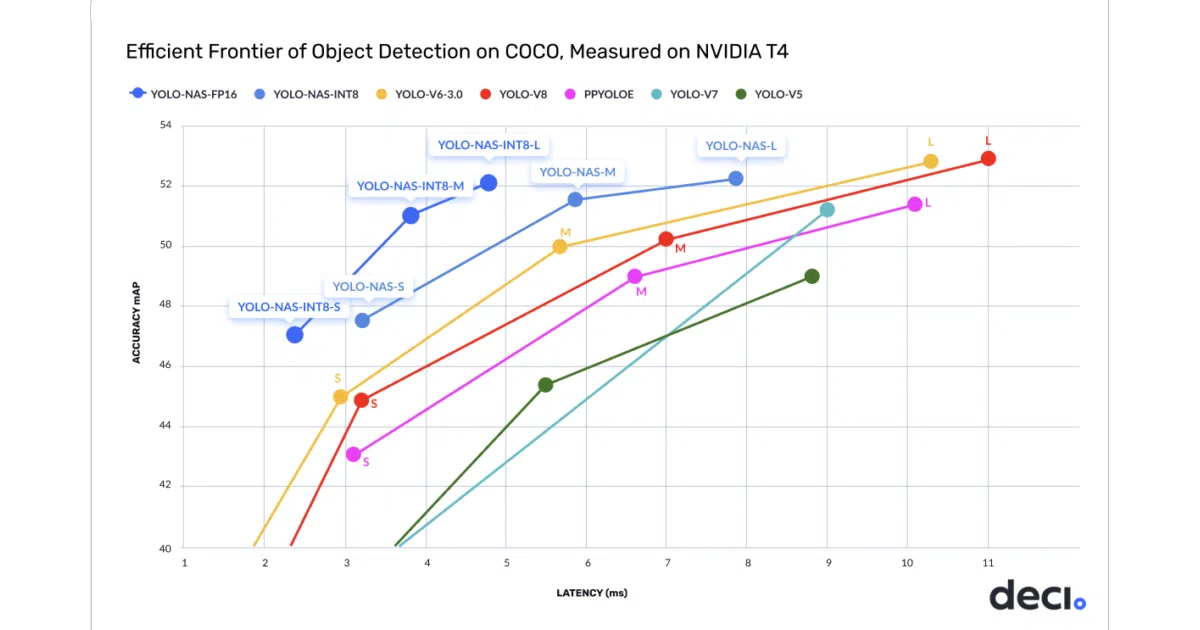
The interesting bit The repo is the home of YOLO-NAS and YOLO-NAS-POSE, Deci’s own architecture family that the README claims outperforms YOLOv5 through YOLOv8 on speed-accuracy tradeoffs. Rather than a simple model zoo, it acts as an opinionated training framework where recipes are first-class citizens and the unglamorous bits—quantization-aware training, transfer learning—are handled through bundled notebooks.
Key highlights
- 34 pre-trained checkpoints in the model zoo, loadable by architecture name.
- Four supported CV tasks: image classification, semantic segmentation, object detection, and pose estimation.
- Recipe-driven training via YAML configs, reducing the need for custom training loops.
- Built-in ONNX export with
prep_model_for_conversionfor downstream runtime deployment. - Quantization-aware training (QAT) and post-training quantization (PTQ) support included.
Verdict Grab it if you want a batteries-included PyTorch environment for standard CV workloads and prefer convention over configuration. Pass if you need a minimal-dependency research toolkit or dislike framework abstraction layers.
Frequently asked
- What is Deci-AI/super-gradients?
- SuperGradients bundles 34 pre-trained vision models and opinionated training recipes so you can skip the PyTorch boilerplate and ship to TensorRT or OpenVINO faster.
- Is super-gradients open source?
- Yes — Deci-AI/super-gradients is open source, released under the Apache-2.0 license.
- What language is super-gradients written in?
- Deci-AI/super-gradients is primarily written in Jupyter Notebook.
- How popular is super-gradients?
- Deci-AI/super-gradients has 5k stars on GitHub.
- Where can I find super-gradients?
- Deci-AI/super-gradients is on GitHub at https://github.com/Deci-AI/super-gradients.