DayBreak-u/chineseocr_lite
Full Chinese OCR in 4.7 MB, no GPU needed
It squeezes Chinese text recognition—including vertical layouts—into under 5 MB so it can run on CPUs and edge devices.
Not currently ranked — collecting fresh signals.
star history
What it does
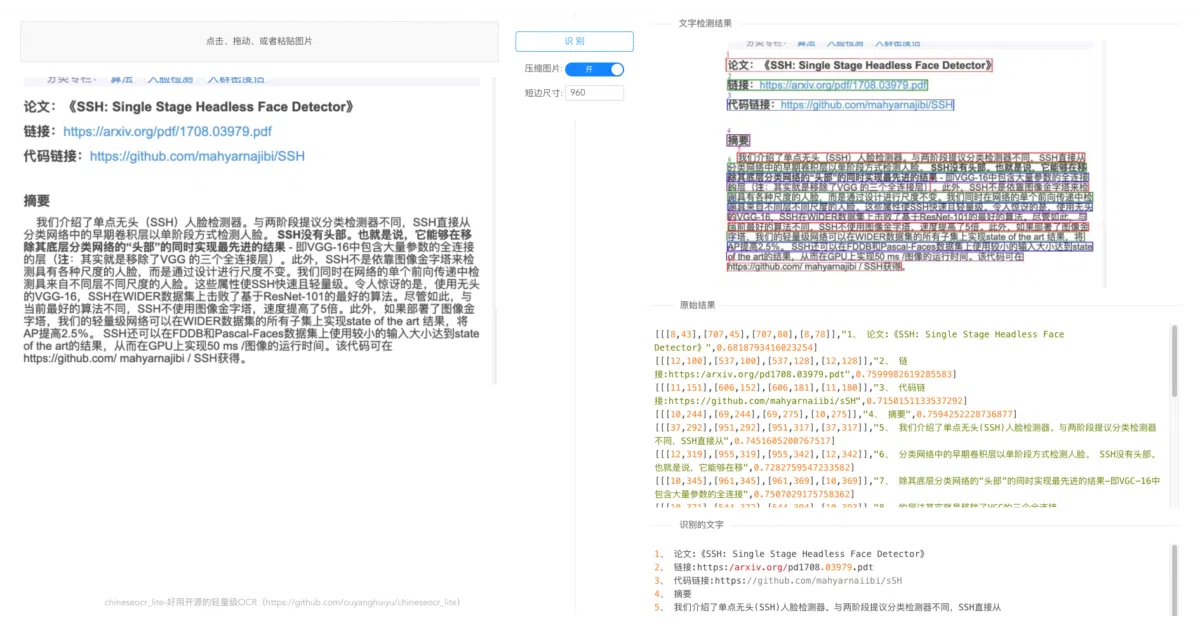
chineseocr_lite detects and reads Chinese text from images using a three-piece model stack—DBNet for detection, CRNN for recognition, and a tiny angle classifier—totaling roughly 4.7 MB. It handles vertical layouts, runs entirely on CPU via ONNX Runtime, and ships with both a Tornado web UI and a Python CLI that emits structured JSON. The models are bundled with the package, so it works offline out of the box.
The interesting bit
The repository treats the Python implementation as the reference text and then rewrites it for C++, JVM, Android, and .NET through independent demos using NCNN, MNN, and ONNX Runtime. Rather than a unified SDK, it reads like a phrasebook for embedding the same 4.7 MB brain into runtimes as different as Vulkan Android and VB.NET.
Key highlights
- The combined model weight is about 4.7 MB (DBNet ~1.8 MB, CRNN ~2.5 MB, angle net ~378 KB), which is small enough for edge and embedded use.
- No GPU is required for the main ONNX Runtime branch; it runs on Windows, Linux, and macOS using only the CPU.
- CLI output includes full text, per-block confidence scores, bounding boxes, and elapsed time in a stable JSON schema suited for agents and scripts.
- Supports vertical text recognition, a format many compact OCR pipelines ignore.
- Reference demos cover C++, JVM, Android, and .NET, with some NCNN builds offering optional Vulkan GPU acceleration.
Caveats
- The multi-platform demos are explicitly described as independent reference translations of the Python code, not a maintained cross-platform framework, so integration work is left to the user.
- The README still recommends Python 3.6, which reached end-of-life years ago; compatibility with modern Python is unclear from the sources.
- Pre-integrated Android source projects are only available through a QQ group, not directly in the repository.
Verdict
Reach for this if you need an offline, low-footprint Chinese OCR that avoids GPU dependencies. Look elsewhere if you want a turnkey, actively harmonized multi-platform SDK.
Frequently asked
- What is DayBreak-u/chineseocr_lite?
- It squeezes Chinese text recognition—including vertical layouts—into under 5 MB so it can run on CPUs and edge devices.
- Is chineseocr_lite open source?
- Yes — DayBreak-u/chineseocr_lite is open source, released under the GPL-2.0 license.
- What language is chineseocr_lite written in?
- DayBreak-u/chineseocr_lite is primarily written in C++.
- How popular is chineseocr_lite?
- DayBreak-u/chineseocr_lite has 12.3k stars on GitHub.
- Where can I find chineseocr_lite?
- DayBreak-u/chineseocr_lite is on GitHub at https://github.com/DayBreak-u/chineseocr_lite.